Reviewed · HALF-DAY
Split and Trogir Half Day Tour from Split (with port pickup)
Split and Trogir in one shot is a time-saver. This half-day tour strings together UNESCO Trogir and Split’s Roman roots with a comfortable ride and a real guide, not just a driver and a map.
I like that it’s easy logistics for cruise days, with central port pickup and the tour ending in the city center. I also like how the pacing gives you guided context at key monuments, then leaves you some breathing space in Trogir. One thing to plan for: it’s still a lot of walking in a short window, and most entry costs are not included.
In This Review
- Key highlights at a glance
- Why Split and Trogir in Four Hours Works
- Getting Picked Up at the Cruise Port Without Stress
- Diocletian’s Palace: The Half-Old-Town Moment in Split
- Trogir UNESCO Stroll, Plus What to Do With Your Free Time
- Cathedral of Saint Domnius: A Church Complex With Roman DNA
- Kula Karmelengo and Prokurative: Fortifications and Venetian Echoes
- Saint Lawrence’s Cathedral: Why Last Stops Still Matter
- Ending in Split City Center and Getting Back to Your Ship
- Air-Conditioned Coach, Live Commentary, and a Small Group Feel
- Price and Value: Is $78.61 Worth It?
- Who This Tour Suits Best (And Who Might Want Something Else)
- What to Bring for a Smooth Half-Day
- Should You Book This Split and Trogir Half-Day Tour?
- FAQ
- How long is the Split and Trogir half-day tour?
- What is the price per person?
- Is port pickup included?
- Where does the tour start and end?
- Is the tour in English?
- Does the tour include an air-conditioned vehicle?
- Are entry fees included?
- Is food or drinks included?
- How much walking should I expect?
- Is there a limit on group size?
Key highlights at a glance
- Port pickup that’s built for cruise schedules, with a clear meeting plan and guidance on where to stand
- Air-conditioned coach to keep you comfortable during the ride
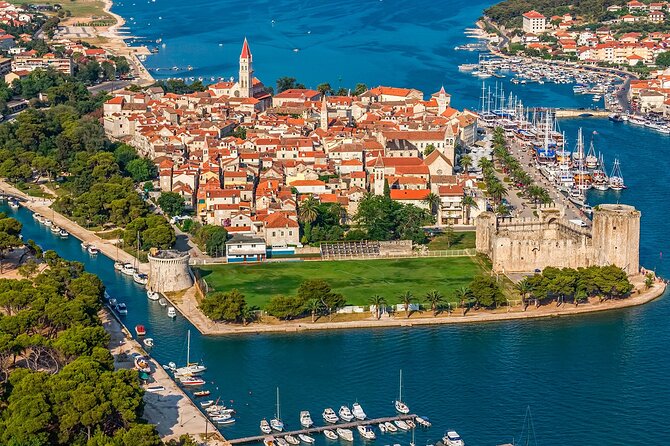
- UNESCO World Heritage Trogir plus standout Romanesque, Renaissance, and Venetian-period details
- Split’s Diocletian-era setting, including the palace that shaped half the old town
- Smart photo stops like the St. Domnius complex and Kula Karmelengo
- A small-group feel with a stated maximum of 50 travelers
Why Split and Trogir in Four Hours Works
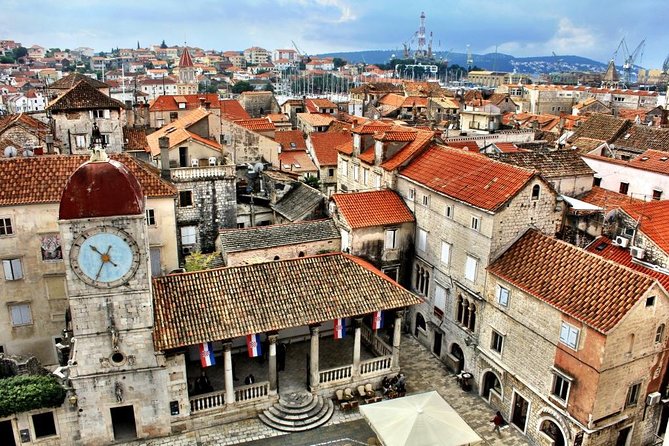
This is a short tour with a clear job: give you the big story of Roman and Venetian influence in two compact places. Split anchors the “Roman engine” side with Diocletian’s Palace area, while Trogir shows how that legacy grew and blended through later centuries.
The main value is focus. Instead of trying to see everything, the guide routes you to the monuments that explain the place quickly, then you get time to wander and absorb the vibe.
Getting Picked Up at the Cruise Port Without Stress
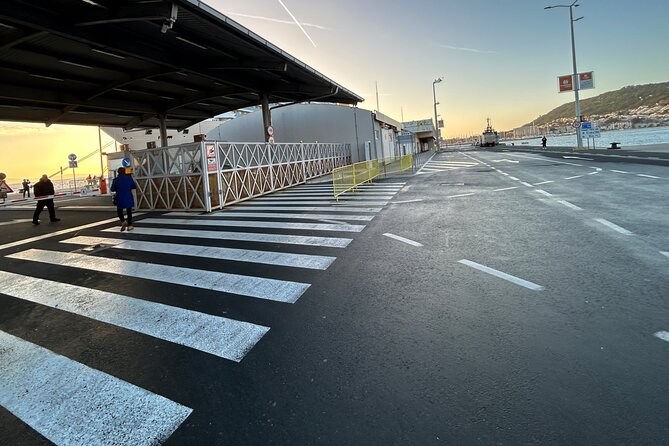
If you’re on a cruise, the meeting point matters as much as the sights. You meet at the New Split Berth for cruise ships at Obala kneza Domagoja 16, and the guide holds a sign for Croatian Trails by the entrance to the ship’s terminal, near the hop-on hop-off red buses, past the fence area.
Timing is cruise-realistic. The schedule notes a 9:00 AM pickup for early arrivals (around 7:00 to 8:30 AM) and then the exact details get sent to you ahead of time. One big practical point: if you miss the tour because your ship is late or you don’t make the meeting time, the tour can’t be waited on.
For non-cruise passengers, pickup details are sent one week prior via Viator messaging, so check your message inbox before you travel.
Still riding at anchor off Split
- Split: Krka Waterfalls Trip with Boat Cruise and Swimming★ 4.8 · 10,519 reviews
- From Split: Krka Waterfalls, Food & Wine Tasting Tour★ 5.0 · 9,326 reviews
- Blue cave, Mamma Mia and Hvar, 5 islands speedboat tour★ 5.0 · 7,150 reviews
Diocletian’s Palace: The Half-Old-Town Moment in Split
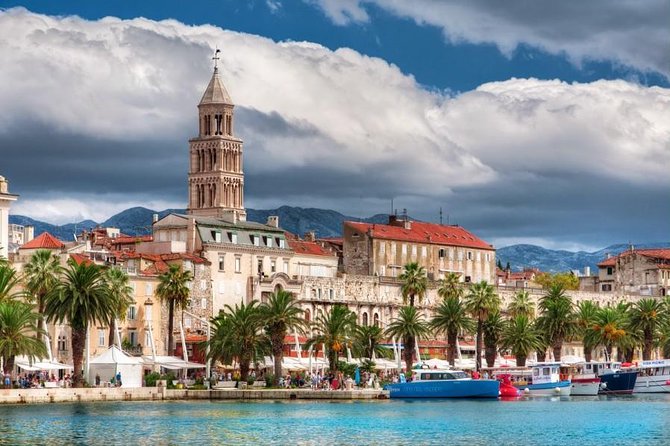
Your first stop is the Palazzo di Diocleziano, the Roman emperor Diocletian’s palace built around the turn of the 4th century AD. Today, it’s not a single museum site you walk through and leave. It forms about half of Split’s old town and city center, so you see how power and architecture became a street-level reality.
You’ll have around 20 minutes here, and admission is not included. That means you’re likely doing the “see the scale and understand the context” version, not a long indoor deep tour. If you want maximum impact, arrive mentally ready for quick framing: the guide will explain why these walls and streets shaped what you see later.
A small caution: 20 minutes disappears fast in old-city areas. Bring water, and wear shoes with grip. Split’s stone can be slippery if the weather turns.
Trogir UNESCO Stroll, Plus What to Do With Your Free Time
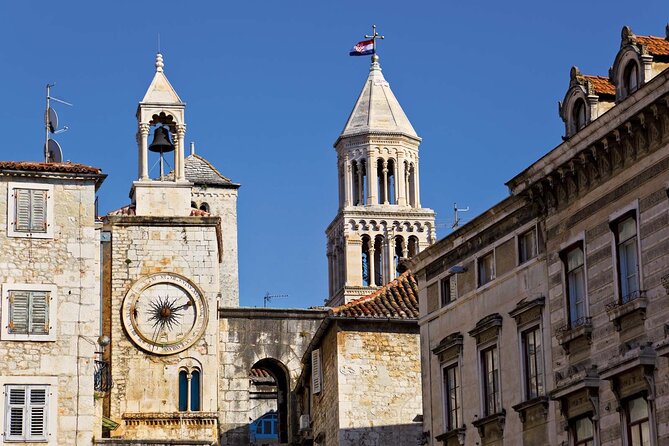
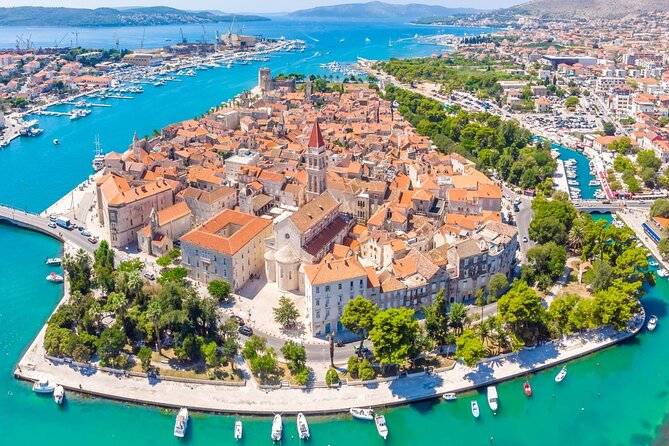
Then you ride along the coast to Trogir, a UNESCO World Heritage Site with a 2,300-year tradition of continuous urban life. The city traces back to Greek colonists in the 3rd century BC, and the built environment shows how periods layered on top of each other.
You get about one hour for Trogir, and admission is noted as free for this portion. That hour is where you can switch modes from guided narration to independent wandering. I’d spend at least part of that hour simply looking up at façades and church details, because the Romanesque churches and the later Venetian-era Renaissance and Baroque buildings are meant to be read like a timeline.
You’ll also be visiting multiple church and landmark stops afterward, so use your one hour wisely. I like the strategy of doing a quick loop first, then returning to whatever grabbed you most.
One tip from guide-style feedback: many guides share practical pointers for quick bites, and at least one guide recommendation included a gelato stop in Trogir. If your guide mentions an easy treat spot during your free time, it’s often a time-efficient way to keep energy up without breaking the schedule.
Cathedral of Saint Domnius: A Church Complex With Roman DNA

Next up is the Cathedral of Saint Domnius complex, where the story is unusually specific. The complex includes a church formed from an Imperial Roman mausoleum, plus a bell tower. Even the dedication is split: the church is dedicated to the Virgin Mary, and the bell tower to Saint Domnius.
You’ll spend about 20 minutes here, with admission not included for the stop. This is one of those places where even when you can’t go inside, the shapes and layout still teach you what the Romans started and what later generations changed.
If you like details, ask your guide one pointed question early, like: how much is Roman structure versus later additions? That helps your brain “lock on” to what you’re seeing instead of just moving from point to point.
Two moorings down in Split:
- From Split: Krka Waterfalls, Food & Wine Tasting Tour
★ 4.9 · 6,598 reviews - Split/Trogir: Blue Cave, Mamma Mia, Hvar and 5 Island Tour
★ 4.6 · 6,320 reviews - Blue Lagoon & 3 Islands Cruise with Lunch from Split
★ 4.5 · 5,756 reviews - Blue Cave and Hvar Tour – 5 Islands Tour from Split and Trogir
★ 5.0 · 4,815 reviews
Kula Karmelengo and Prokurative: Fortifications and Venetian Echoes
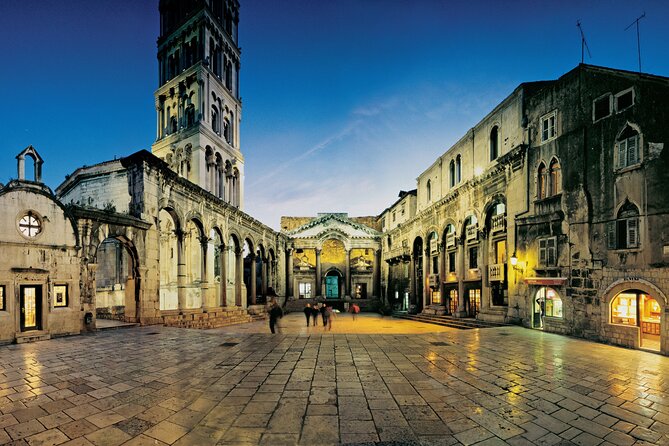
Kula Karmelengo is a castle-like structure built in the mid-15th century by Marin Radoj as part of an expansion of the Veriga Tower (which was built on that site in the late 14th century). It’s also used as a summer performances location, so if you’re there during warm months, you might see it used as a stage rather than just a view.
You’ll have about 20 minutes at this stop, and admission is not included.
Then you’ll move to Prokurative, a 19th-century complex supervised by General Marmont and initiated by Split’s mayor Antonio Bajamonti. Here’s the interesting visual link: it’s inspired by Italian architecture at the time and closely resembles St. Mark’s Square in Venice. Even the architect was from Venice and aimed to build something that felt like home.
This stop is short, about 15 minutes, and admission is free for the portion listed. It’s still worth paying attention, because Prokurative helps you see the Venetian influence that runs through much of Dalmatia. You might think of Venice as a far-away place, but in Split it shows up in building design you can stand right next to.
Saint Lawrence’s Cathedral: Why Last Stops Still Matter
The final featured monument is Saint Lawrence’s Cathedral, described as a Roman Catholic triple-naved basilica built in Romanesque-Gothic style in Trogir. Construction took several centuries, so the building reflects styles that followed one another across Dalmatia.
You get around 15 minutes, and admission is listed as free here. Even with limited time, this stop can work well as a “wrap your head around it” moment. Earlier stops give you the big Romanesque and Venetian-period story. This one can show the middle ground where styles evolved instead of staying fixed.
If your feet are tired by now, focus on a few things, not everything. Look at the structure rhythm across the façade and how the church reads as a long, layered project rather than a single-era snapshot.
Ending in Split City Center and Getting Back to Your Ship
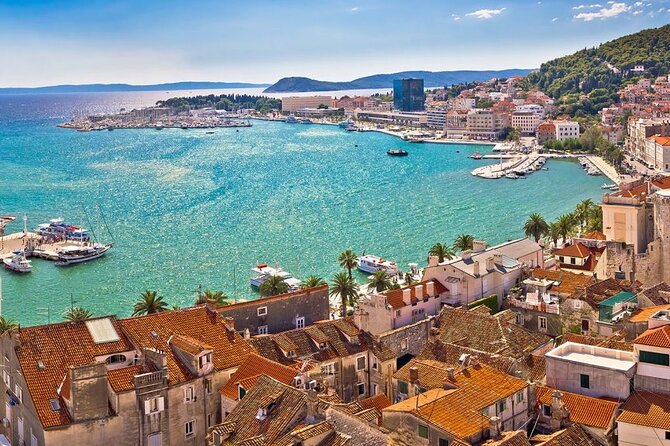
The tour ends in Split Riva in the city center. For cruise passengers, there’s no direct drop-off, and the walk back to the ship’s terminal is noted as about 20 minutes.
This is manageable for many people, but don’t assume it’s effortless. Old-town paths, crowds, and turning off a main street can slow you down. If you want a low-stress return, stay with the group a few minutes after the last stop, then head straight toward your ship route without stopping for long photo breaks.
The good news is that the guide can help you get a taxi if needed. On a cruise day, I think that’s an underrated safety net, especially if the heat hits late afternoon or your ship’s departure time is tight.
Air-Conditioned Coach, Live Commentary, and a Small Group Feel
The coach part matters more than it sounds. You’re traveling between Split and Trogir, and local roads and timing can shift with traffic. The tour is built around air-conditioned transport, plus live commentary on board, so you get context during the ride instead of only at stops.
Also, the group size limit is stated as maximum 50 travelers. That tends to keep things organized and makes it more likely you can hear the guide during key moments. It’s not a private tour, so you should still expect to move as a group.
One practical note: the tour operates in all weather conditions and advises you to dress appropriately. If there’s rain, you’ll want a light rain layer and shoes that can handle wet stone.
Price and Value: Is $78.61 Worth It?
At $78.61 per person for about 4 hours, this isn’t a bargain bus tour, and it’s not trying to be. You’re paying for the mix of port pickup, guided stops, and air-conditioned transportation, all with an English-speaking guide.
The “value” part comes down to how entry fees work. The tour notes that entry fees are not included, but several portions are listed as free: Trogir sightseeing time, Prokurative, and Saint Lawrence’s Cathedral are free according to the stop notes. Other stops like Diocletian’s Palace and the Cathedral of Saint Domnius are marked as not included for admission.
So you’re not paying for full museum-style access everywhere. Instead, you’re buying guided orientation and time at the monuments that give you the structure of both cities. For a first visit, that approach can be exactly right.
I’d say it’s best value if you want a guided overview and you’re okay with short stops. If you’re the type who wants 60 to 90 minutes inside each major site, you might find the timing tight.
Who This Tour Suits Best (And Who Might Want Something Else)
This fits you if:
- You’re on a cruise day and need a timed plan with pickup
- You want a guided overview of Split and Trogir without building your own route
- You like church architecture and town squares where history shows up in streets
- You’re comfortable with walking at a moderate pace for a half-day
It may be less ideal if you:
- Struggle with sustained walking and uneven old-city surfaces
- Want long indoor time at major monuments instead of quick guided stops
- Are hoping for a relaxing sit-down sightseeing day with minimal movement
The tour guidance notes a moderate physical fitness level, and that lines up with the “short stops, lots of shifting” reality of old towns.
What to Bring for a Smooth Half-Day
Keep it simple, but don’t forget the practical stuff:
- Comfortable walking shoes for stone streets
- A light rain layer, since the tour runs in all weather
- Water, especially in hot months
- Your mobile ticket, since this tour uses a mobile ticket format
- If you’re on a cruise, double-check your ship details provided at booking, like docking and re-boarding times
Also, keep your phone charged. You may need it for navigation when the tour ends at Split Riva and you walk back.
Should You Book This Split and Trogir Half-Day Tour?
Yes, if you want the fastest way to understand why Split and Trogir feel so tightly linked to Roman and Venetian eras. The combination of port pickup, air-conditioned coaching, and guided stops makes it a smart use of limited time, especially on a cruise.
Book it with a realistic mindset. You’ll see major sights, but you’re not settling into slow museum time. Wear your walking shoes, accept that the schedule is busy, and you’ll get a day that feels like a guided shortcut through two of the Adriatic’s most meaningful historic towns.
If you tell me your travel dates and whether you’re on a cruise ship, I can help you judge whether this timing is likely to feel rushed or just right.
FAQ
How long is the Split and Trogir half-day tour?
It runs for about 4 hours (approx.).
What is the price per person?
The price listed is $78.61 per person.
Is port pickup included?
Yes. Port pickup is included for cruise ship passengers.
Where does the tour start and end?
It starts at the New Split Berth for cruise ships at Obala kneza Domagoja 16 and ends at Split Riva in the city center. Drop-off is not included.
Is the tour in English?
Yes, it is offered in English.
Does the tour include an air-conditioned vehicle?
Yes. Transportation is via an air-conditioned vehicle.
Are entry fees included?
No. Entry fees are not included, and some stops are marked as not included for admission.
Is food or drinks included?
No. Food and drinks are not included.
How much walking should I expect?
The tour is marked as requiring moderate physical fitness, and it includes multiple short walking stops. The end-to-ship walk is noted as about 20 minutes for cruise passengers.
Is there a limit on group size?
Yes. The tour has a maximum of 50 travelers.
Latest arrivals logged at Split




Half-Day, compared.
Zrmanja River: Half-Day Guided Kayaking Tour Near Zadar
Read our review →

Half-Day Rafting Experience on Cetina River with Cliff Jumping and more
Read our review →
Half-Day Blue Lagoon, Čiovo and Trogir Boat Tour
Read our review →Half-Day Blue Lagoon, Čiovo and Trogir Boat Tour
Read our review →
4 Jewels of Zadar, Dugi otok, sunken ship, tunnel – Half day
Read our review →