
Reviewed · WALKING TOURS
Trogir walking tour with a local guide
Trogir hits hard in just 90 minutes. This local-guided walking tour is a tight circuit through the Old Town, where Romanesque and Gothic details sit side by side with Venetian-style stonework, and the sea air shows up right at the end. I love how the guide turns each stop into a story you can picture, and I love the way the route connects monuments with everyday town life, from plaza hangouts to the Riva promenade.
One thing to keep in mind: the advertised time is about 1 hour 30 minutes, but timing can run a bit shorter depending on pace and how quickly the group moves through each highlight. Also, it does require good weather, so have a Plan B if skies look sketchy.
In This Review
- Key Highlights You Get in This Trogir Walk
- Why This 90-Minute Trogir Walk Works
- Getting Oriented at the Meeting Point and North Gate
- St. Lawrence Cathedral and Radovan’s Portal: Medieval Art With a Big View
- John Paul II Square and Town Hall: Venice’s Influence, Right in Trogir
- St. Sebastian Church and Clock Tower: Plague Thanks Turned Into Stone
- Town Loggia: Where Decisions Happened in the Shade
- Palace Cipiko and the Garagnin-Fonfogna Palaces: Venetian Renaissance Meets Local Details
- Our Lady of Mount Carmel and the Fishermen, Craftsmen, and Workers
- The Kairos Bas-Relief: A Sculpture That Feels Like Advice
- Riva Waterfront Promenade: Where the Town Breathes
- Kamerlengo Castle: The End Point With Sea Views and Local Noise
- Local Guides Make the Difference: What You’ll Notice Once You’re Walking
- Value Check: $18.14 for a Highlights Loop That Actually Makes Sense
- Timing, Pace, and How to Prepare Like a Pro
- Who Should Book This Tour
- Should You Book This Trogir Walking Tour?
Key Highlights You Get in This Trogir Walk
- St. Lawrence Cathedral views: Bell tower panoramas over Trogir, Čiovo, and the Adriatic
- Radovan’s Portal: A 13th-century sculptural entrance that feels surprisingly modern
- Plaza time at John Paul II Square: A historic “open-air lounge” moment with real local cafe life
- Venetian stonework made human: Town Hall staircase, Town Loggia covered space, Cipiko Palace details
- Kairos bas-relief: A striking sculpture with a very practical message about timing
- Sea breeze finish at Kamerlengo: Views, local atmosphere, and a fortress end point
Why This 90-Minute Trogir Walk Works
Trogir is small, but it’s not simple. The Old Town is a stone maze with levels of history stacked on top of each other, so it’s easy to wander and miss what matters most. This tour solves that problem with a smart loop: you start with the cathedral story, then you move through the civic buildings and churches, and you finish at the water, with the fortress sitting right there like the town’s final punctuation.
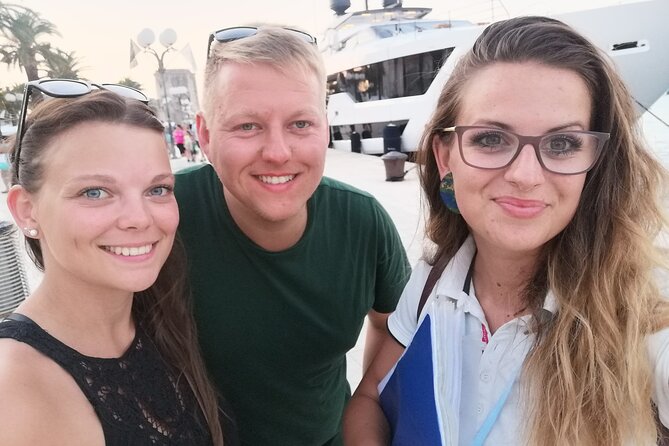
The best part is that it’s not just a “look at this, look at that” checklist. Your guide links design details to the reason they were built, who used them, and how the town’s identity shaped what you see. That’s why people rave about guides like Daniella and Kristina: the narration is calm, easy to follow, and full of local context without making you feel like you need a university degree to enjoy it.
Getting Oriented at the Meeting Point and North Gate
Your walk starts at Ul. Gradska vrata 5, right by the old gate area. The vibe here is simple and practical. You’re not sent into a distant pickup location where you burn time trying to find the group. You meet, you walk, and within minutes the town’s historic core makes sense.
From here, the route naturally feeds you into the walled-town layout. You’ll also pass the North Gate area, which is important because it sets up how the Old Town museum space and nearby palaces fit into the town’s earlier defensive and residential logic. If you’re the type who likes to understand how places were arranged, you’ll appreciate that “orientation” feeling.
More Walking Tours in Trogir
- Trogir: City Highlights Guided Walking Tour★ 4.9 · 199 reviews
- Shipwreck – Blue Lagoon All Inclusive + Trogir Walking Tour★ 4.4 · 110 reviews
- Trogir: Old Town Guided Walking Tour★ 4.6 · 76 reviews
St. Lawrence Cathedral and Radovan’s Portal: Medieval Art With a Big View
The tour’s first heavy hitter is the Cathedral of St. Lawrence, whose construction began in 1213 and took five centuries to complete. That long timeline matters. You can actually feel the blended styles, Romanesque structure paired with Gothic details, in a way that’s more interesting than a single-period building.
Then comes the moment many people remember: the bell tower. From up there, you get panoramic views over Trogir, the island of Čiovo, the mainland, and the Adriatic Sea. Even if you’re not the “climb everything” type, this stop gives you the big-picture perspective that makes the rest of the walk click.
Right at the entrance is Radovan’s Portal, the main carved entrance sculpted by Master Radovan, a craftsman from medieval Trogir. This isn’t just decorative. It’s one of those pieces that makes you slow down because the carving looks like it was built to be read, not just looked at. It’s 13th-century work, and it still communicates power and skill.
Practical tip: if you’re visiting in warmer months, go steady here. The cathedral area has a lot of stone, so it can feel cooler at first and then warmer as the day moves on. Wear shoes that can handle uneven Old Town surfaces.
John Paul II Square and Town Hall: Venice’s Influence, Right in Trogir

After the cathedral, you shift from sacred grandeur into civic life. Next up is John Paul II Square (Trg Ivana Pavla II). This square is one of the prettiest historic piazzas you’ll see in this size of town, and it has a very real, everyday feel. It’s surrounded by important buildings, and the cafes spill into the space. It’s basically an open-air lounge, so even if you only stop briefly, it helps you reset your brain.
Then you reach the Town Hall, built in the 15th century. The stone building has a courtyard with coats of arms, and there’s a distinctive outside staircase that shows Venetian architecture in a clear, eye-catching way. This is a great pause point because you can see how politics and power were staged in public spaces. Not dry, not hidden. On display.
If you’re the type who thinks architecture is just “pretty,” this section gently corrects that. Those coats of arms are identity. That staircase is how you move people in and out with ceremony. And the fact the tour slows down here is a hint: this is where you start understanding Trogir as a living town, not just a museum street.
St. Sebastian Church and Clock Tower: Plague Thanks Turned Into Stone
Next, you visit St. Sebastian’s Church and Clock Tower, built in 1476. The story behind it is straightforward and human: the citizens of Trogir built it in gratitude after being delivered from the plague. So when you stand in front of it, you’re not looking at an abstract monument. You’re looking at community memory made visible.
This church was designed by Niccolò di Giovanni Fiorentino, known in English as Nicolas of Florence. If you like tracing artistic influence, this is one of the places where names and styles connect across regions. The clock tower angle adds another layer, because timekeeping is part of civic identity. People built the structures that organized daily life, even when life itself was fragile.
More marble lanes taken slowly:
- Trogir Highlights Walking Tour with Local Guide
★ 5.0 · 32 reviews - Split Old Town Walking Tour
★ 5.0 · 25 reviews - Private Trogir walking tour with LOCAL guide
★ 4.8 · 23 reviews - Dubrovnik: Old Town Walking Tour
★ 4.8 · 5,174 reviews
Town Loggia: Where Decisions Happened in the Shade

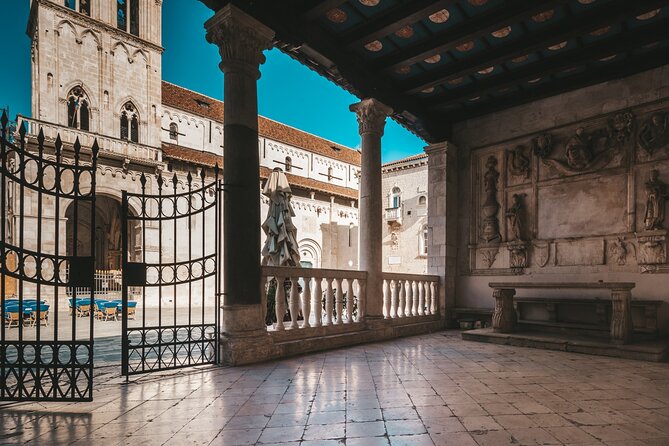
Right after that you get Town Loggia, dating back to the 13th century. This covered space next to the clock tower was where citizens used to congregate to discuss issues of the day. The local court would also meet there on certain days to proclaim laws and handle cases.
Why this stop is worth your attention: loggias are easy to ignore when you rush. But when your guide explains what happened in that space, it becomes real. You start thinking about the town as a place where people gathered, talked, and made decisions, not just a place tourists photograph.
Also, the covered area is handy if you’re dealing with sun or a sudden breeze. It’s a small comfort that can matter on a short tour.
Palace Cipiko and the Garagnin-Fonfogna Palaces: Venetian Renaissance Meets Local Details

The tour then moves to Palace Cipiko, often called the Great Cipiko Palace. It’s a group of Romanesque buildings that later took on a Venetian Renaissance look between the 15th and 17th centuries, after extensive remodeling. So you’re seeing the town’s long-term growth in a single complex.
Niccolò di Giovanni Fiorentino worked on parts of this project too, including carving the south portal of the palace. Even if you only catch it briefly, it’s the kind of detail that rewards slow attention. Portal carving is where wealth, pride, and artistic skill get shown in public.
From here, you also get a sense of the Garagnin-Fonfogna palace complex, housed in palaces associated with the Venetian family. You’ll see the museum area as soon as you step through the Old Town through the North Gate. This matters because it connects the architectural storyline to how the town preserves it today.
Our Lady of Mount Carmel and the Fishermen, Craftsmen, and Workers
Next is the Church of Our Lady of Mount Carmel, founded in the Middle Ages. The tour frames it as historically the church of Trogir’s fishermen, craftsmen, and labourers. That’s a key distinction. Many visitors focus only on cathedral big shots, but this kind of church shows how daily work and community devotion were linked.
If your timing lines up, the tour also points out a special date: on 16th July, you can catch a traditional evening procession with the statue of Our Lady. Even if you’re not there then, it helps you understand what the church represents in local life.
The Kairos Bas-Relief: A Sculpture That Feels Like Advice
One stop brings you face to face with a bas-relief describing a winged figure, likely tied to the Greek idea of Kairos, the right moment. The sculpture shows a young man standing on tiptoe, ready to fly away, arms outstretched, holding scales. His hair tuft is long, and the meaning is clear: seize the moment when it’s available, because when it passes, it’s gone.
This is one of those “how is this in a church or civic building?” moments that makes a walking tour worth it. It turns art into something you can apply to your own travel mindset: don’t postpone the good view until tomorrow. In Trogir, the good view is often around the corner.
Riva Waterfront Promenade: Where the Town Breathes
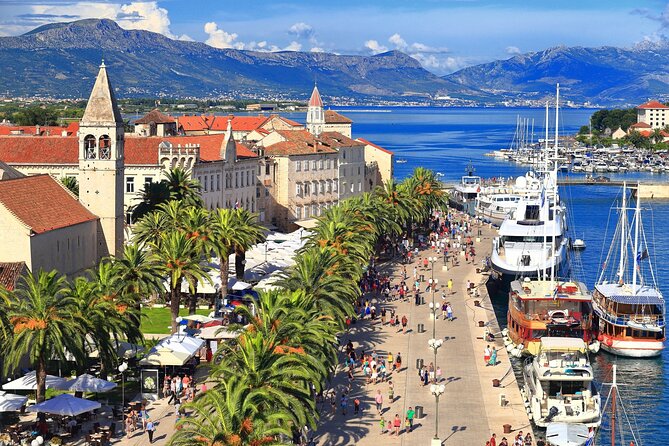
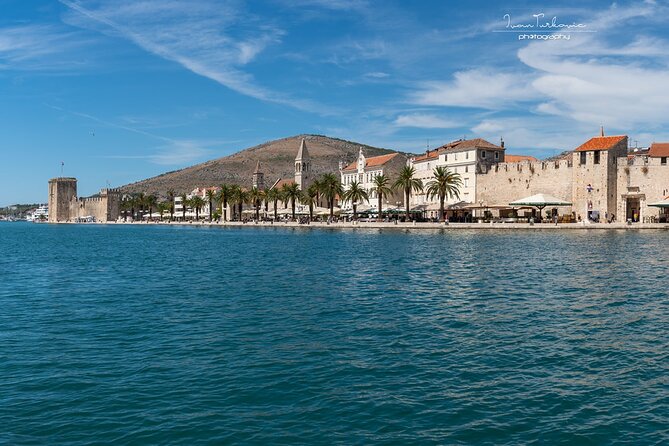
The finish shifts to the waterfront with Riva, what locals call the palm-fringed promenade. It’s wide, flat, and straight, running along the water edge. That makes it a relief after Old Town streets that feel like a puzzle.
Most importantly, you get splendid views across the sea channel to the nearby island of Čiovo. You’re not just looking at boats. You’re watching how the town relates to the water that shaped its economy and daily life.
If your group pace allows it, linger here for a minute longer than you think you need. This is where the walk becomes vacation mode.
Kamerlengo Castle: The End Point With Sea Views and Local Noise
At the far end of the promenade sits Kamerlengo Castle, an early 15th-century fortress at the end of Trogir’s promenade. It stands on the corner of the tiny island where the Old Town is located, so it feels like the town’s edge and identity are both there at once.
Right next to it, you’ll notice the practical local side of life: a small football pitch, a playground, and even stalls associated with local tour operators. That mix is why the ending works. It doesn’t feel like the tour ends in a dead zone. It ends where people actually live and pass their time.
Local Guides Make the Difference: What You’ll Notice Once You’re Walking
The guides are consistently what people talk about. In the names you’ll see attached to different tour runs, you’ll hear patterns: calm delivery, lots of context, and personal stories that make the town feel inhabited.
For example, Daniella and Daniela (you might see either name used) are described as engaging and interactive, and people say they learn so much in such a short time. Kristina and Blanca get mentioned for being enthusiastic locals with intimate knowledge of history and how different time periods connect. Some guides also bring in family-rooted perspectives, including stories about generations living in the area and experiences tied to the Homeland War. That personal layer does not replace the facts. It helps you remember them.
If you want the best experience, do this: ask one simple follow-up question while you’re walking. Something like where locals go first for views, or which buildings you should notice more closely because of a particular detail your guide just mentioned. Your guide is there to connect dots.
Value Check: $18.14 for a Highlights Loop That Actually Makes Sense
At $18.14 per person for about 1 hour 30 minutes, this is good value if you like structure. In a place like Trogir, you pay either money for guidance or time for trial and error. This tour compresses the “what to see” decisions into a single, well-planned route.
You also get more than one type of attraction:
- big monuments like St. Lawrence Cathedral
- civic buildings like Town Hall and Town Loggia
- a religious stop that ties to everyday workers
- a waterfront section with real views
- an ending at Kamerlengo, which feels like the town’s final frame
One more value point: the tour is offered in English, and it’s set up as a small group (up to 15 people). That size keeps the experience moving but not chaotic. You also get a mobile ticket, which is convenient when you’re juggling reservations across Croatia.
Timing, Pace, and How to Prepare Like a Pro
This is a short walk. That means your job is simple: show up with the right basics so you can enjoy the stories without fatigue.
Wear comfortable shoes with grip. Old Town streets can be uneven, and you’ll be moving between corners, squares, and waterfront paths. Bring water, especially in the sun on the Riva section.
Because it requires good weather, check the forecast the day before and be ready to adjust plans. If rain or storms roll in, you might get a different date or a refund option.
Also, if you have strict timing for dinner reservations, I’d keep your expectations flexible. Even though the tour is listed as about 1 hour 30 minutes, some runs can end sooner depending on pace. If you’re the type who likes to schedule to the minute, leave a buffer.
Who Should Book This Tour
This is a strong pick if:
- You want a structured introduction to Trogir without spending hours mapping it out.
- You like architecture with context, not just photo stops.
- You enjoy short, story-driven walking tours with a local voice.
It may be less ideal if you want a long, slow wander with lots of independent free time. This is a highlights loop. You’ll see key sites, but you’ll still have to pick what you want to revisit afterward.
Should You Book This Trogir Walking Tour?
Yes, if you want the fast route to understanding Trogir. For the money and time, you get cathedral scale moments, Venetian-influenced civic architecture, and a waterfront finish that helps everything feel connected. The biggest reason to book is the local-guided storytelling, especially the personal family perspective that makes the stones feel like they belong to an actual place.
If you’re visiting for just a day or you’re arriving with Trogir already on your must-see list, I’d book early in your trip. Use the tour to get your bearings, then come back on your own to linger at the spots that grabbed you most.
Latest arrivals logged at Trogir



Walking Tours, compared.
Walking Tour of Split and Diocletian’s Palace
Read our review →
Krka Waterfalls tour with Trogir Walking tour and Krka panoramic boat cruise
Read our review →
City Walls Early Morning or Sunset Walking Tour
Read our review →Browse the lists this tour appears in