
Reviewed · WALKING TOURS
Daily or night walking tour through Medieval Šibenik
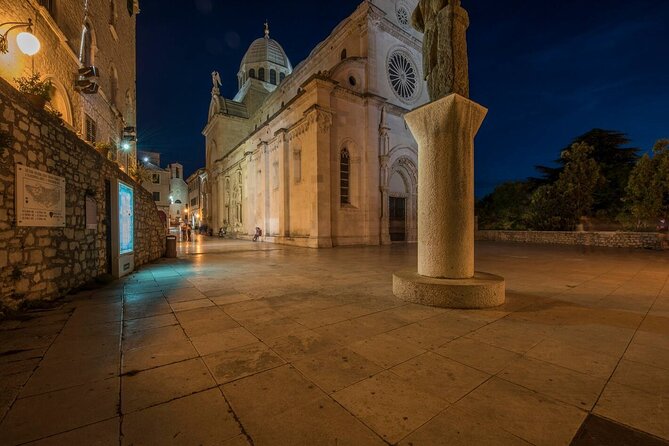
A walk through medieval Šibenik feels like stepping sideways in time. This 1.5-hour guided loop is built around big stone landmarks, plus smaller spots that explain how the city worked, from water storage to church carving. You can choose a day or night version, and you’ll get a Sibeniк city map style approach to help you connect the dots.
What I loved most were two things. First, the way Dario Mikulandra ties details in St. Jacob’s Cathedral to the people who built it, including Juraj Dalmatinac and the cathedral’s many odd features. Second, the value is real: for one set tour price, the stops include major sights and the tour description lists admission ticket free at each main stop.
One heads-up: the tour leans heavily on churches and sacred art. If you only want social or political medieval history, you might feel the religious layer is thicker than you hoped.
In This Review
- Key highlights not to miss
- Medieval Šibenik at night or day: why this tour format works
- Start point and what to expect in the first stretch
- Inside St. Jacob’s Cathedral: stone, theology, and the “why” behind the details
- Church of St. Barbara: Gothic architecture with a physician-focused story
- Trg 4 bunara: the Square of the Four Wells and the underground cistern
- St. Ivan, St. Frane, and the church details that act like time machines
- Crkva Svetog Duha and the medieval fraternities angle
- Medulić Square and the surprise of medieval measurement, plus 1895 electricity
- Price and value: is $29.79 fair for 90 minutes?
- My practical tips to enjoy the walking route
- Should you book this Medieval Šibenik walk?
Key highlights not to miss
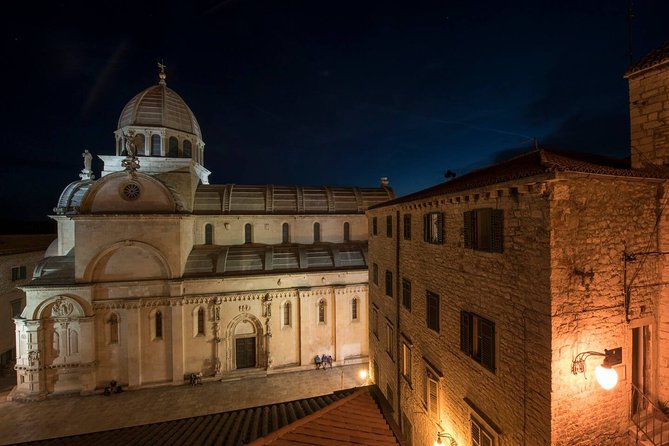
- St. Jacob’s Cathedral on the UNESCO World Heritage list, and why construction took about 105 years
- Church of St. Barbara with a Gothic niche sculpture of St. Nikola by Bonino from Milan
- Square of the 4 Wells and an underground cistern supervised by Juraj Dalmatinac, holding 28,000 barrels of water
- St. Ivan’s church details like the Turkish clock and Renaissance windows decorated with fruits and vegetables
- Franciscan complex at St. Frane, including a library with 151 incunabula and the Šibenik Prayer in Latin
- Medulić Square stories about medieval measuring units, plus a modern electricity link from 1895
Medieval Šibenik at night or day: why this tour format works
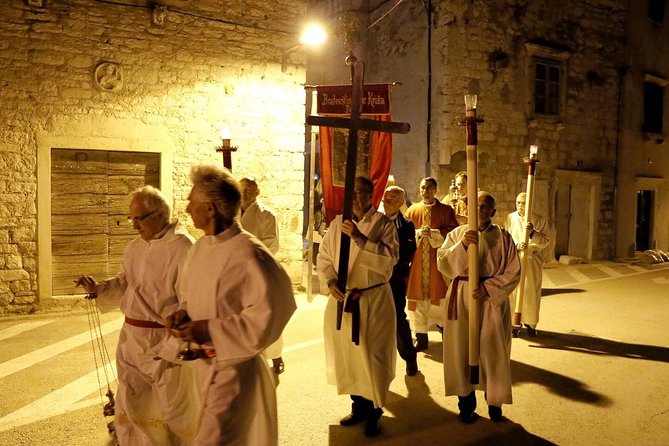
Šibenik’s medieval center is all tight turns, stone steps, and buildings that feel close enough to touch. That makes a guided walk a smart move, because you get the “what am I looking at?” answer as you go, not 30 minutes later while you’re standing in the wrong spot.
Doing it by day or at night changes the mood. Day gives you clearer views of facades, arches, and the shapes of Gothic-Renaissance design. Night can make the tunnels, passages, and the general medieval feel more intense, especially around the cathedral and the underground cistern area. Either way, you’re moving with a map-style flow, so you’re not stuck just following your phone screen.
Best of all, this tour keeps a tight loop. It’s about 1 hour 30 minutes and ends back at the starting point, so you can plug it into your day without losing half a sightseeing day to logistics. With a maximum group size of 10, the guide can actually slow down when questions pop up.
Start point and what to expect in the first stretch
You meet at Ul. Biskupa Fosca 9, Šibenik and the tour finishes back there. It’s offered in English, and confirmation is sent at booking. The walking is described as something most travelers can participate in, and service animals are allowed.
Practical tip: wear shoes you trust on stone steps. One thing Šibenik does well is charm, and one thing it does less politely is throw in stairs. If you have mobility limits, just plan on slower pacing and bring your patience. The tour also includes several short stops, so you’ll get breaks along the way rather than doing one long grind with no stops.
More Walking Tours in Sibenik
- Private Sibenik Walking Historical Morning or Evening Tour★ 5.0 · 93 reviews
- Sibenik: Guided Evening Walking Tour★ 4.9 · 62 reviews
- Šibenik: Medieval Night Walking Tour★ 5.0 · 27 reviews
Inside St. Jacob’s Cathedral: stone, theology, and the “why” behind the details
Most people aim straight for the big cathedral. This tour does that, but it also teaches you how to look at it.
You’ll spend about 30 minutes at St. Jacob’s Cathedral (St. St. Jakov), described as the most important building of Croatian culture from the 15th and 16th centuries, and listed on UNESCO’s World Heritage list. The guide’s focus is construction and meaning: what came before the current building plan, how the cathedral’s design works, and whether the roughly 105 years of construction is a lot. In other words, you’re not just seeing the outside, you’re learning how a major medieval project actually gets built, piece by piece.
Then comes the fun part, the details that make you stop and stare. You’ll learn why there are so many shells inside, what’s up with the presbytery story involving fruit and vegetables, and why there are so many heads carved into the space. You’ll also see the connection to Juraj Dalmatinac, including his signature on the work.
I love this stop because it makes “great cathedral” feel less vague. Instead of thinking, It’s beautiful, you start thinking, Someone planned this, argued about it, carved it, and left clues on purpose. That changes how you walk around it after the tour too.
Church of St. Barbara: Gothic architecture with a physician-focused story

Next you head to Church of St. Barbara, a single-nave Gothic church with construction beginning around 1400. The stop is about 10 minutes, but it’s packed with specific objects to notice.
Over the main entrance, you’ll see a Gothic niche with a sculpture of St. Nikola, made by the Italian master Bonino from Milan. On the north wall, there’s a Gothic window, and in its lower part a sculptural work tied to a vow in 1419 by a Šibenik doctor named Marko.
This is a rare kind of medieval detail. It’s not only about saints and prayers. It’s about civic life and professional identity, in the form of a relief depiction of physicians on the eastern Adriatic coast. If you enjoy medieval art as social record, this is the kind of stop that makes the tour feel worth slowing down for.
Trg 4 bunara: the Square of the Four Wells and the underground cistern
This part is why I think the tour is more than a church tour. Near the cathedral you’ll reach Trg 4 bunara i srednjevjekovna cisterna, the Square of the 4 Wells.
You’ll spend about 15 minutes here, learning why Šibenik built public water storage. The story is practical and defensive at the same time. The cistern was built by local people due to frequent droughts and also frequent military sieges, and the construction contract was agreed in 1446, supervised by Juraj Dalmatinac.
The numbers are huge for a city square: the cistern could hold 28,000 barrels of water. There was also a special tax introduced to fund it. Above ground, the plateau has four wells, and in the underground space there are openings used for taking water.
One neat extra: the complex has been renovated and today includes an underground cafe and wine bar. Even if you skip any drink, you’ll still get oriented to what the cistern looked like, including the water filtration system and the four openings, described as crowns. This is where you start seeing Šibenik as an engineered system, not just a medieval postcard.
More marble lanes taken slowly:
- From Sibenik: Private Walking Sibenik Sightseeing Tour
★ 4.9 · 15 reviews - The Best of Sibenik Private Walking Tour
★ 5.0 · 13 reviews - Sibenik Old Town Private Walking Tour Experience
★ 5.0 · 9 reviews - Sibenik: Guided Walking Tour
★ 5.0 · 8 reviews
St. Ivan, St. Frane, and the church details that act like time machines
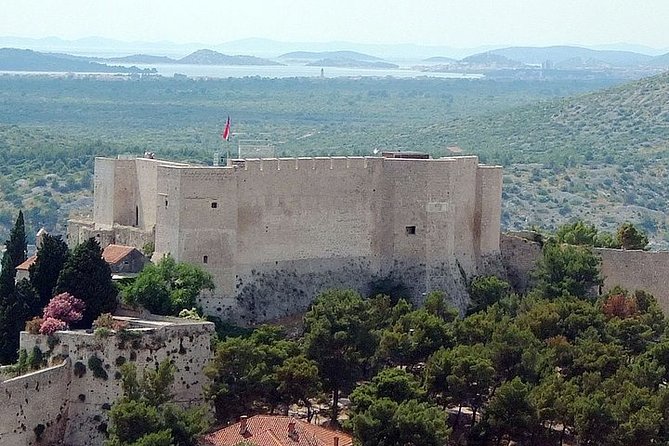
The tour stacks several religious stops close together, and the guide uses them to show different layers of medieval and Renaissance influence.
First, you’ll visit Crkva sv. Ivana Krstitelja (St. Ivan’s Church) for about 10 minutes. It’s described as Gothic-Renaissance, built in the 15th century originally under the name Church of St. Trinity. You’ll spot the staircase along the south side, credited to builder Ivan Pribislavić, decorated with bas-relief. There’s also a Renaissance window by Nicholas of Florence, plus a relief with a lamb and a winged angel.
Then comes the unusual object that makes this stop memorable: the bell tower includes a Turkish clock with one hand, brought from Drniš after the Turks abandoned it in the 18th century. You’ll also see mysterious iron hoops on the north wall and learn their function from the early 17th century. The tour also mentions a Renaissance window on the bell tower window area, decorated with fruits and vegetables, by Nikola Firentinac. This is the kind of craft detail that you’d miss entirely alone.
After St. Ivan, you’ll move into Church of St. Frane in the extreme southeastern part of the historic center, described as a spacious single-nave Gothic building with less ornament than some of the others. The guide points out the main entrance with a Gothic stone frame, and in the chapel of St. Cross there’s an organ described as made in 762 by Petar Nakić.
What I like most here is the monastery context. In the Franciscan complex on the south side, the monastery dates to the 14th century, and the library includes a collection of 151 incunabula and manuscript codices. The guide also shares the story of the Šibenik Prayer, described as one of the oldest Croatian linguistic and literary monuments, written in Latin around 1375. If you care about history beyond architecture, this stop does the job.
The stop also connects to the city’s layout, with remains of the eastern city walls and the Vrančić Palace, where Antun and Faust Vrančić were born. It turns one church complex into a bridge across art, language, and local identity.
Crkva Svetog Duha and the medieval fraternities angle
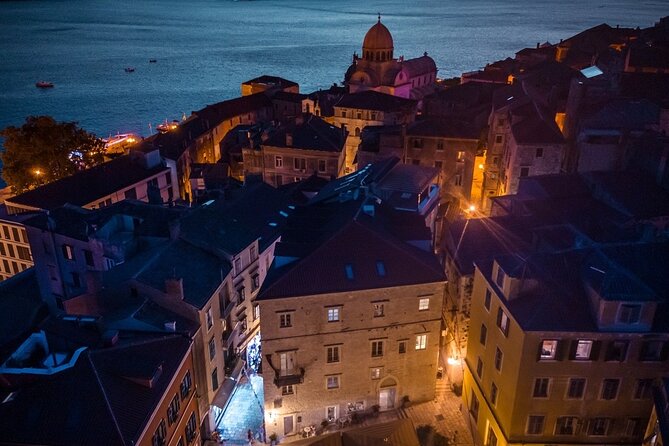
Next is Crkva sv. Duha (Church of the Holy Spirit), placed on Dinko Zavorović Square. You spend about 5 minutes here.
This one is described as a 17th-century church built based on a project by Antun Nogulović. The tour frames it as the third church within about 100 meters, belonging to three key medieval fraternities. You also hear about a medieval custom tied to Christmas season, when on the night of December 17-18, the bells of Šibenik churches ring to announce the arrival of Christmas.
Even though it’s a short stop, it helps balance the longer architecture moments. It reminds you that these buildings were active, not museum pieces.
Medulić Square and the surprise of medieval measurement, plus 1895 electricity
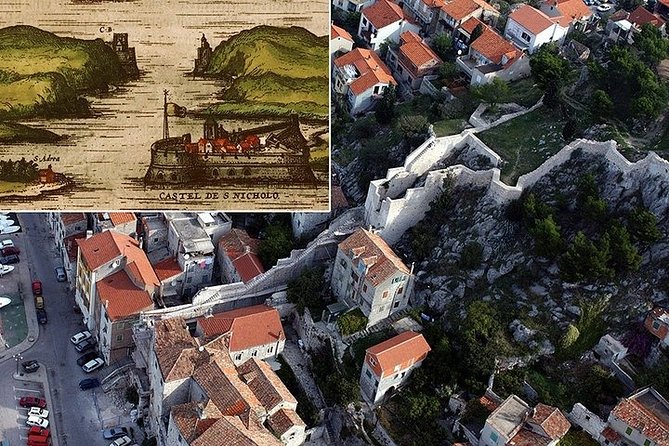
The final stop is one of the more surprising ones: Medulić Palace rooms and apartments at Medulić Square, for about 15 minutes.
Here the tour shifts from churches to civic life. In the Middle Ages, the square is described as the seat of a small trading lodge. The guide explains the problems merchants faced with the simple question of measurement, especially the concept of what a “meter” meant. On the palace wall, you’ll see official measuring units of the Venetian Republic and the city of Šibenik.
Then you get a link to a bigger story. At Divnić Palace in the square of the same name, there’s a copy of a lamp that shone in 1895, when Šibenik was described as the first city in Europe to receive alternating electricity and lighting from the hydroelectric power plant on the river Krka. That’s a neat contrast to the medieval masonry, and it makes the city feel like a living timeline.
Finally, nearby there’s a stone pet bowl, described as AMOR D. CANI. It’s a modern touch, but it works because you’re already in the mindset of how public spaces evolve.
Price and value: is $29.79 fair for 90 minutes?
At $29.79 per person for about 1 hour 30 minutes, this tour feels priced like it’s meant to be accessible rather than exclusive. The value comes from two things.
First, you’re paying for a guide’s ability to explain how details connect. You’re not just collecting photos of stone. You’re learning why Juraj Dalmatinac’s work matters here, why the cistern holds so much water, and why certain reliefs and carvings exist.
Second, the tour lists admission ticket free at key stops, including the cathedral and multiple churches and cistern areas. Even if some sights have different rules on different days, the general structure here is that you’re not stacking extra ticket costs on top of the tour fee.
Also, with a max group size of 10, you’re more likely to get your questions answered instead of being one face in a crowd.
My practical tips to enjoy the walking route
A few small moves will help you get more out of it.
- Bring comfortable shoes. Šibenik’s stone steps are part of the story, not an optional extra.
- If you can, choose day or night based on your energy. Day is easier for seeing carving details. Night can be more atmospheric around the cathedral and underground cistern feeling.
- Keep your questions simple. Ask what a specific feature is supposed to mean, like the cathedral shells or the cistern openings. The guide’s style is built for that.
- Use the city map approach. Even if you end up walking on your own later, it helps you remember where everything sits.
Should you book this Medieval Šibenik walk?
Book it if you want a guided way to understand Šibenik’s medieval core, especially the mix of cathedral architecture, Gothic details, and the city’s water engineering. It’s also a strong pick if you like learning through objects, not through vague storytelling.
Skip it only if your main goal is non-religious history with zero church focus. This tour is heavily anchored in churches and sacred art, even when the stories broaden into civic life.
If you’ve got just a short window and you want to leave with the sense that you truly understand the city’s shape and meaning, this is a very solid way to do it.
Riva Evenings


Latest arrivals logged at Sibenik



Walking Tours, compared.
Walking Tour of Split and Diocletian’s Palace
Read our review →
Krka Waterfalls tour with Trogir Walking tour and Krka panoramic boat cruise
Read our review →
City Walls Early Morning or Sunset Walking Tour
Read our review →Browse the lists this tour appears in