
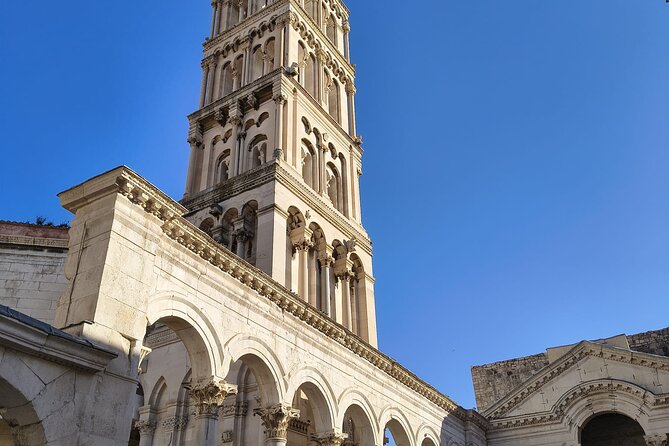
Reviewed · DIOCLETIAN'S PALACE TOURS
Walking Tour of Diocletian’s Palace and Old town-small group
Walls that still shape the city.
This Diocletian’s Palace walking tour is interesting because you move room to room, so the Roman layout makes sense fast. I especially like the clear stop-by-stop pacing and how the guide ties each space to a real purpose, from the palace’s monumental center to later urban squares. The main drawback is simple: it depends on good weather, so plan for an outdoor walk.
I like that this is a tight group experience, with a maximum of 7 people, and you get it in English with a mobile ticket. The tour is also value-friendly because the listed stops are free to enter, and you end back at where you meet. One thing to keep in mind, though, is that some areas are just passed through rather than fully explored.
In This Review
- Key highlights you’ll feel on the walk
- Getting Your Bearings in Split’s Roman Core
- Golden Gate Start: Diocletian’s Palace in One Easy Primer
- Peristyle Square: The Palace’s Most Preserved Roman Showpiece
- Vestibulum: The Imperial Chambers Start Here
- Triklinij: The Emperor’s Residence and Promenade Logic
- Diocletian Palace Substructures: Cellars, Preservation, and What You Don’t See
- Temple of Jupiter to Baptistery: A Quick Transformation Stop
- Narodni Trg: How Split Expanded Westward
- Fruit Square (Trg Brace Radic) and Prokurative: Squares for People Watching
- Grgur Ninski Statue: The End Point That Feels Like a Story Wrap
- Pace, Group Size, and What You Get for $23.83
- Who This Tour Fits Best in Your Split Plans
- Should You Book This Split Walking Tour of Diocletian’s Palace and Old Town?
- FAQ
- How long is the Walking Tour of Diocletian’s Palace and Old town?
- What language is the tour offered in?
- Where does the tour start?
- How many people are in the group?
- Is there an admission fee for the stops?
- Do you go inside the Temple of Jupiter?
- What kind of ticket do I get?
- What happens if the weather is poor?
- Can I cancel for a full refund?
- Are service animals allowed?
Key highlights you’ll feel on the walk
- Golden Gate start that gives you the palace map without making you memorize facts
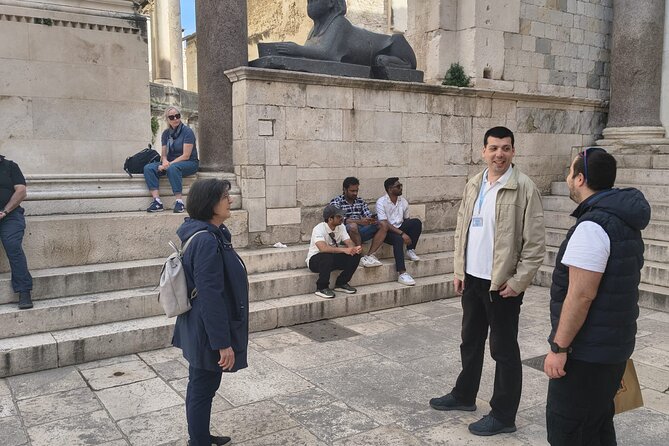
- Peristyle square as a key Roman space, explained in plain language
- Triklinij and the emperor’s residence logic, not just architecture trivia
- Substructures cellars and why they remain so well preserved
- Old town squares like Narodni Trg and Prokurative, tied to how Split grew
- Grgur Ninski statue as a clean, satisfying wrap-up
Getting Your Bearings in Split’s Roman Core
Split’s old town can feel like a maze of stone streets and café corners. This tour solves that problem by giving you a guided route that starts inside the palace walls and then steps outward into the city that grew around it. In about an hour and a half, you cover the palace’s most meaningful spaces and then shift to the squares that show later chapters of Split’s story.
The value here is not speed. It’s clarity. You’re shown how Diocletian’s Palace worked as an imperial world, then how the surrounding town pushed outward, leaving recognizable evidence in the urban plan. With a small group, you should also get enough time to ask questions and keep the walk feeling personal rather than rushed.
Golden Gate Start: Diocletian’s Palace in One Easy Primer
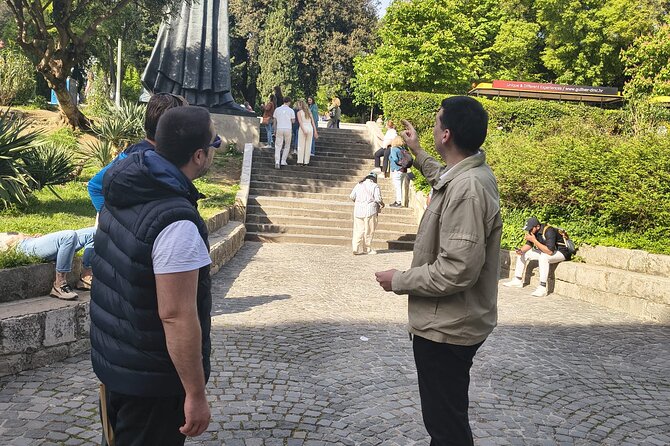
The walk begins at Ul. kralja Tomislava 15, and your first landmark is the Golden Gate. This is a smart opening move because it frames what you’re about to see: an imperial residence that functioned like its own city. You get an intro to Diocletian’s Palace right away, so the stone around you stops looking random.
At this stage, I find it helps to listen for the big idea the guide is using. Instead of drowning you in dates, the tour focuses on what these spaces were for and how they connect. That makes it much easier to follow later stops, especially once you enter the palace’s interior rhythm.
More Walking Tours in Split
- Split: Old Town and Diocletian Palace Walking Tour★ 4.9 · 4,727 reviews
- Walking Tour of Split and Diocletian’s Palace★ 5.0 · 2,588 reviews
- Krka Waterfalls tour with Trogir Walking tour and Krka panoramic boat cruise★ 5.0 · 1,659 reviews
Peristyle Square: The Palace’s Most Preserved Roman Showpiece
Next comes the Peristyle, described as the most preserved Roman square in the palace. This is the kind of spot where Roman planning becomes visible without any translation needed. You’re not just looking at ruins, you’re standing in the center of a civic stage.
What I like about this stop is the emphasis on importance. The Peristyle isn’t treated like a photo backdrop. You learn why it matters in how the palace was organized and how movement through the complex would have felt. It’s also a turning point: once you understand the Peristyle, the palace’s other corridors and entrances start clicking into place.
Vestibulum: The Imperial Chambers Start Here
From the Peristyle, the tour moves into the Vestibulum. Think of this as a transitional space, the kind of entrance area that signals status and control. The vestibule is explained as an entrance point to the imperial chambers, so you’re not wandering hallways blindly.
This is a short stop, but it’s useful. In many heritage sites, you can lose track of where you are in the larger plan. Here, the guide gives you that orientation quickly, so the next areas feel like a progression rather than a disconnected set of monuments.
Triklinij: The Emperor’s Residence and Promenade Logic
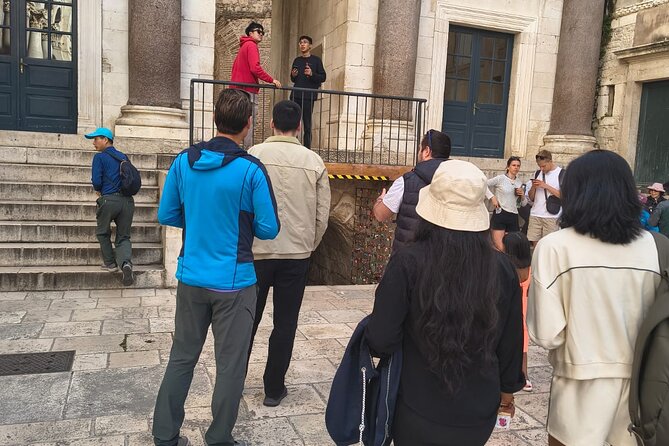
The Triklinij stop is where the tour becomes more than stone sightseeing. You see the emperor’s residence area and also get a sense of the promenade concept, meaning the way people moved, approached, and experienced the spaces linked to daily power.
I like the way this stop tends to shift your thinking. Instead of asking, What am I looking at? you start asking, What would this have felt like to occupy? Even if you don’t go deep into emotional imagining, it helps you notice practical details of layout and flow.
With a small group, this is also the kind of stop where questions are easier. If you’re curious about what parts of the palace would be used by officials versus private life, this is an area where that kind of discussion fits naturally.
More corridors of the emperor’s palace:
- Split & Diocletian’s Palace Walking Tour
★ 5.0 · 1,125 reviews - Split: Diocletian Palace & Old Town Guided Walking Tour
★ 4.7 · 882 reviews - Split Old Town and Diocletian’s Palace Tour
★ 4.8 · 716 reviews - Split: Game of Thrones Tour with Diocletian’s Palace Cellar
★ 4.8 · 545 reviews
Diocletian Palace Substructures: Cellars, Preservation, and What You Don’t See

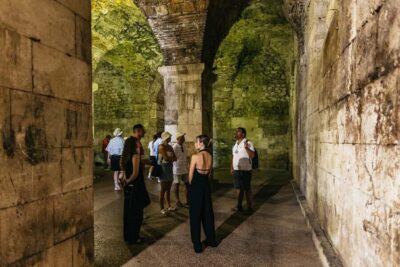
Then you reach the Diocletian Palace substructures, which focus on the cellars and why they’re so well preserved. This is one of the most interesting segments for practical travelers, because it’s about survival. You learn how these lower spaces stayed intact and why that matters when you’re looking at the palace as a whole system, not just a surface-level monument.
One note that’s worth paying attention to: you’ll be passing through parts that are not paid for. That doesn’t mean it’s a waste, but it does mean your route inside may feel slightly different from what you expect if you imagined a guided path that only goes into ticketed zones.
This stop is a good reminder that the tour is designed as an overview. You get explanations that connect the dots, even when you are not going deep into every room.
Temple of Jupiter to Baptistery: A Quick Transformation Stop
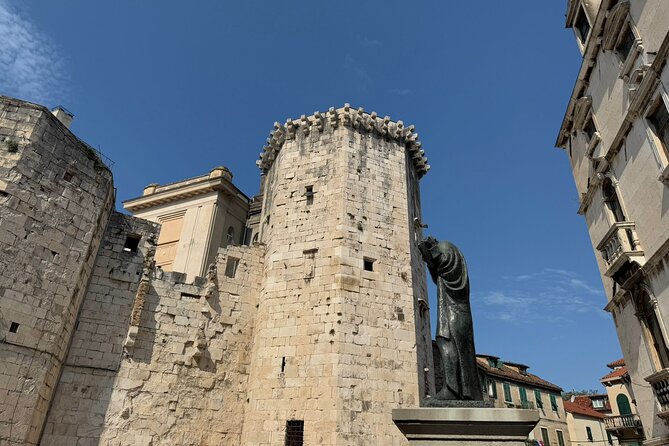
After the substructures, the tour heads to the Temple of Jupiter. You learn about the transformation from a temple to a baptistery, but you won’t go inside.
That makes this stop different from the others. It’s more about interpretation at the threshold, which can be a smart choice in a short tour. If you’re the type who gets more out of context than long interior visits, this is the right kind of stop. It also keeps the overall pacing steady, so you don’t lose the momentum of the walk.
Narodni Trg: How Split Expanded Westward

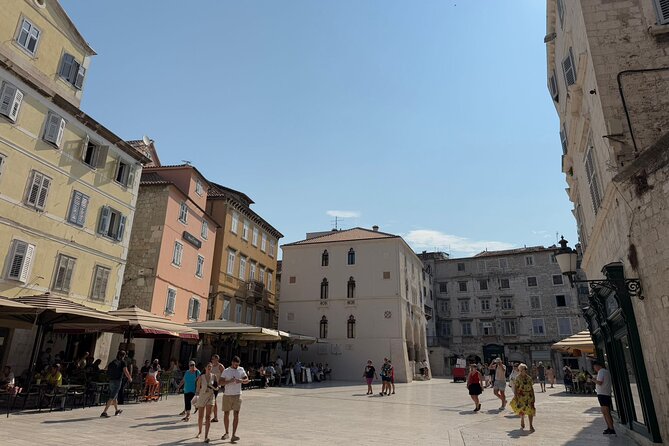
Now you shift from the palace interior to the city’s later growth, with Narodni Trg as the marker. The tour explains that this square is a consequence of Split expanding westward. That’s the kind of cause-and-effect detail that makes old town streets easier to read.
Standing here, you can connect the dots between the old fortified core and the town that grew around it. You stop thinking of Diocletian’s Palace as a standalone island and start seeing it as a foundation. Even if you don’t memorize street lines, you’ll notice the difference in urban scale.
Fruit Square (Trg Brace Radic) and Prokurative: Squares for People Watching
Two of the tour’s stops focus on squares, and that’s practical. Squares are where city life shows up fastest. Fruit’s Square, also called Trg Brace Radic, is one of those places where the guide points out several interesting angles, helping you look past the obvious.
Then comes Prokurative. Here the tour explains that the square was modeled after a European square, and you’ll notice a hotel and an interesting church nearby. I like this stop because it balances Roman legacy with later European-style planning, so Split feels like it kept evolving instead of freezing in time.
If you enjoy pausing in the middle of a walk to take in how people use space, these square stops are a good fit. They also help you decompress after the denser palace areas.
Grgur Ninski Statue: The End Point That Feels Like a Story Wrap
The tour finishes at the Grgur Ninski statue. The guide brings you to the statue with interesting facts about Gregory of Nin, then uses it as a clean ending point.
This is more than a random landmark finish. It closes the loop by grounding the palace story in Split’s identity beyond Roman walls. Once you know what you’ve seen, the statue helps you step back and understand that Split’s old town is layered, not just ancient.
Pace, Group Size, and What You Get for $23.83
At $23.83 per person for about 1 hour 25 minutes to 1 hour 35 minutes, this tour is positioned as a quick, high-return orientation. The price can look small because the stops you visit are listed as admission-free. You’re paying mainly for guided context, route planning, and the value of someone translating the site layout into something you can understand on your feet.
The small group size, up to 7 travelers, matters more than you might expect. It keeps the walk from becoming lecture mode. It also helps with a practical reality: old town streets can get crowded, and having someone who knows shortcuts can save your energy and keep the tour moving at an enjoyable pace.
Based on the guide’s style, expect a relaxed feel rather than a strict script. Luka, the guide mentioned in the experience, is friendly and easy to follow, and he’s known for knowing shortcuts to the best places. He also involves the group with questions, which turns the tour into a conversation instead of a one-way talk.
Who This Tour Fits Best in Your Split Plans
This walk is a great match if you want a structured introduction without committing to a long day. You’ll enjoy it if you like seeing how major monuments connect to the way a city grew, and if you appreciate clear explanations at a manageable pace.
It’s also a solid option for many travelers because the tour is described as something most people can participate in, and service animals are allowed. If you’re short on time in Split, this one gives you a lot of context quickly, especially compared to aimless roaming through the palace streets.
If you hate walking, or you expect a slow museum-style visit with lots of interior time, you may find the pacing too brisk. The tour is built to move through spaces and keep the story flowing.
Should You Book This Split Walking Tour of Diocletian’s Palace and Old Town?
I think this is a good booking when you want an efficient, human-guided route through the palace and the squares that shaped later Split. The best reason to go is the structure. You get a clear sequence, you learn why spaces matter, and you finish with a coherent sense of how Diocletian’s Palace connects to the old town.
Book it if:
- You want a small group experience with time for questions.
- You’d rather understand the layout than just collect photos.
- You like a guided route that ends back at the same meeting point.
Skip it if:
- You’re hoping to spend long periods inside multiple buildings, since some key stops are described as pass-through or won’t go in.
- You’re traveling during weather you can’t control, because the tour requires good weather.
If you’re in Split for a first visit, this is one of the easiest ways to get your bearings fast.
FAQ
How long is the Walking Tour of Diocletian’s Palace and Old town?
It runs about 1 hour 25 minutes to 1 hour 35 minutes.
What language is the tour offered in?
The tour is offered in English.
Where does the tour start?
The meeting point is Ul. kralja Tomislava 15, 21000, Split, Croatia.
How many people are in the group?
This activity has a maximum of 7 travelers.
Is there an admission fee for the stops?
The listed stops include admission ticket free.
Do you go inside the Temple of Jupiter?
No, the tour notes that you won’t go in.
What kind of ticket do I get?
You receive a mobile ticket.
What happens if the weather is poor?
The tour requires good weather, and if it is canceled due to poor weather, you’ll be offered a different date or a full refund.
Can I cancel for a full refund?
You can cancel up to 24 hours in advance for a full refund.
Are service animals allowed?
Yes, service animals are allowed.
Marble Lanes, Slowly



Latest arrivals logged at Split




Diocletian's Palace Tours, compared.

Walking Tour of Split and Diocletian’s Palace
Read our review →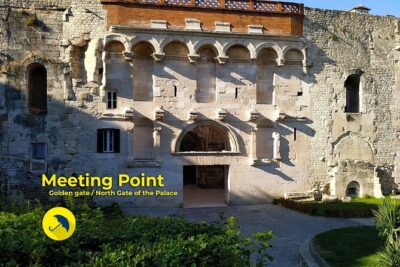
Diocletian Palace & Old Town Guided Walking Tour
Read our review →
Game of Thrones Tour with Diocletian’s Palace Cellar
Read our review →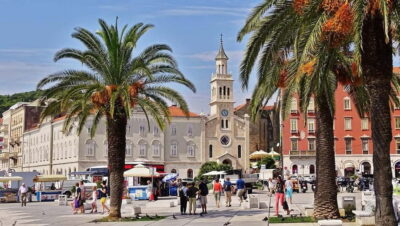
Diocletian’s Palace and Old Town SMALL GROUP Walking Tour
Read our review →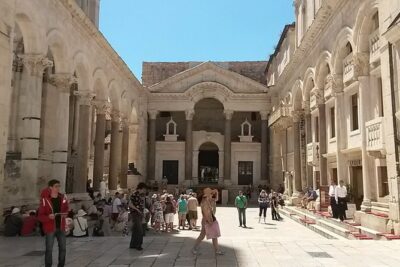
PRIVATE Walking Tour of Diocletian’s Palace & Old Town
Read our review →Browse the lists this tour appears in