
Reviewed · CITY TOURS
Back to Yugoslavia Private City Tour in Old-Timer Yugo Car
Ride a Yugo through communist Zagreb. I love the original 35-year-old Yugo and the licensed local guide who ties big political eras to the sights you see every day. The only real drawback is you should plan for good weather, since this is a mix of driving and short walking stops.
This is a focused 2.5-hour private city tour based in Zagreb, starting and ending at Koncertna dvorana Vatroslav Lisinski. You get a mobile ticket, English guidance, and included snacks, plus you can steer the conversation toward what you care about most.
If your goal is not another museum-only day, but instead a street-level way to understand Yugoslavia in Zagreb, this one is different. And yes, the old Yugo car changes how the city feels in motion.
In This Review
- Key highlights you should notice before you book
- Why a classic Yugo tour makes communist Zagreb make sense
- Starting at Lisinski and keeping the day simple
- Gorica open-air market and the abandoned dishes factory stop
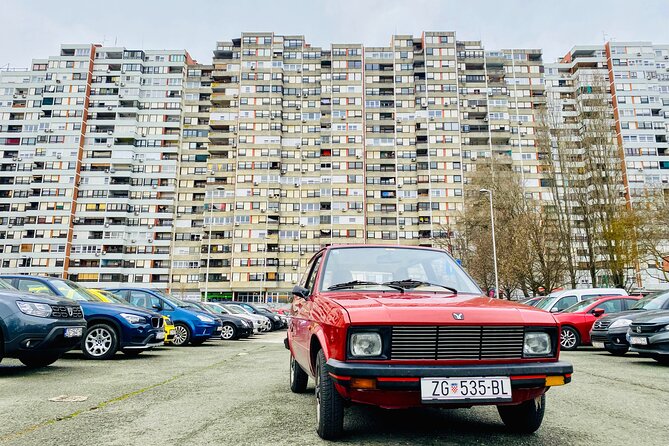
- Travno and The Mammoth, Zagreb’s biggest apartment-building statement
- Zagreb Fair: trade shows as a window into civic life
- Kockica and The Dice: when politics looks like housing
- Sava River levee and Hendrix Bridge for calm, real-world views
- Lisinski for Eurovision 1990, plus the Lady from Zagreb
- Dražen Petrović Museum and the Cibona tower stop
- How the private format lets you control what you care about
- Price and value for your Zagreb day in a real old car
- Who should book this Old-Timer Yugo tour
- Should you book the Back to Yugoslavia private Yugo tour?
- FAQ
- Where does the Back to Yugoslavia private city tour start?
- How long is the tour?
- How much does it cost?
- Is the tour private or shared?
- What language is the tour offered in?
- What is included in the tour?
- What if the weather is bad?
- What is the cancellation policy?
- Is there a meeting place or end location option?
Key highlights you should notice before you book
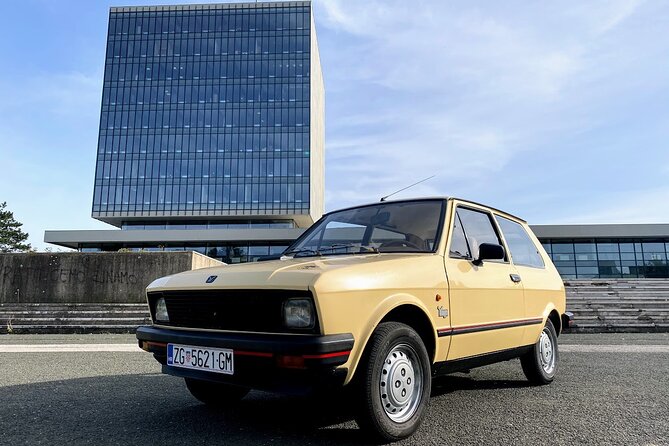
- Original 35-year-old Yugo ride: the car is part of the story, not just transport.
- Licensed local guidance with Yugoslavia context: you get the why behind the architecture and street choices.
- Concrete and symbolism stops: The Mammoth, The Dice, and other named landmarks make themes easy to follow.
- River walk for city scale: the Sava River levee and Hendrix Bridge give you a calmer stretch.
- Private, bespoke pacing: you can keep the focus on what interests you, not a fixed script.
Why a classic Yugo tour makes communist Zagreb make sense
Zagreb has plenty of photo-worthy buildings, but understanding them can be harder when you only glance from a sidewalk. The Yugo ride helps because you experience the city at human speed, with time to look up at mass housing, landmark towers, and the civic sites tied to Yugoslav life.
I like that the tour keeps the attention on everyday reality, not just big headlines. Your guide connects the places to how people moved, worked, lived, and gathered. When a stop is labeled with a clear theme, like housing linked to communists or civic spaces used for major events, you walk away with a mental map that actually sticks.
The other big win is tone. This is not a lecture where you have to sit still. You get short viewpoints, driving between them, and just enough time at each stop to ask questions and take photos.
Starting at Lisinski and keeping the day simple
The meeting point is Koncertna dvorana Vatroslav Lisinski, at Trg Stjepana Radića 4. Practically, that’s convenient because it’s a recognizable central anchor, and it also matches the tour’s focus. The tour ends back in front of Lisinski, or at a chosen location within 3 km of the main square.
Timing is also friendly: about 2 hours 30 minutes total. That length is long enough to cover multiple Zagreb areas without turning into a full-day slog. You’ll also want to remember there are a few walking moments, including a brief stretch along the Sava River levee.
One more detail that matters for your day: the tour is private. That means the pace can follow your group. If you want more time at a particular landmark, you can usually ask, rather than watching the clock while everyone else moves on.
Still riding at anchor off Zagreb
- From Zagreb: Plitvice & Rastoke Guided Day Trip with Ticket★ 4.9 · 2,955 reviews
- Zagreb: Rastoke & Plitvice Lakes Guided Tour with Ticket★ 4.9 · 1,897 reviews
- Communism & Croatian Homeland War Tour★ 5.0 · 1,355 reviews
Gorica open-air market and the abandoned dishes factory stop
Early on, the tour makes a stop at the open air market and the abandoned dishes factory called Gorica. This is the kind of place that gives you “how cities age” perspective. Even if you are not a history buff, there is something powerful about seeing the remnants of production and daily trade in the same city where people shop and walk today.
What I like about starting here is contrast. Before you hit the more iconic political or architectural landmarks, you get a sense of how Zagreb used to produce goods, how industry lingers, and how urban change shows up physically. It’s not polished, and that’s part of the point.
If you’re into photography, bring your camera ready for textures and mixed-use vibes. Also, wear shoes you can walk in comfortably, because this kind of stop is often on uneven ground or near areas with foot traffic.
Travno and The Mammoth, Zagreb’s biggest apartment-building statement
Next you head to Travno, with a stop in front of The Mammoth, described as the largest apartment building in Zagreb. This is one of those locations where scale does the explaining. In motion you can see the overall mass, but standing nearby makes it clearer why planners built in this way and why this type of housing became so central to life.
The tour gives about 5 minutes here, which is short. That’s a good reminder: treat this as an orientation moment. Get a couple of angles that show the building’s footprint, and use the time to ask your guide what everyday life looked like around major housing blocks.
Also, since admission is free for this stop, there is no barrier to simply walking around your viewing area, taking photos, and listening for how your guide connects the architecture to social structure.
Zagreb Fair: trade shows as a window into civic life
You’ll also stop at Zagreb fair, the main Zagreb venue for fairs and trade shows. This might look like a straightforward civic site, but it works well for the tour’s theme. Markets and fairs show how a city gathers, how goods and ideas circulate, and how public life forms around organized events.
What makes this stop useful is flexibility. If you care more about “how people lived” than “who ruled,” this is a natural shift. A fairground tells you something about practical culture: the rhythm of public events, the sense of planning, and the role of large venues in daily social life.
No long stay is built into the schedule, but it’s a worthwhile stop for anyone who wants context beyond monuments.
Two moorings down in Zagreb:
- Zagreb: City and WWII Tunnels Walking Tour
★ 4.9 · 1,230 reviews - Zagreb: City & History Walking Tour & WW2 Tunnels
★ 4.9 · 1,202 reviews - Plitvice Lakes with Ticket & Rastoke Guided Tour from Zagreb
★ 5.0 · 966 reviews - Zagreb: Communism and Croatian Homeland War Tour
★ 4.9 · 927 reviews
Kockica and The Dice: when politics looks like housing
One of the most distinctive parts of the tour is Kockica, with a stop at The Dice, the building built to house the Central Committee of Croatian Communists. This is symbolism you can see immediately. Instead of abstract concepts, you stand near architecture tied to power.
The tour keeps it short, about 5 minutes, and that works if you use the time well. Take one photo that captures the building’s defining features, then turn to your guide with a question like what this type of building meant for official life and how the city would have related to it.
This stop is also marked as free to view from the outside. So you’re not paying to understand it. You’re paying, in a sense, for interpretation, and that is the real value of a licensed guide here.
If you’re especially interested in Yugoslav-era politics and how it shaped the built environment, this stop is a key anchor for the whole route.
Sava River levee and Hendrix Bridge for calm, real-world views

Then you get a different vibe: a walk on the levee of the Sava River, with time to see the famous Hendrix bridge. This is about 10 minutes, and it’s a smart break in the tour’s rhythm.
Why I like this section: it gives you a sense of Zagreb’s geography and movement. River edges show you how cities breathe, where people might pause, and how different districts relate visually. Even if the bridge is the photo target, the walk helps you connect it to the wider city.
This is also a good moment to ask questions that are not tied to one building. If your guide has been focusing on architecture or named landmarks, a river walk invites more general talk about daily life, neighborhood patterns, or how major shifts in Yugoslavia-era culture changed city layout.
Bring a light layer if the air is cool, and keep your camera handy, because bridge angles are easier when you have a short walking window.
Lisinski for Eurovision 1990, plus the Lady from Zagreb
The tour then reaches Koncertna dvorana Vatroslav Lisinski, noted as the venue that hosted the Eurovision song contest in 1990. Even if you are not a Eurovision fan, it’s a useful landmark because it marks how Zagreb showed up on an international stage. Cultural events are a different kind of politics, one tied to visibility and identity.
The schedule also includes passing by the attraction known as The Lady from Zagreb. This is the kind of stop that adds local flavor to a tour otherwise focused on broader themes. Small landmarks help you remember the day later, when your brain tries to sort information into a few buckets.
This section is also where you might feel the tour is most “Zagreb.” You move through recognizable civic spaces, not only heavy political architecture. If you want to understand how Zagreb balanced official Yugoslav identity with everyday culture, this is where the pieces start to connect.
Dražen Petrović Museum and the Cibona tower stop
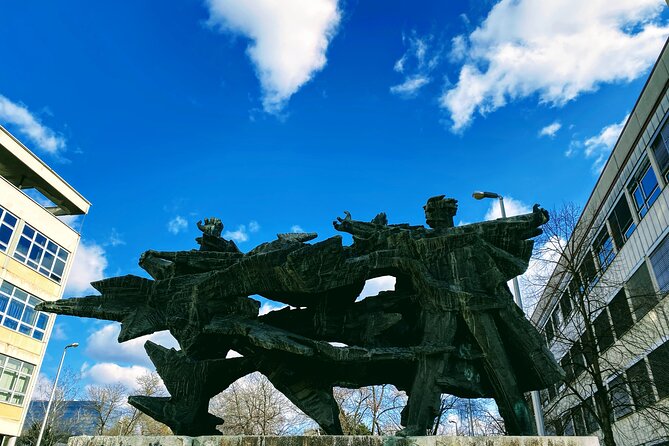
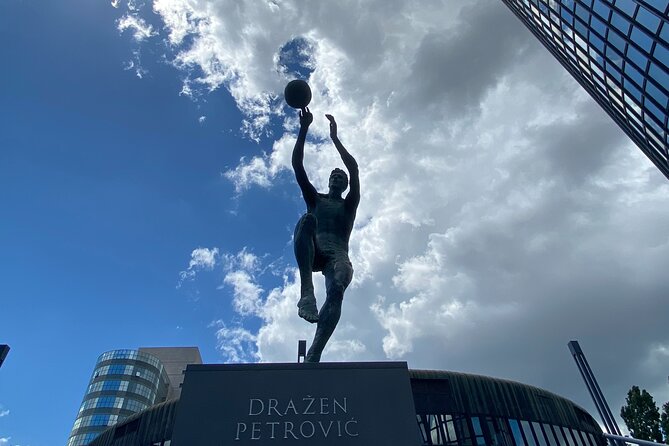
In the final stretch, you visit the Dražen Petrovic Museum – Memorial Center area. You’ll see the statue of Dražen Petrović, known basketball player, and the Cibona tower.
This stop works because it switches from political symbolism to a form of cultural identity. Sports and public figures become another way cities tell stories about values, pride, and collective memory. You’re still dealing with the same “what shaped Zagreb” question, just through a different lens.
It’s another short stop, about 10 minutes, and it’s free to view from the outside. So treat it as a listen-and-look moment. Get a photo that includes both the statue presence and the nearby tower context, then let your guide explain why these public icons matter in a tour focused on Yugoslav history and city life.
How the private format lets you control what you care about
Because this is a private, bespoke tour, the best strategy is to arrive with at least one angle you want to explore. For example: are you here for communist-era architecture, or are you here for everyday life and cultural clues?
During the ride, ask questions in real time, not only at stops. In a car you can ask about what you’re seeing as it passes: building style, street placement, and how the city’s design could reflect the values of the era.
In my experience with this kind of tour format, the guide’s explanations land best when you steer the focus. One simple tactic: pick two landmarks you care about most, and tell the guide you want extra context around them. Then take the rest as supporting chapters.
Price and value for your Zagreb day in a real old car
At $102.41 per person for roughly 2 hours 30 minutes, this is not a budget street tour. But value comes from three things you don’t get on cheaper options: the classic Yugo ride, the licensed local guide, and the fact it is private.
The Yugo car is not a gimmick in this case. It changes how you experience the route. You see the city from inside an older vehicle, which makes the political and everyday-story elements feel less like facts on paper and more like something living and physical.
You also get included snacks, which is small but practical. It reduces the need to find a quick bite right before or during the tour.
If you are comparing options, I’d treat this as a “special experience” day in Zagreb. If your travel style leans toward authentic, off-mainstream context, it’s a fair spend. If you mainly want broad views with minimal explanation, you might want something simpler and cheaper.
Who should book this Old-Timer Yugo tour
This tour is a great fit if you:
- Want Zagreb through Yugoslav and communist-era lenses, but without heavy museum time
- Enjoy cars with character and photos that feel specific to a place
- Like guided context where a licensed guide explains more than just dates
- Prefer a private pace you can steer
It may be less ideal if you:
- Hate walking, even short stretches (there is a brief walk along the Sava River levee)
- Travel in rainy or poor weather, since the experience requires good weather
- Want a long, deep stop schedule at each landmark (the key viewpoints are intentionally short)
Should you book the Back to Yugoslavia private Yugo tour?
If you are curious about Yugoslavia in Zagreb, and you want that curiosity answered through real buildings and real neighborhoods, I’d book it. The route includes big named landmarks you can anchor your memory to, like The Mammoth, The Dice in Kockica, Hendrix Bridge, and the Dražen Petrović memorial area.
Book it especially if you like the idea of a private tour where you can shift the focus. Tell your guide what you want most, and you will likely get more value out of the time than you would on a group tour with fixed stops.
One last practical note: keep an eye on the forecast. This is offered with the expectation that you’ll be able to walk briefly and enjoy the outdoor viewpoints.
If that sounds like your kind of Zagreb day, this is one of the more fun and genuinely different ways to learn the city.
FAQ
Where does the Back to Yugoslavia private city tour start?
It starts at Koncertna dvorana Vatroslav Lisinski, Trg Stjepana Radića 4, Zagreb, Croatia.
How long is the tour?
The tour lasts about 2 hours 30 minutes.
How much does it cost?
The price is $102.41 per person.
Is the tour private or shared?
It is private. Only your group participates.
What language is the tour offered in?
The tour is offered in English.
What is included in the tour?
Included are snacks, private transportation, an experienced licensed local guide, and a ride in an original 35-year-old classic Yugo. You also get detailed information about Zagreb’s history and everyday life.
What if the weather is bad?
This experience requires good weather. If it is canceled due to poor weather, you will be offered a different date or a full refund.
What is the cancellation policy?
Free cancellation is available up to 24 hours in advance for a full refund.
Is there a meeting place or end location option?
The tour ends either back in front of the Lisinski concert hall or at your chosen location within the city limits, up to 3 km around the main square.
Latest arrivals logged at Zagreb


City Tours, compared.
City Walls Early Morning or Sunset Walking Tour
Read our review →
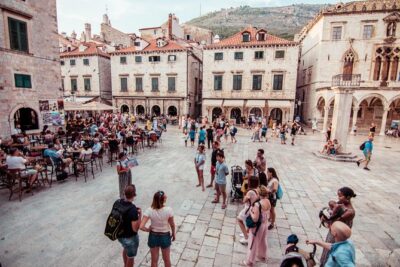
Dubrovnik Combo: Old Town & Ancient City Walls
Read our review →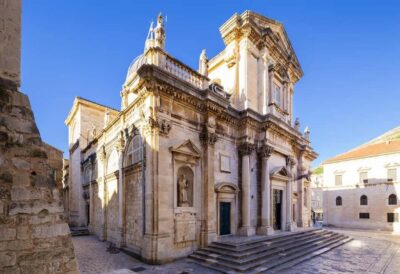
City Walls, Old Town Walking Tour & Adriatic View
Read our review →
Hop On Hop Off Panoramic bus – Zagreb City Tour
Read our review →Browse the lists this tour appears in