
Reviewed · WALKING TOURS
Explore Zagreb: A Guided Walking Tour of the City Centre
Zagreb has a knack for hiding big stories in plain sight. This 90-minute walking tour is a quick, well-paced way to see the city center up close, with licensed local guidance and lots of specific stops you would otherwise skip. It starts at the Well of Life sculpture by Ivan Meštrović, then threads through squares, gates, and viewpoints that explain how Zagreb grew and why certain places matter.
I really like two things about this format. First, it gives you strong context in the exact spots where the history happened, like St Mark’s Square and the Stone Gate. Second, it sprinkles in moments that feel personal, not lecture-y, such as the story tied to Nikola Tesla and the daily noon cannon at Lotrščak Tower. The main drawback to plan around is simple timing: you are walking a lot in a short window, so if you want a slow, sit-down tour with lots of breaks, this one may feel a bit fast.
In This Review
- Key things that make this walk worth your time
- Beginning at the Well of Life, where the route instantly makes sense
- Trg Republike Hrvatske and the Tesla connection in Nikola Street
- Flower Square to Uspinjača, a quick shift from formal to everyday Zagreb
- Lotrščak Tower and the daily Grič cannon at noon
- St Mark’s Square, Croatian governance, and a church roof with coats of arms
- Stone Gate and the candles for the Virgin Mary
- Bloody Bridge to Tkalčićeva Street, a story-driven walk through conflict and cafes
- Dolac Market and Zagreb Cathedral, local flavors meet Gothic architecture
- A model of old Zagreb, then finish at Ban Jelačić Square
- Price, time, and value: what $23 buys you in Zagreb
- Who this guided walk is best for
- What the guide experience feels like in practice
- Should you book this Zagreb guided walking tour?
- FAQ
- Where does the Zagreb city center walking tour start?
- How long is the walking tour?
- How much does it cost?
- What are the main stops on the route?
- Who leads the tour, and what languages are offered?
- What is included in the price?
- Is there free cancellation?
- Can I reserve without paying right away?
- What is special about Lotrščak Tower on this tour?
Key things that make this walk worth your time
- Ivan Meštrović’s Well of Life start, an instantly recognizable entry point to the whole route
- Republic of Croatia Square to Nikola Tesla Street, arts, education, and one of Zagreb’s most famous names
- Lotrščak Tower and the Grič cannon at noon, a ritual you can time your stroll around
- St Mark’s Square landmarks, Croatian governance plus the church roof covered with coats of arms
- Stone Gate candles and the patron saint, a small place with a very human tradition
- Dolac Market plus Zagreb Cathedral, local food culture paired with Gothic architecture and earthquake restoration
Beginning at the Well of Life, where the route instantly makes sense
The tour kicks off right in front of the Croatian National Theatre, at the Well of Life. This is a smart start point because it anchors you in a civic, cultural zone rather than dumping you somewhere random. From there, you can look around and get a feel for Zagreb’s “center” shape before you even move far.
The Well of Life matters for a practical reason too. It is not just a pretty sculpture, it gives the guide an easy way to start connecting themes like Croatian identity and public art. If you are trying to learn a new city fast, you want the first five minutes to give you structure. This start does that.
Trg Republike Hrvatske and the Tesla connection in Nikola Street
The first major stop is Trg Republike Hrvatske, the cultural heart of Zagreb. The guided walk here is short but focused, which is ideal in a 90-minute experience. You pass the University building, the Academy of Music, and the Museum of Arts and Crafts, and the guide frames how the square functions as a central meeting point for learning, culture, and public life.
Then you move toward the statue of Nikola Tesla on Ulica Nikole Tesle. Tesla is one of those names that most people know, but it is harder to connect it to a city unless someone points you to the exact details in the right place. Here you get the story of his life and contributions while you are physically at the moment.
One reason this part works well: it splits the city into two categories quickly. You learn Zagreb as a place of institutions and arts, then you get Zagreb as a place that claims world-famous innovation. That contrast helps the rest of the walk stick in your memory.
More Walking Tours in Zagreb
- Zagreb: City and WWII Tunnels Walking Tour★ 4.9 · 1,230 reviews
- Zagreb: City & History Walking Tour & WW2 Tunnels★ 4.9 · 1,202 reviews
- Walking tour of Zagreb★ 5.0 · 383 reviews
Flower Square to Uspinjača, a quick shift from formal to everyday Zagreb
Next comes Cvjetni trg, officially Petar Preradović Square, a local gathering spot known for flower stands and cafés. You get to switch gears from the major institutional setting into a more everyday scene. Even if you only spend a few minutes here, it changes the mood of the route so it does not feel like you are only walking through monuments.
From Flower Square, the walk heads toward Uspinjača, the funicular area. The itinerary includes it as a guided stop, so you are not just watching rails and stairs pass by. You get context for how this hillside connection fits into the city’s layout, which matters later when you climb toward the Upper Town sites.
Lotrščak Tower and the daily Grič cannon at noon
Getting to Lotrščak Tower is where the walk starts to feel like a classic “city center to old town” progression. Lotrščak is a medieval defensive structure, and the guide’s job is to make that concept easy to picture. You are standing at the kind of place built for lookout and control, not for sightseeing selfies.
The best detail here is the Grič cannon story. You hear about the cannon that fires daily at noon. This is useful because it gives you a real planning lever. If your schedule lines up with midday, you can time your presence in that general area for the moment. Even if it does not, the story makes the tower feel active, not static.
A small practical note: because the cannon is tied to a specific time, the walk’s feel might vary slightly depending on when you start. That is not a problem, but it is good to know what kind of day you are walking into.
St Mark’s Square, Croatian governance, and a church roof with coats of arms
From the tower area, the route continues on foot to St Mark’s Square. This is one of Zagreb’s power-and-identity hubs. The itinerary has a guided segment designed to make you understand what you are looking at, including the Croatian Parliament, the Government building, and St Mark’s Church.
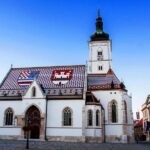
The church is the star for many first-timers because of its colorful roof depicting Croatia’s historical coats of arms. That visual detail is easy to spot, but the guide also explains why those symbols belong on a landmark like this. It turns the roof from decoration into information.
What I like about this part of the tour is the way it connects architecture to governance. You are not just hearing that institutions exist, you get a sense of how public authority is presented in the city’s most central spaces. If Zagreb feels confusing at first, this is where it starts to click.
More marble lanes taken slowly:
- Zagreb Small Group Guided Walking Tour with WW2 Tunnels
★ 5.0 · 380 reviews - Zagreb: Restaurants, Food & Old Town Walking Tour
★ 5.0 · 191 reviews - Zagreb Unveiled: Private walking tour with a local guide
★ 5.0 · 185 reviews - Zagreb: Restaurants, Food & Old Town Walking Tour
★ 4.7 · 170 reviews
Stone Gate and the candles for the Virgin Mary
Next you visit the city’s first pharmacy and then pass through the Stone Gate, described as the only preserved entrance to the old town. That phrase matters. When a city’s access points survive, they act like historical bookmarks. You are literally walking through a remnant of older Zagreb, then stepping into the emotional layer of religious tradition.
At the Stone Gate, the tradition you are guided toward is the lighting of candles in front of the painting of the Virgin Mary, Zagreb’s patron saint. Even if you are not religious, it is still meaningful to see how faith shows up in daily behavior and public space. It is a small ritual that makes the stones feel lived-in, not museum-like.
Also, it gives a nice pace change before the next segment. After the formal government focus, this feels more intimate and human.
Bloody Bridge to Tkalčićeva Street, a story-driven walk through conflict and cafes
Then the tour goes to the Bloody Bridge, a historic conflict site between Kaptol and Gradec. This stop is important because Zagreb is often told as a single city, but historically it was shaped by rivalry between two sides. By placing the story right at the bridge, you can understand how disagreement can be built into geography.
Right after, you walk onto Tkalčićeva Street, lined with cafés, restaurants, and shops. The itinerary keeps this part moving, but it gives you a real “now” moment. You are not just learning history, you are stepping into where people go to eat, browse, and relax.
If you want a practical takeaway, it is this: after a walk full of squares and symbols, Tkalčićeva helps you transition to self-exploration. You leave with streets you can return to without needing a map.
Dolac Market and Zagreb Cathedral, local flavors meet Gothic architecture
The tour reaches Dolac Market, Zagreb’s most famous market. This is a big stop in a short walk, and the guide uses it to connect you to local taste and fresh products. Even if you are not buying anything, it is the kind of place that gives you an instant feel for what residents prioritize day to day.
From the market, you look toward Zagreb Cathedral and get guided context on its Gothic architecture and the fact that it has undergone restoration after a recent earthquake. That earthquake detail is not a footnote. It is part of how the city continues to function and rebuild, which makes the cathedral feel current, not frozen in the past.
If you are the type who likes photos, this stop is also efficient. You get a natural vantage point near the market plus architectural attention at the cathedral. It is a good payoff zone before the final stretch.
A model of old Zagreb, then finish at Ban Jelačić Square
The final guided stops include a visit to the model of old Zagreb. A model can feel touristy, but in a city like Zagreb, it helps you connect the earlier stops into one mental picture. After you have walked from theater to cathedral to old town entrances, you suddenly understand where everything fits.
Then the tour concludes at Ban Jelačić Square, the city’s main meeting point. Finishing here is a smart move because it is easy to extend your day without guessing. You can head to cafés, keep wandering nearby, or grab a transit option from a central hub. In other words, the tour ends where you still have choices.
Price, time, and value: what $23 buys you in Zagreb
At about $23 per person for 90 minutes, this walk is priced like a city-center introduction, not a half-day deep specialization. The value comes from the concentration of recognizable landmarks plus the “why this matters” explanations built into each stop. It is also a small-group style experience, which usually means you can ask questions without feeling like you are talking over a crowd.
If you only have a short window in Zagreb, the timing makes sense. You get history and culture in a format that keeps you moving but still gives you guided stops where you can actually look and listen.
If you are already obsessed with architecture research or you plan to spend hours in museums, you might find you want more time. But as a first pass through the core, this is a tidy deal.
Who this guided walk is best for
This tour fits best if you want an efficient first taste of Zagreb that still feels grounded and specific. It is especially good for:
- First-time visitors who need orientation fast
- Travelers who prefer walking with a narrative thread
- People who like seeing how politics, religion, and everyday life overlap in one area
- Anyone who enjoys short, high-impact stops like Lotrščak Tower and Dolac Market
It may not be ideal if you dislike crowds around major squares, or if you want frequent long breaks. The tour is designed to move, and the route is built around seeing a lot on foot.
What the guide experience feels like in practice
The tour is led by licensed local guides who speak Croatian and English. That language coverage is practical if you are traveling with mixed-language comfort levels, or if you want explanations without translation gaps.
The reviews include praise for the guide quality. One standout detail is a mention of Branko as friendly and cultured, and another review simply calls it excellent and recommends it. With a short tour like this, that kind of guide praise matters because you need clear storytelling, not just a list of sights.
Should you book this Zagreb guided walking tour?
Yes, if you want a 90-minute Zagreb center lesson that actually follows the city’s logic. This tour is strong on the kinds of details that help you return on your own later, especially the connections between public spaces like St Mark’s Square, traditions at the Stone Gate, and the real local energy at Dolac Market.
Book it if your priority is getting oriented quickly, learning a few high-value stories, and leaving with a route you can confidently explore further. Skip it only if you want a slower pace with lots of time to linger, or if you already know these specific landmarks well and need something more specialized.
FAQ
Where does the Zagreb city center walking tour start?
The tour starts in front of the Croatian National Theatre, at the Well of Life sculpture by Ivan Meštrović.
How long is the walking tour?
The tour lasts about 90 minutes.
How much does it cost?
The price is $23 per person.
What are the main stops on the route?
You’ll pass through Republic of Croatia Square, the Tesla area, Flower Square, Lotrščak Tower, St Mark’s Square, the Stone Gate, Dolac Market, Zagreb Cathedral, and you finish at Ban Jelačić Square.
Who leads the tour, and what languages are offered?
It is led by a licensed local guide. The tour is available in Croatian and English.
What is included in the price?
The tour includes the guided walking experience and all fees and taxes.
Is there free cancellation?
Yes. You can cancel up to 24 hours in advance for a full refund.
Can I reserve without paying right away?
Yes. The tour offers a Reserve now & pay later option, so you can book and pay nothing today.
What is special about Lotrščak Tower on this tour?
The guide shares the story of the Grič cannon, which fires daily at noon.
Latest arrivals logged at Zagreb




Walking Tours, compared.
Walking Tour of Split and Diocletian’s Palace
Read our review →
Krka Waterfalls tour with Trogir Walking tour and Krka panoramic boat cruise
Read our review →
City Walls Early Morning or Sunset Walking Tour
Read our review →Browse the lists this tour appears in