
Reviewed · WALKING TOURS
Split Walking Tour: Explore Top Sights & Hidden Gems
Split’s old core is more fun on foot. This compact route strings together Diocletian’s Palace highlights, from underground spaces up to the Peristyle square, and it helps you read what you are seeing fast. You also get a proper “walk the city like a local” moment with stops outside the palace walls.
What I like most is the way the tour is built around transitions: you start in a park, shift to the seaside Riva, then move into the palace for the big Roman set pieces. The pacing is also friendly. You are not stuck in one spot the whole time, and each stop feels like it explains the next one.
One possible drawback to consider: the tour is short, so if you were hoping for a huge palace deep dive, you may still want to return and explore more on your own afterward. And while the guide experience is generally praised, one review notes the guide Ana can be a bit hard to understand due to a soft voice, so pick a spot where you can hear well.
In This Review
- Key things that make this Split walk worth your time
- Price and logistics: what $28 actually buys you
- Park Josipa Jurja Strossmayera: the calm start before the Roman rush
- Split Riva waterfront: a quick sea-breeze reset
- Diocletian’s Palace Peristyle: the tour’s big payoff
- The Golden Gate: entering through the emperor’s door
- Grgur Ninski statue and the “surprise” route ending
- When the guide makes the difference: tips for hearing Ana
- Timing and pacing: start at 1:30 pm and keep up
- Who should book this Split walking tour
- Should you book it?
- FAQ
- How long is the Split walking tour?
- How much does it cost?
- Is the tour offered in English?
- Do the listed stops require admission tickets?
- Where does the tour start and end?
- What is the cancellation policy?
Key things that make this Split walk worth your time
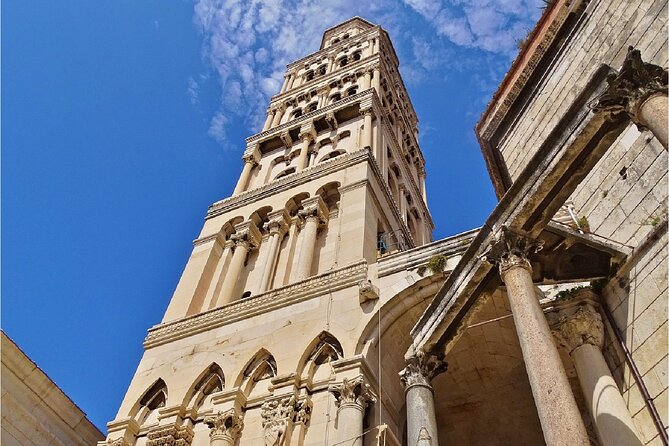
- Underground to Peristyle: you go from the palace’s underground storage basements up to the central Peristyle square.
- Golden Gate focus: you enter through the northern gate tied to the emperor’s route.
- A smart “outside then inside” rhythm: park and waterfront first, then Roman stone and corridors.
- Small group size: a maximum of 15 people means more chances to ask questions.
- Free entry at every listed stop: you are mostly paying for the guide and orientation, not ticket fees for sights.
Price and logistics: what $28 actually buys you
At $28 per person for about 1 hour 30 minutes, you are paying for two things that matter in Split: a professional guide and a tight route through the places that can otherwise blur together. The itinerary includes multiple stops that are marked free for admission, so the money is not going mostly to site entry. It is going to interpretation, order, and walking efficiency.
The group size is capped at 15, which is a quiet win. Smaller groups move more smoothly, and you are less likely to feel lost when the guide points out details. The tour is also offered in English, and you get a mobile ticket, which is handy if you are juggling plans and don’t want extra paper.
One more practical point: the tour starts at GC5R+RHF in Split and ends back at the same meeting point. That matters because Diocletian’s Palace area streets can be confusing. When the tour loops back to where you started, you do not have to figure out a second ending location while you are already tired from walking.
Park Josipa Jurja Strossmayera: the calm start before the Roman rush
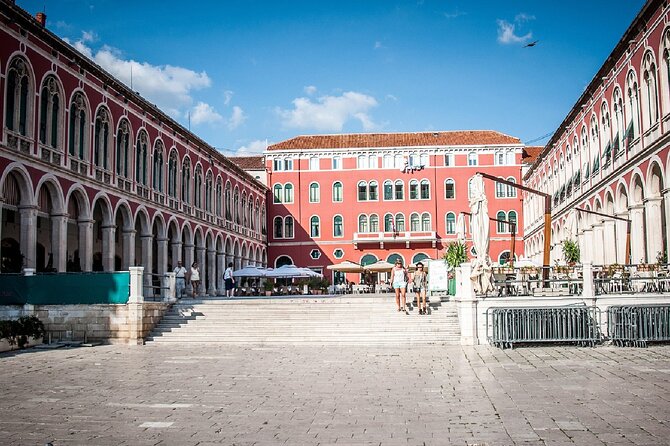
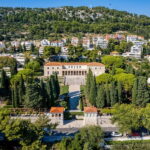
The walk begins at Park Josipa Jurja Strossmayera, a historic green space where locals gather. Starting here is a clever move. It gives you shade, a breath of air, and a quick sense of where you are in modern Split before the stone-and-staircase world of Diocletian’s Palace takes over.
You will also see the statue of Marko Marulić, described as the father of Croatian literature. That detail is more than a name on a sign. It gives you a cultural anchor so Split is not just Romans and medieval walls. You get to connect the city’s identity to language and ideas, not only architecture.
Why this stop works: it helps you “reset your eyes.” After the park, you step into tighter streets and denser buildings, so having this first open-air reference point makes the rest of the route easier to follow.
What to watch for: this is still a walking tour, so give yourself time to take quick photos but don’t linger so long you miss the momentum. The best value of this tour comes from keeping the pace.
More Walking Tours in Split
- Split: Old Town and Diocletian Palace Walking Tour★ 4.9 · 4,727 reviews
- Walking Tour of Split and Diocletian’s Palace★ 5.0 · 2,588 reviews
- Krka Waterfalls tour with Trogir Walking tour and Krka panoramic boat cruise★ 5.0 · 1,659 reviews
Split Riva waterfront: a quick sea-breeze reset
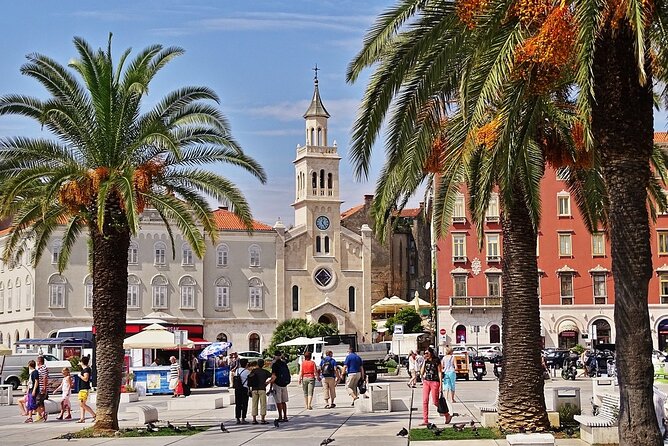
Next up is Split Riva, the waterfront promenade lined with palm trees, cafes, and historic buildings. Even if you have seen photos of the Riva, the walking part matters. You learn the shape of the coastline, you notice which buildings face the sea, and you feel the rhythm of the city.
This stop is a “gear shift” from the park. It takes you from local-gathering calm to a more public, street-level view of Split. That’s useful because the palace is dramatic and enclosed, but your brain needs one open line of sight to understand the layout of what comes next.
What I think you will like here: the Riva makes the palace feel connected to everyday life. You are not touring an isolated monument. You are touring a district that still lives with the waterfront right there.
Practical tip: if it is sunny, plan for it. A waterfront promenade can be bright. Hats and water are worth it, especially since the tour starts in the early afternoon at 1:30 pm.
Diocletian’s Palace Peristyle: the tour’s big payoff
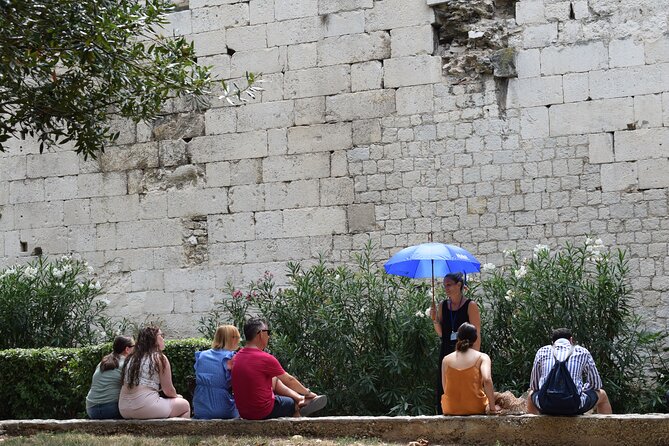
The Peristyle of Diocletian’s Palace is where the tour starts to feel like a real “wow, I get it now” moment. You walk through the palace basements, described as underground storage spaces, and then you emerge at Peristil, the central square where the emperor was worshipped.
That underground-to-open transition is the heart of this tour’s design. If you have ever wandered Diocletian’s Palace on your own, you know how easy it is to see stone everywhere and still miss the story. Here, the route is set up so you experience the building in layers. Storage down below, ceremonial center above. That contrast makes the palace’s purpose feel more clear.
This is also a good stop for orientation. Peristil acts like a hub. Once you understand where the square sits and why it was used for worship, everything else you see later makes more sense.
A small consideration: you are walking, and basements can involve uneven steps and tighter areas. If you feel slower in tight indoor spaces, you might want to choose a spot near the front when the group transitions from outdoor to underground.
The Golden Gate: entering through the emperor’s door
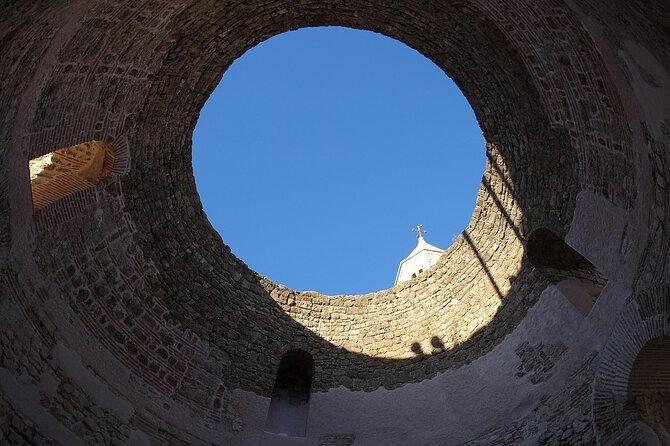
After Peristyle, the tour moves to the Golden Gate. You enter through the northern gate of Diocletian’s Palace, described as a route once used exclusively for the emperor and guarded by Roman soldiers.
This part is great because it is not just “look at a gate.” It is about route and access. When you go in through the area tied to the emperor, it gives you a sense of hierarchy in the palace design. Where you enter changes what you notice next.
Why this is valuable for first-time visitors: gates sound like small details, but in Roman-era design they signal power and movement. Knowing that this entrance was tied to elite use helps you read the space as an organized system, not a random collection of doorways.
Practical note: keep your eyes up and outward as you move through. Even if the gate itself is the headline, the surrounding walls and entry paths help you map what is where in the palace complex.
More marble lanes taken slowly:
- Split & Diocletian’s Palace Walking Tour
★ 5.0 · 1,125 reviews - Walking Tour of Split with a ‘Magister’ of History
★ 5.0 · 1,122 reviews - Split Walking Tour with Professor of History
★ 5.0 · 926 reviews - Split: Diocletian Palace & Old Town Guided Walking Tour
★ 4.7 · 882 reviews
Grgur Ninski statue and the “surprise” route ending
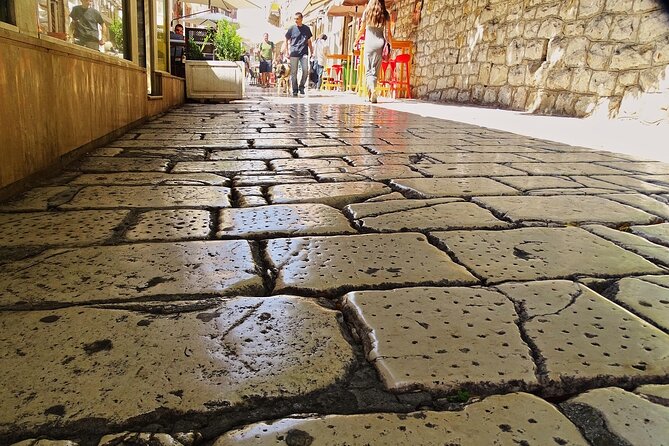
The tour includes a stop for the Grgur Ninski statue, and it notes that there are a few more stops along the way kept as a surprise. That approach can be fun if you like not having every single turn spoiled ahead of time.
The Grgur Ninski statue stop is valuable because it gives you another recognizable landmark tied to the palace district. These anchor points help you remember the route after the tour ends, especially since the experience finishes back at the start.
The “surprise” element also explains why this is a one-and-a-half-hour walk. The guide can keep the route fluid based on pace and crowd flow, rather than sticking to a rigid checklist where you lose the feeling of discovery.
One thing to consider: if you hate uncertainty, you might feel the “surprise” stops are not fully predictable. On the other hand, that unpredictability is often what keeps a short tour from feeling mechanical.
When the guide makes the difference: tips for hearing Ana
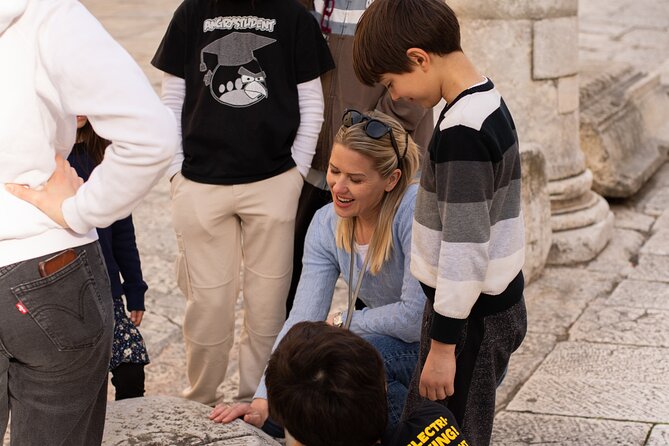
A professional guide is included, and one review singled out Ana as very nice. At the same time, that same review notes her voice can be difficult to understand because it is a bit soft.
Here is how to handle that without stress:
- Try to stand where you can hear clearly, not off to the side.
- Pay attention during transitions between stops, because that is when the explanations tend to matter most.
- If you wear sunglasses or have earphones, be extra mindful of volume and position. Soft voice plus open-air noise can make details harder to catch.
This tour’s value is heavily tied to interpretation, especially for the palace basement-to-Peristyle sequence. If you can follow the guide’s explanations, you will feel like the tour “clicks” in your head.
Timing and pacing: start at 1:30 pm and keep up
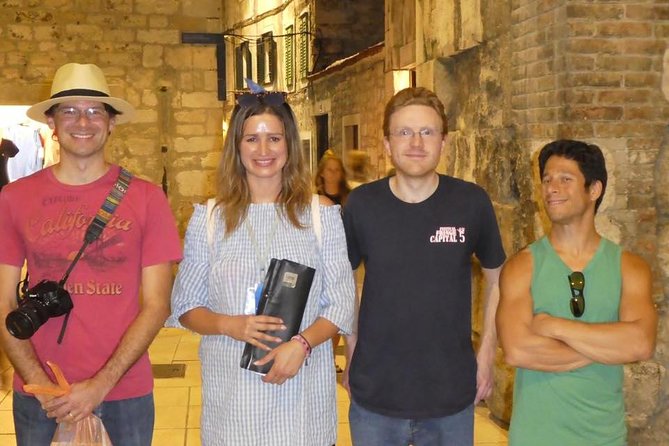
The scheduled start time is 1:30 pm, and the duration is about 1 hour 30 minutes. That means you will likely finish in the mid-to-late afternoon. For many people, that timing is convenient. You can do morning sightseeing at a relaxed pace, then join this tour as a focused orientation session.
The route includes multiple stops of roughly 15 to 20 minutes each. That is long enough to hear what matters and short enough to keep your legs from turning into noodles. Still, you are walking between areas, and Diocletian’s Palace is a stone maze. Comfortable shoes help a lot.
Also, consider your energy level. This tour is well-suited for visitors who want structure, but not for people who want to sit and linger for a long time at each spot.
Who should book this Split walking tour
This is a strong fit if you:
- Want a guided route through the main Diocletian’s Palace areas rather than doing it all on your own.
- Prefer a mix of outside space (park, waterfront) plus inside Roman architecture.
- Like small-group tours, since the limit is 15 people.
- Are visiting Split for a short stay and want a fast, readable overview.
It may not be ideal if you:
- Want a very long, exhaustive palace tour. This one is focused and built for an efficient loop.
- Need loud narration or struggle in noisy settings, because one note mentions a soft voice from the guide.
Should you book it?
Book it if you want the quickest way to understand Diocletian’s Palace without getting lost in the details. The route is smart, the stops are practical, and the big transitions like basements to Peristyle make the story easier to grasp.
Skip it or plan extra time if your top priority is seeing every corner of the palace complex. This walk is built to give you a tight hit of the best-known and most meaningful parts, then send you back with enough knowledge to explore on your own.
FAQ
How long is the Split walking tour?
The tour lasts about 1 hour 30 minutes.
How much does it cost?
It costs $28.00 per person.
Is the tour offered in English?
Yes, it is offered in English.
Do the listed stops require admission tickets?
No. The stops on the route are marked as admission ticket free.
Where does the tour start and end?
It starts at GC5R+RHF, Split, Croatia, and ends back at the meeting point.
What is the cancellation policy?
You can cancel for a full refund up to 24 hours before the experience starts. Cancellation is free, and cut-off times are based on local time.
Latest arrivals logged at Split



Walking Tours, compared.

Walking Tour of Split and Diocletian’s Palace
Read our review →
Krka Waterfalls tour with Trogir Walking tour and Krka panoramic boat cruise
Read our review →
City Walls Early Morning or Sunset Walking Tour
Read our review →Browse the lists this tour appears in