
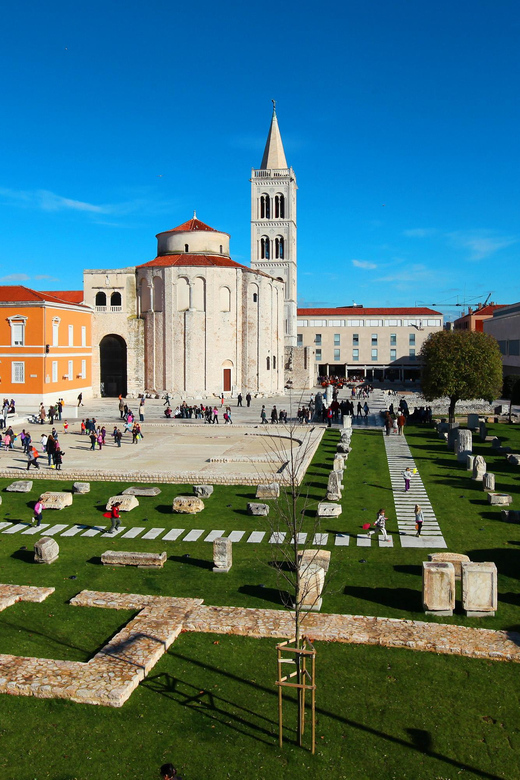
Reviewed · WALKING TOURS
Zadar City Tour 120min Walk
One solar panel and one sea keyboard, then Roman stone. This Zadar City Tour is built as a compact stroll through the places that shaped the city, from the famous waterfront installations to the Roman Forum and medieval churches. You meet an English guide at a clear city landmark and then follow a route designed for a smooth pace, usually with a group capped at 16.
I especially like the small group size, which makes it easier to ask questions and hear the guide without feeling lost in a crowd. I also love that the route mixes big-photo stops with real context, like what you are seeing at the Sea Organ and why the Forum and rotunda churches matter.
One drawback to consider: this is a walking tour, and it is not recommended for travelers with mobility issues. Also, there are no planned toilet breaks, so plan ahead if you need frequent stops.
In This Review
- Key things I’d circle before you go
- A 120-minute route that hits Zadar’s must-sees without rushing
- Finding your guide: umbrellas, Land Gate, and pickup minivans
- Stop 1, Greeting to the Sun: where the solar system meets the promenade
- Stop 2, Sea Organ: the coastline that plays music
- Stop 3, Cathedral of Saint Anastasia: biggest Romanesque in Dalmatia
- Stop 4, The Forum: Roman civic life in the middle of the peninsula
- Stop 5, Church of St. Donatus: a rotunda in the Roman Forum
- Stop 6, Benedictine Monastery of St. Maria: art and the convent chapter
- Stop 7, Sea Gate (Morska vrata): a classic fortified entrance
- Stop 8, Narodni trg: medieval square with loggia and guard presence
- Stop 9, Church of St. Simon: a saint’s body and a goldsmith’s sarcophagus
- Stop 10, Knezeva Palaca (Rector’s Palace): a recently restored prince’s palace
- Stop 11, Five Wells: Renaissance square with five well crowns
- Stop 12, Captain’s Tower: medieval walls and a crown top
- Stop 13, Perivoj kraljice Jelene Madijevke: one of Croatia’s early public parks
- Stop 14, Land City Gates (evening tour): the start point that frames the Old Town
- The optional tastings: maraschino and cheese without the hard sell
- Price value: what you get for around $32.67
- Who this tour fits best, and who might want a different plan
- Quick practical tips so your day runs smoother
- Should you book this Zadar City Tour?
Key things I’d circle before you go
- Clear meeting points with a visible guide, including a white ZADAR CITY TOUR umbrella for the 11 AM start
- Sea Organ and Greeting to the Sun, two modern waterfront landmarks tied to the sea and sunlight
- Roman Forum Peninsula sights, with remains of ancient Roman architecture along your walk
- Exterior-only stops at the cathedral and several churches, so you are mostly sightseeing from outside
- Optional maraschino and cheese tastings that are meant to be quick add-ons, not hard sells
- Pickup option for those who book it, using a black minivan with a white ZADAR CITY TOUR logo
A 120-minute route that hits Zadar’s must-sees without rushing
This tour is scheduled for about 2 hours, which is a sweet spot when you are in Zadar for a day and want a first-pass orientation. In that time, you cover the modern icons along the promenade, then shift into the Old Town core where you can read Zadar like a layer-cake of eras.
What makes it feel worthwhile is the structure. You are not just “see a building, take a photo, move on.” The route is organized so you understand what each place was for, whether it is Roman civic life or later church power.
The group limit of 16 matters here. With that size, the guide can keep track of people moving together and you are less likely to get stuck at the back.
Finding your guide: umbrellas, Land Gate, and pickup minivans
There are two starts, and getting this right saves stress.
For the 11:00 tour, the guide starts in English and you should look for someone holding a white ZADAR CITY TOUR umbrella, with blue license, standing by the solar system installation that represents the solar panel art. That umbrella is there for a reason, and it makes meeting up faster than chasing a vague description.
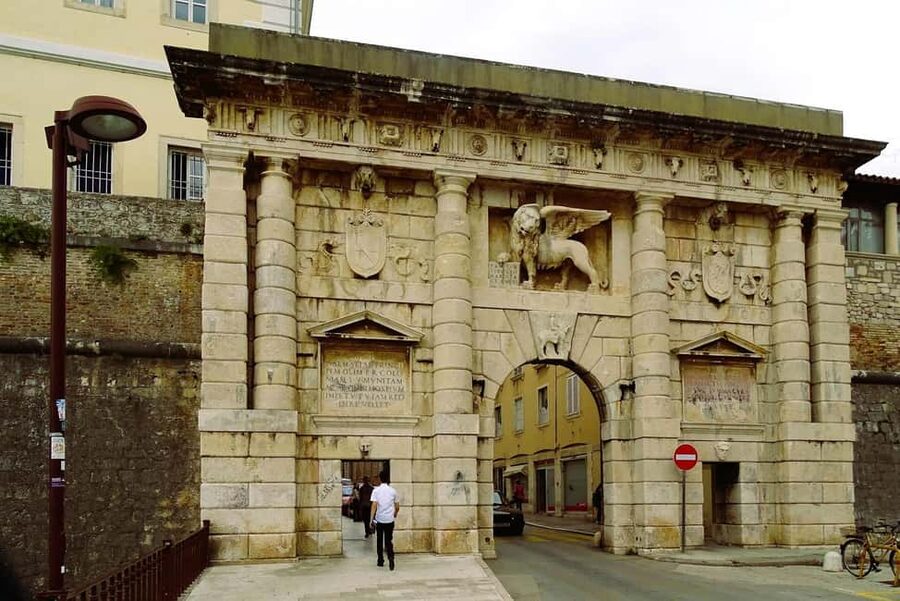
For the 18:30 tour, the walk begins in English from the huge Venice Republic Land Gate, with the guide waiting in front of the gates beside the bikes.
If you booked the option with pickup, your transport is a black minivan with white ZADAR CITY TOUR logo on the side. The driver has your name on paper and lets you into the vehicle, and drop-off happens right after the tour. Messaging about pickup time and place is handled through the booking platform or by email or WhatsApp.
If you are arriving by cruise ship, do not assume your port location. Zadar has two ports, and pickup may not be needed if your ship docks in the center near the meeting area.
More Walking Tours in Zadar
- Zadar Walking Tour sponsored by Gligora Cheese and deli★ 4.9 · 716 reviews
- NEW! Zadar Food Tasting & Old Town Guided Walking Tour by Šušur★ 5.0 · 123 reviews
- Zadar Walking Tour sponsored by Gligora Cheese and deli.★ 5.0 · 119 reviews
Stop 1, Greeting to the Sun: where the solar system meets the promenade
You start at the Greeting to the Sun installation, built to look like a solar system concept and tied to a solar panel on the floor. It is a fast, easy opener, and you are right to start here because it sets the mood for the waterfront theme of the rest of the walk.
This first stop is also a great “meet and settle” moment. It gives you a chance to confirm you are with the right guide, get oriented, and hear the basics before you begin moving deeper into Old Town.
Admission is free at this stop, and the tour starts at 11:00 in English with that visible guide setup. If you are doing the later departure time, you are more likely to coordinate your overall timing with when the installation is at its most impressive.
Stop 2, Sea Organ: the coastline that plays music

Next comes the Sea Organ, one of Zadar’s best-known installations. It is designed like a staircase shaped into a piano keyboard, and the sound comes from the movement of the sea. The idea is simple, but the result feels magical in person, especially when waves push air through the system beneath the walkway.
This is one of those stops where listening matters. I like that the tour keeps this as a dedicated segment instead of a quick photo break. You get a short window to understand how it works and then experience it directly while you are there.
Admission is free here too. In practical terms, this is a win for value because you are getting a major highlight without paying extra once the tour begins.
Stop 3, Cathedral of Saint Anastasia: biggest Romanesque in Dalmatia
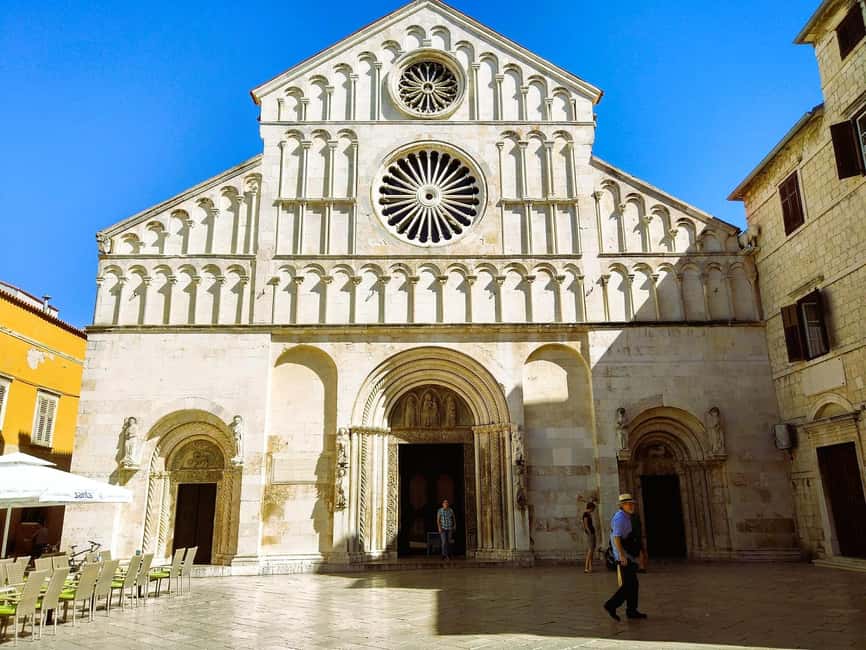
From the waterfront you head into Old Town, where the tour shifts into older stone. The Cathedral of Saint Anastasia is the largest Romanesque church in Dalmatia, and it is associated with the city patron, Anastasia.
Important detail: you do not enter. The tour is set up for viewing the church exterior and hearing what it represents, and there is no entrance ticket included for this stop.
Still, this is a meaningful moment. It helps you place Zadar’s medieval identity on the map after you have just seen modern installations. If you love architecture, seeing the scale from outside does a lot for your overall understanding.
More marble lanes taken slowly:
- Zadar: Food Tasting & Old Town Walking Tour
★ 5.0 · 94 reviews - Zadar: Virtual Reality Guided History Walking Tour
★ 4.4 · 86 reviews - Zadar: Private Walking Tour Through 3,000 Years of History
★ 4.7 · 71 reviews - Zadar City Tour 120min Walk
★ 5.0 · 45 reviews
Stop 4, The Forum: Roman civic life in the middle of the peninsula
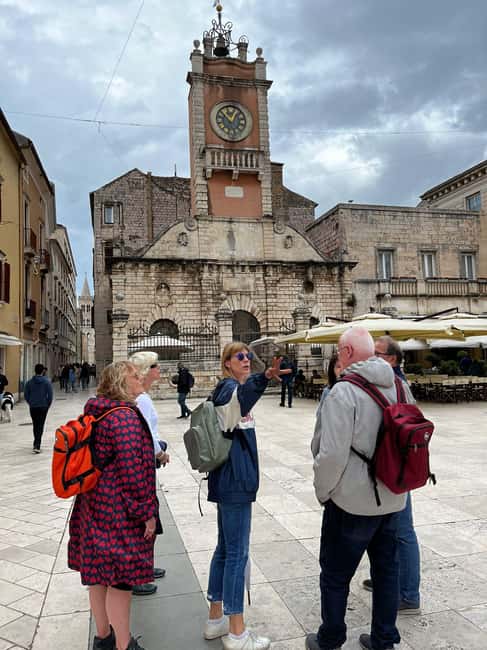
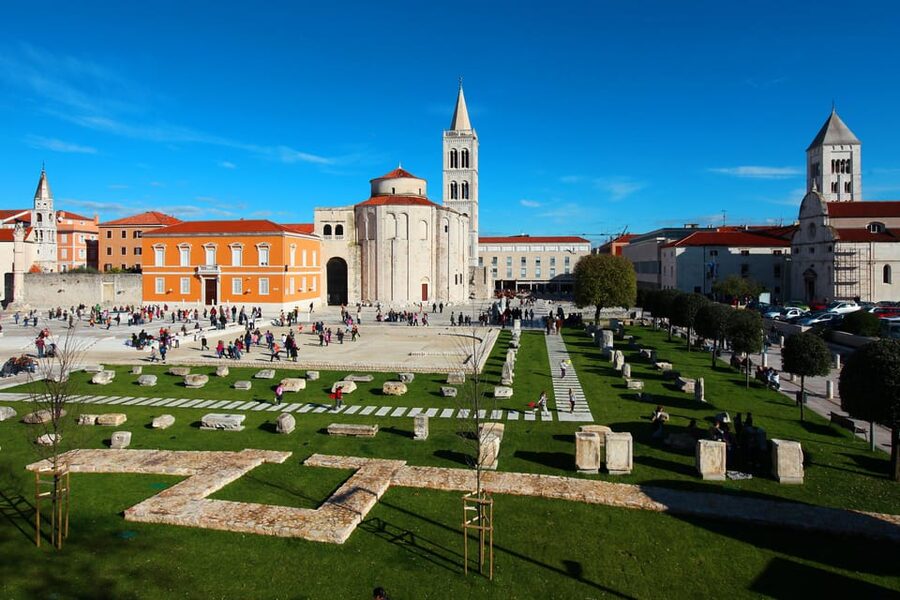
Then you move into the Forum area, a Roman forum dating to the 1st century BC. Even without going inside, this is the kind of stop that makes Zadar feel physically layered, because you are walking through a space where Roman civic and public life would have happened.
Admission is free, and this fits the tour style: lots of walking through outdoor landmarks that do not require extra tickets. The Forum is also one of the clearest ways to connect the history theme into something you can “see and stand in.”
The only caution is attention. This is a stop where it helps to slow your pace for a minute and really look around. The Roman remains are not all labeled like a museum, so your guide’s framing makes it easier.
Stop 5, Church of St. Donatus: a rotunda in the Roman Forum

St. Donatus is a 9th century church built in a pre-Romanesque style, shaped as a huge rotunda placed right in the Roman Forum space. It is a visually striking contrast: circular, imposing, and tied to the earlier Roman setting around it.
Again, the tour does not include entrance. You get the overview from outside, which is the right choice if your goal is to keep the two-hour flow without adding ticket lines.
This is one of those stops that gives you a quick visual summary of the city’s “then and now” story. After you see the Forum, St. Donatus reads like a bridge between Roman public space and later church influence.
Stop 6, Benedictine Monastery of St. Maria: art and the convent chapter
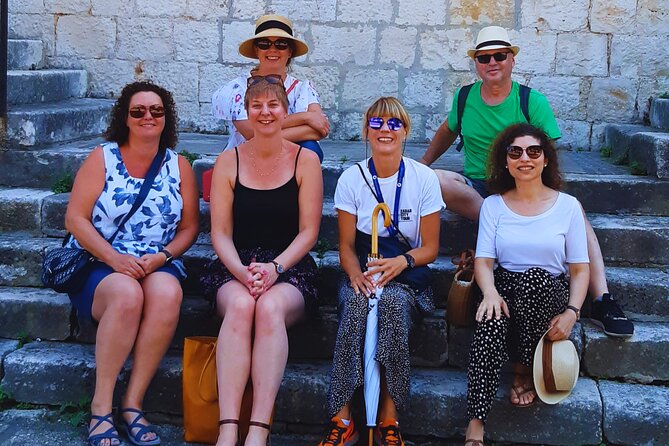
Next is the Benedictine Monastery of St. Maria, a convent linked to the 11th century, with a Renaissance church component. The monastery is described as having a permanent exposition of religious arts.
No entrance is included for this stop, so you are mostly there for orientation and context. Even so, it adds another layer to the tour because it shifts the focus from public Roman spaces to religious institutions that shaped daily life.
This stop is brief, so if you want to linger for photos, just do it quickly and follow your guide. The tour is paced to keep the whole Old Town loop feeling complete.
Stop 7, Sea Gate (Morska vrata): a classic fortified entrance
The Sea Gate, or Morska vrata, is a 16th century structure with Roman elements. It makes a lot of sense in the route, because after the Roman and early medieval stops, you are moving into an era when access points and defenses mattered.
Admission is free here, and the tour keeps it as a short photo and explanation stop. You are not meant to memorize dates, but you are meant to recognize how the city controlled movement between land and sea.
This is also a nice moment to rest your legs for a minute since the stop is shorter than some of the earlier architectural anchors.
Stop 8, Narodni trg: medieval square with loggia and guard presence
Narodni trg is a medieval square with a 16th century loggia and a city guard connection. It is the kind of space where Zadar’s public life shows up, not just its monuments.
Admission is free, and your guide likely ties it to how people gathered, traded, and moved through the city. Even if you do not do anything else in that square, stopping here helps you break up the longer monument sequence with a more “human scale” point.
If you like street-level travel, this is one of the stops that will feel more real than postcard-only landmarks.
Stop 9, Church of St. Simon: a saint’s body and a goldsmith’s sarcophagus
The Church of St. Simon is connected to a Renaissance church that houses the body of the saint inside a huge sarcophagus described as a goldsmith’s masterpiece. This stop is listed as no entrance, so you will not go inside.
Still, it is worth it as a historical anchor. The tour gives you the story and the reason it matters, and you get that context without adding ticket costs.
This is also a small reminder that the walking tour is designed for understanding. The route is not just hitting high-profile icons, it is also pointing you toward lesser-seen details that many visitors might miss.
Stop 10, Knezeva Palaca (Rector’s Palace): a recently restored prince’s palace
Next you see Knezeva Palaca, also referred to as Rector’s Palace Zadar. It is described as a recently restored prince’s palace, and the tour offers no entrance.
Even from outside, a restored building like this helps you feel the city’s continuity. Old Town Zadar is not frozen in time. It is a living place where layers get preserved and reused.
This stop is short, but it adds a civic and political dimension beyond churches and Roman ruins.
Stop 11, Five Wells: Renaissance square with five well crowns
Five Wells is a Renaissance square defined by five well crowns. It is one of those charming details that makes a walking tour better than a purely museum-based plan.
Admission is free, and the stop is quick, which is perfect here. You get a visual break after churches and gates, and the guide’s explanation helps you understand why the site is shaped the way it is.
If you enjoy architecture as “lived-in” design, you will probably like this one.
Stop 12, Captain’s Tower: medieval walls and a crown top
Captain’s Tower is tied to medieval crown walls, and it is another quick stop. Again, no entrance is included, but it works as a viewpoint-and-context moment.
Even if you do not climb anything, towers are visual landmarks. Your guide helps you connect it to how Zadar was organized and defended, and that makes the Old Town loop feel less random.
This is also a good spot to look around and take in the overall shape of the area, since you are surrounded by buildings that show different time periods.
Stop 13, Perivoj kraljice Jelene Madijevke: one of Croatia’s early public parks
Perivoj kraljice Jelene Madijevke is one of the first public parks in Croatia. It is a short stop that changes the tempo, giving you a breather from strict monument hopping.
Admission is free. It also makes the tour feel more balanced, because not every stop is a church or fortress.
If you want a moment of shade or a place to reset your focus before the final leg, this stop is useful.
Stop 14, Land City Gates (evening tour): the start point that frames the Old Town
For the 18:30 departure, the walk starts at the Land City Gates, described as a Venice Republic land gate built in the form of a triumphal arch. Your guide waits beside the bikes in front of the gates.
This start point is a good match for people who want to orient themselves at a bigger landmark before heading deeper into the Old Town. It also gives you a different approach direction than the 11:00 route that begins at the solar installation.
The optional tastings: maraschino and cheese without the hard sell
One of the nice extras is the possibility of a stop for maraschino liquor and cheese tastings on the way, or sometimes a free entrance to a medieval church. The wording here matters, because these are described as possible add-ons rather than guaranteed entries.
When tastings happen, the goal is a light local flavor moment during the walk. The tone is meant to be relaxed, not sales-driven, which is what you want on a short two-hour tour.
If you like food breaks but hate schedules that turn into shopping, this kind of add-on is usually a good compromise. Just remember it might not run in every departure.
Price value: what you get for around $32.67
At about $32.67 per person for roughly two hours, you are paying for two things: a planned route and an English guide who explains what you are looking at while you walk. A lot of the stops are free to view, including major highlights like the Sea Organ and Greeting to the Sun, which helps keep your total day cost under control.
You also get a maximum group size of 16, which is a practical value factor. Smaller groups usually mean better audio, easier pacing, and fewer people lost at each corner.
The “not included” pieces are also clear. Entrance fees are not part of the tour, and some church or monastery sites are exterior-only in this format. If you expect every stop to include an interior visit, you might feel limited. But for a two-hour orientation, the outside viewing approach still makes sense.
Who this tour fits best, and who might want a different plan
I think this tour is best for first-timers in Zadar who want a structured overview without over-planning. It is also a good fit if you like history told in walking segments, where modern waterfront and older Roman and medieval sites connect into one story.
It may not fit you if you need accessibility support, because it is not recommended for travelers with mobility issues. It is also not suitable for children, and animals are not allowed.
If you hate walking, it might feel like a lot, since the whole route is designed as a continuous stroll through Old Town.
Quick practical tips so your day runs smoother
Plan your meeting point carefully, especially if you are on a cruise. Confirm which Zadar port your ship uses before relying on pickup.
Wear comfortable shoes. The tour is short, but it still covers multiple stops and you will want stable footing, especially near waterfront areas.
If you have dietary interests, ask when tastings are scheduled, since they are described as possible add-ons. And since toilet breaks are not included, make sure you handle that before the tour begins.
Should you book this Zadar City Tour?
Book it if you want a tight, high-impact Old Town walk that pairs modern icons with Roman and medieval context in about two hours. The combination of a small group, clear English guiding, and standout waterfront stops like Sea Organ and Greeting to the Sun is what makes it a strong value.
Skip it or switch to something else if you need lots of indoor entrances, frequent breaks, or better accessibility support. With this format, you are trading interior tickets for a smart route and fewer moving parts.
If your schedule is flexible, pick the start time that best matches your goals, 11:00 for an easy start near the solar installation, or 18:30 if you want the evening energy around the Land City Gates and the waterfront.
Latest arrivals logged at Zadar



Walking Tours, compared.

Walking Tour of Split and Diocletian’s Palace
Read our review →
Krka Waterfalls tour with Trogir Walking tour and Krka panoramic boat cruise
Read our review →
City Walls Early Morning or Sunset Walking Tour
Read our review →Browse the lists this tour appears in