
Reviewed · ZAGREB TOURS & ACTIVITIES
Zagreb in a day including cable car to Medvednica Nature park
Zagreb in one day hits the right notes. You get a private tour with live guide commentary, so the city feels organized instead of chaotic, from Zrinjevac to the Upper Town. One heads-up: it is a full day with lots of short stops, so comfy shoes and a flexible pace matter.
What I really like is the built-in nature break. The Sljeme cable car takes you up to Medvednica for proper forest-and-mountain air, and you are not stuck only in museums or streets.
Starting from Zrinjevac (or with pickup if offered), this tour is designed to move efficiently. The big value is you get transportation for the driving parts, then walk for the sights that benefit from close-up looking and real explanations.
In This Review
- Key things I’d circle before you book
- Price and value: what your money buys
- Starting in Zrinjevac, the Green Horseshoe intro
- Ban Jelačić Square: Zagreb’s meeting point and public life
- Kaptol and Zagreb Cathedral: Gothic skyline, earthquake scars
- Dolac Market: what Zagreb eats, and how locals shop
- St Francis of Assisi Church: quiet contrast to the cathedral
- Tkalčićeva Street and Krvavi Most: history tucked into everyday streets
- Grič Tunnel and the funicular: turning points under your feet
- Lotrščak Tower and the noon cannon ritual
- Gradec Upper Town: cobblestones, power, and the view test
- St Mark’s Square: church roof tiles you will remember
- Kamenita Vrata (Stone Gate): a medieval gate with a candle habit
- Radićeva Street, HNK Theatre, and the art-forward squares
- Zagreb railway hub and the Green Horseshoe idea in practice
- New Zagreb: Mamutica and what socialist-era scale looks like
- Mirogoj Cemetery: art in arcades and domes
- Sljeme Cable Car and Medvednica: the payoff part of the day
- Practical tips so the day feels easy
- Should you book this Zagreb day tour with Medvednica cable car?
- FAQ
- How long is the Zagreb day tour with the Medvednica cable car?
- Is this tour private?
- What language is the tour guide?
- What transportation and attractions are included?
- Are tickets to the stops included?
- Is food and drinks included?
- What is the cancellation policy if I need to change plans?
Key things I’d circle before you book
- Private guide attention: your group gets full focus and the chance to tailor the pace
- City plus mountain in one day: cable car up to Medvednica, not just urban highlights
- Funicular included: a short historic ride that also drops you into the Upper Town mood
- Major landmarks, short time: cathedral, markets, the medieval gate, and political squares
- Real local context: why places are named what they are, like Bloody Bridge
- Guide names you might get: past guides include Bernarda and Aleksandar
Price and value: what your money buys
At $300.35 per person for a 6 to 8 hour private experience, the price only starts making sense when you look at the package. You are paying for more than walking around a city center. You are getting a guide with live commentary, plus an air-conditioned vehicle and private transportation for the parts that would otherwise eat up your day.
You also get the big ticket nature add-on: the cable car to Medvednica is included, and the tour also includes the historic funicular ride in Zagreb. Many other stops are free, so your day is about seeing and learning rather than stacking paid attractions.
Food and drinks are not included, which is normal for this kind of day. I suggest budgeting for at least one snack stop or meal on your own, especially since places like Dolac Market are made for tasting, not just photographing.
Starting in Zrinjevac, the Green Horseshoe intro
Most days start at Zrinjevac, officially Nikola Šubić Zrinski Square. It is one of Zagreb’s prettiest green pauses right in the city core, part of the Green Horseshoe idea that connects parks and squares into an easy-to-follow route.
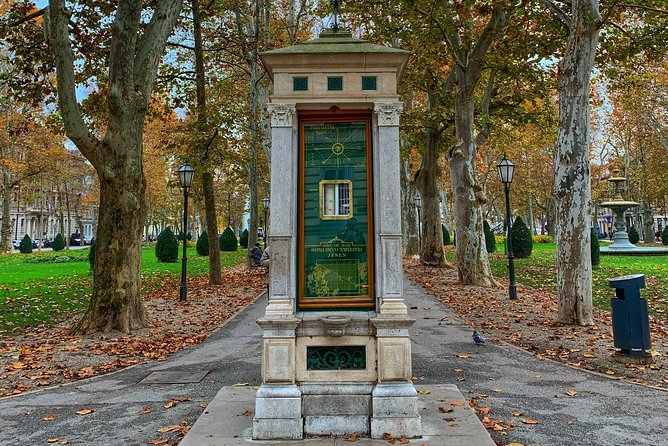
I like starting here because it sets the tone. You get plane trees, flowerbeds, classical sculptures, and space to reset your brain before the Upper Town climb and the historical stops. There is also that unusual 19th-century meteorological post from 1884, a cast-iron column that once provided weather data using instruments for temperature, pressure, and humidity.
If you are the type who enjoys small details, this is the kind of stop that makes the rest of the city feel more personal. Time is short, though, so treat it as a warm-up, not a long hangout.
Still riding at anchor off Zagreb
- From Zagreb: Plitvice & Rastoke Guided Day Trip with Ticket★ 4.9 · 2,955 reviews
- Zagreb: Rastoke & Plitvice Lakes Guided Tour with Ticket★ 4.9 · 1,897 reviews
- Communism & Croatian Homeland War Tour★ 5.0 · 1,355 reviews
Ban Jelačić Square: Zagreb’s meeting point and public life
From the park, you roll straight into Ban Josip Jelačić Square, the main crossroads between Zagreb’s Upper and Lower Towns. It is easy to understand why this is the city’s heartbeat. Trams, crowds, people watching, cafés, and historic buildings all feed into the same spot.
You cannot miss the equestrian statue of Ban Josip Jelačić. The sculptor is Anton Dominik Fernkorn (1866), and the statue’s history includes removal during the Yugoslav era and a return in 1990. Your guide’s live commentary is especially useful here because the square is just as much about symbolism as sightseeing.
This stop is mostly about orientation. You see the city’s main stage, then you start walking into the layers behind it.
Kaptol and Zagreb Cathedral: Gothic skyline, earthquake scars
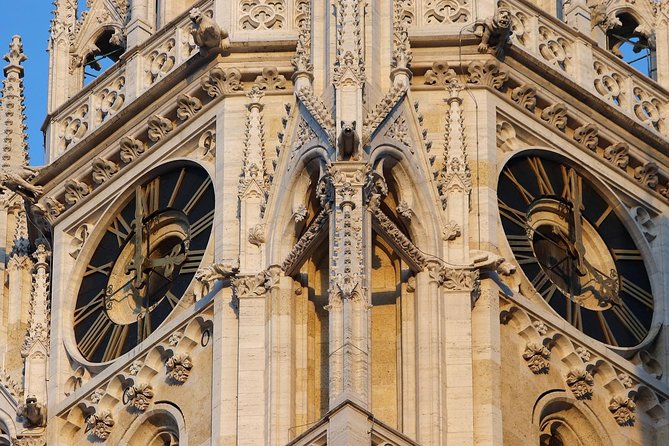
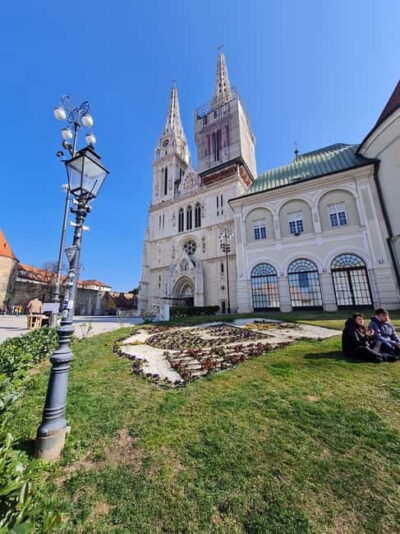
Next comes Kaptol, and with it, Zagreb’s cathedral. The Cathedral of the Assumption of the Blessed Virgin Mary is Gothic and topped by twin spires that dominate the skyline. It is also the tallest building in Croatia, which is exactly the kind of fact you will actually remember because you see it instantly.
The story matters too. The cathedral dates back to the 13th century, but it has faced major reconstructions, especially after the earthquake of 1880. That mix of age and repair gives the building a lived-in feel, not just a postcard look.
If your group is into architecture, you will appreciate how your guide ties the cathedral to the medieval religious core of the city, when clergy and bishops were based here. The cathedral interior can be impressive, but keep in mind you will likely have a short window, so prioritize the views first, then decide how long you want inside.
Dolac Market: what Zagreb eats, and how locals shop
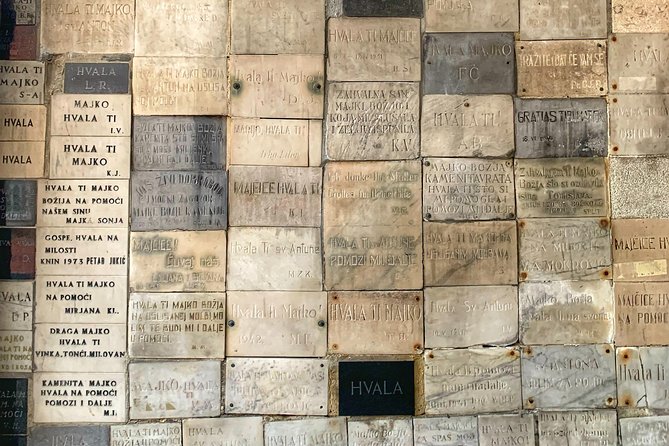
Dolac Market is the quick hit I always recommend in Zagreb, because it shows daily life in a way monuments cannot. It is often called the belly of Zagreb, and it sits just a short walk from Ban Jelačić Square.
You’ll see the famous red umbrellas, plus two market levels: open-air stalls for produce and flowers, and a covered area below for butchers, fishmongers, and cheese sellers. The most useful part is knowing what you are looking at, seasonal items, and the connection to nearby villages where produce is sourced.
Even if you do not want to buy anything, you can taste with your eyes. And if you do snack, this is the place to do it since it is part of the local rhythm. Just remember food and drinks are on you, not included.
Two moorings down in Zagreb:
- Zagreb: City and WWII Tunnels Walking Tour
★ 4.9 · 1,230 reviews - Zagreb: City & History Walking Tour & WW2 Tunnels
★ 4.9 · 1,202 reviews - Plitvice Lakes with Ticket & Rastoke Guided Tour from Zagreb
★ 5.0 · 966 reviews - Zagreb: Communism and Croatian Homeland War Tour
★ 4.9 · 927 reviews
St Francis of Assisi Church: quiet contrast to the cathedral
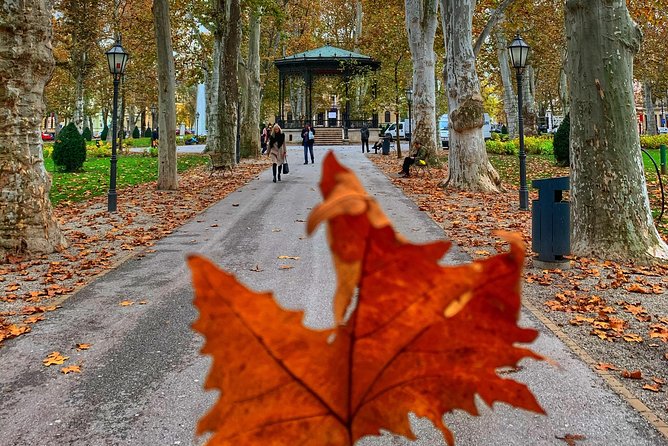
In the Opatovina neighborhood, you stop at the Church of Saint Francis of Assisi. It is modest compared to the cathedral, which makes it a nice reset when your day has already stacked up major architecture.
This church dates back to the 13th century and sits within a Franciscan monastery complex. It shows Gothic and Baroque influences due to later reconstructions and renovations, again linked to damage from the 1880 earthquake.
I like this stop because it is calmer. You get a different side of Zagreb’s religious architecture without repeating the same big-spired scene. Also, it is a good time to step back from crowds and get a few minutes of perspective.
Tkalčićeva Street and Krvavi Most: history tucked into everyday streets
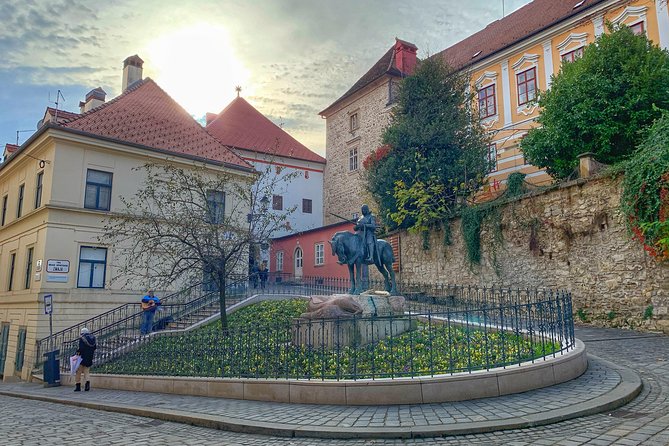
Then you move to Tkalčićeva Street, one of Zagreb’s pedestrian favorites. It runs between Kaptol and Gradec and has an easygoing energy that works well for coffee, casual strolling, and just watching people move.
The street used to be a stream called Medveščak, and it also served as a border between rival medieval towns, Kaptol and Gradec. Your guide’s explanations help you see the street as a historical line, not only a nice place to wander.
A few steps away is Krvavi Most, meaning Bloody Bridge. The name sounds dramatic because medieval clashes happened here between those rival towns, separated by a stream. There is no bridge there today, but the story survives in the name.
This is one of those moments where Zagreb’s past feels close. It also helps you understand why the city layout makes sense once you know the old divisions.
Grič Tunnel and the funicular: turning points under your feet
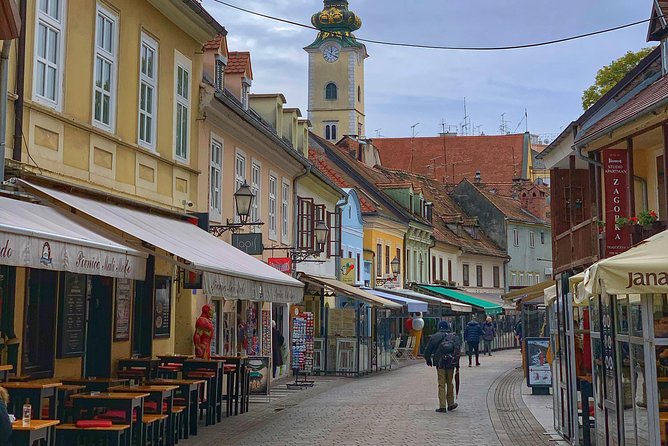
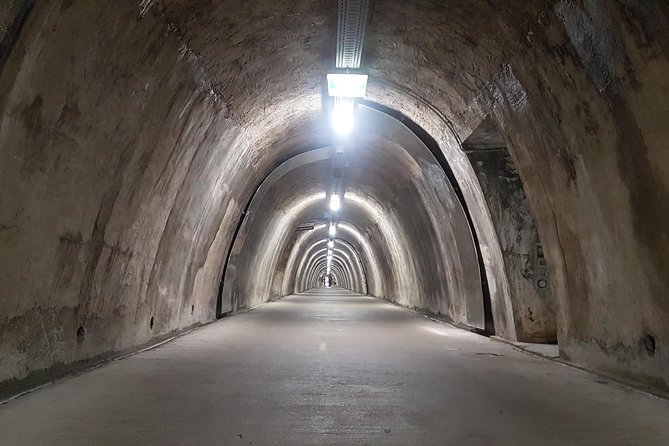
Grič Tunnel is a different kind of stop, cool in temperature and heavy in context. Built during World War II in 1943, it began as a bomb shelter and safe passage for civilians during air raids. It is about 350 meters long and has multiple entrances.
After the war, it faded from everyday use and later returned in a new role. Today it functions as a pedestrian passage and hosts cultural events, exhibitions, and art installations. Even if you only walk through briefly, it is a striking reminder that this city has been shaped by real history, not just eras of architecture.
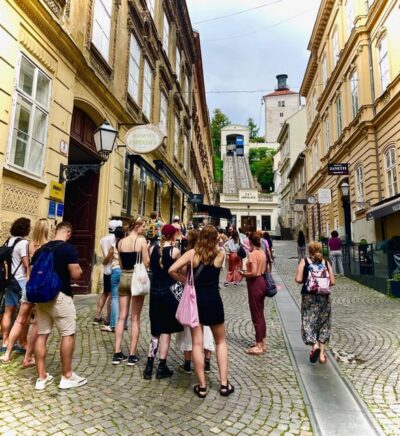
Right after, you ride the Zagreb funicular, Zagrebačka uspinjača. It runs since 1890 and covers a short track of 66 meters, about a minute in motion. I love that it is short, practical, and historic at the same time, with vintage carriages and views back down toward Ilica Street and toward Lotrščak Tower.
The funicular is not just transport. It is a mood shift into the Upper Town.
Lotrščak Tower and the noon cannon ritual
From the funicular, you reach Lotrščak Tower, a medieval fortress built in the 13th century to help protect the southern gate of the old town walls. The name relates to lotr, meaning thief, which hints at its defensive purpose.
Today, its biggest claim to fame is the Grič cannon. It fires every day at precisely noon, a tradition that started in 1877 as a time signal. When the boom happens, it carries through the city in a very Zagreb way: part ritual, part everyday theater.
Your tour stop notes that admission for the tower is not included, so you should think of this as a look-and-learn moment. If timing lines up with noon, you may catch the sound. If not, your guide’s explanation is still worth it because you understand why locals care about the cannon.
Gradec Upper Town: cobblestones, power, and the view test
Now you are in Gornji Grad, also known as Gradec, the fortified heart of the city. Gradec began as a medieval settlement and later merged with Kaptol in 1850 to form modern Zagreb. You feel that older shape in the narrow cobblestone lanes and the mix of baroque buildings.
This is also where you get important city power points. The Croatian Parliament (Sabor) and Banski Dvori (the seat of government and the prime minister’s official residence) sit here, so you are literally standing in the political center of Croatia while still surrounded by medieval streets.
The tour also includes time around St Mark’s Square and nearby civic buildings. If you are short on time, this is the right area to focus on because it concentrates landmarks, stories, and symbolism in a walkable radius.
St Mark’s Square: church roof tiles you will remember
St Mark’s Square is the historical and political center, and it is most famous for St Mark’s Church. The 13th-century church has a roof covered in colorful tiled patterns that show Croatia’s coats of arms, including Croatia, Dalmatia, Slavonia, and Zagreb, plus the opposing side ties to Zagreb specifically.
This is one of those sights where you might not expect a roof to matter, then you look up and it does. Your guide helps by explaining the symbolism so it becomes more than pretty color.
St Mark’s Square also connects directly to state life, with the Sabor and Banski Dvori nearby. If you like the way architecture can signal authority and identity, you will enjoy how the square functions as both sacred space and government space.
Kamenita Vrata (Stone Gate): a medieval gate with a candle habit
Stone Gate, Kamenita Vrata, is one of Zagreb’s most revered landmarks because it is the last remaining original city gate from medieval fortifications. Dating from the 13th century, it has a chapel-like interior where a painting of the Virgin Mary with Child is housed.
The story is part devotion, part survival. The painting is believed to have miraculous powers and survived a devastating fire in 1731 that destroyed much of the surrounding wooden structure. The miracle story shaped the gate’s status, and a small chapel was built within the archway.
Today, locals and visitors stop to light candles and leave votive offerings. This is spiritual tourism without being loud about it. It is also a great contrast after the political symbolism of St Mark’s Square because both are about identity, just in different emotional keys.
Radićeva Street, HNK Theatre, and the art-forward squares
After the medieval center, you sweep through streets that connect Gradec back toward the city’s cultural institutions.
Radićeva Street is a nice walking connector, known for cobblestones and a blend of medieval and 19th-century architecture. It is also full of shops and little courtyards, the kind of places you would miss if you only hurried between big monuments.
Then you reach the Croatian National Theatre, HNK, at Trg Republike Hrvatske. This neo-baroque building opened in 1895, commissioned as part of the period when Emperor Franz Joseph I played a role in the region’s public life. The architects were Viennese Hermann Helmer and Ferdinand Fellner, and the yellow façade is hard to ignore.
In the same square area, you might also see The Well of Life by Ivan Meštrović. A bit later, you can stop at the Art Pavilion, Umjetnički paviljon u Zagrebu, a purpose-built exhibition space from 1898. It was originally constructed for the Millennial Exhibition in Budapest and then reassembled in Zagreb, so you get a nice note of how regional culture traveled.
These cultural stops work well because your guide can explain why Zagreb invested in the arts and how that fits into the city identity.
Zagreb railway hub and the Green Horseshoe idea in practice
One more practical-feeling landmark is the Main Railway Station, Glavni kolodvor. Opened in 1892 and designed by Ferenc Pfaff, it mixes neoclassical and historicist styles, with a grand façade that signals a major European rail node.
Your tour stop ties the station into the Green Horseshoe of linked parks and squares, which makes the city feel planned, not random. Inside, it keeps historic character while still functioning as a modern transport hub.
Even if you never take a train there, it helps you see Zagreb as a city with real regional connections, not only local sights.
New Zagreb: Mamutica and what socialist-era scale looks like
Not all of Zagreb is medieval and baroque. You may also see Mamutica, a massive residential complex in New Zagreb built in the 1970s. It is known as the largest building in Croatia, more than 240 meters long with over 1,100 apartments.
It is Brutalist in style, with raw concrete and a size that feels almost industrial. The name, meaning Mammoth, tells you how this works psychologically, you see the scale first, then you start noticing the details.
This is a useful stop if you want a fuller picture of Zagreb. It shows the city did not only grow through old-world monuments. It also changed through large housing projects and community life in the socialist era.
Mirogoj Cemetery: art in arcades and domes
Another stop that surprises first-time visitors is Mirogoj Cemetery. Established in 1876 and designed by Hermann Bollé, it is known for ivy-clad arcades and grand domes.
It is both a cemetery and a calm park, and it is often described as one of the most beautiful cemeteries in Europe, but the bigger takeaway for you is inclusivity. The cemetery welcomes people of all faiths, and that makes the place feel more like a statement about Zagreb’s identity than a private memorial space.
You can also look for sculptures and headstones for notable Croatian figures. This stop gives you a slower rhythm, which balances the earlier city-walking intensity.
Sljeme Cable Car and Medvednica: the payoff part of the day
Now comes the big vertical move: the Sljeme Cable Car, Žičara Sljeme. It was reopened in 2022 after renovations, and you ride up in about 20 minutes. The cabins are designed for comfort, which matters because the views become part of the attraction itself.
At the top of Medvednica, the air feels different fast. Medvednica is a protected nature park north of Zagreb, stretching over 42 kilometers, with dense forests, trails, and wildlife. It is year-round, so in different seasons you might hike, mountain bike, or go skiing.
Sljeme, the highest peak in Medvednica at 1,033 meters, is the main highlight. The ski slopes are a big deal because the Sljeme Ski Resort has hosted FIS World Cup skiing events. If you are here in winter, your route will likely connect you to ski-side activities or lodges. If you are here in warmer months, you can focus on hiking trails and scenic time outdoors.
Your tour also notes there are attractions like the medieval Medvedgrad fortress and educational paths. And when you want to sit down, there are mountain lodges where you can try traditional Croatian dishes, which is about as satisfying as day-trip food gets.
Practical tips so the day feels easy
This is a 6 to 8 hour day, and you will walk in the city and then spend time up on Medvednica. Moderate physical fitness is mentioned, so if you have knee issues or you know steep cobblestones stress you out, plan a slower pace and ask your guide to tailor the speed.
Weather matters. The tour operates in all weather conditions, but it also advises dressing appropriately. If fog rolls into Medvednica, your views can be reduced, so pack layers and keep expectations flexible for the summit scenery.
Bring a small day bag, water if you like it, and some cash or card for food, because meals and drinks are not included. If you want the best photos, use the short stops for pictures of scale, and save detailed shots for moments where you can step away from traffic.
Should you book this Zagreb day tour with Medvednica cable car?
I think you should book if you want a single-day plan that mixes city history and an actual mountain reset. The private format matters because your guide can explain names and symbols, not just recite facts. Past guides, including Bernarda and Aleksandar, are known for tailoring the pacing to the group’s interests and time limits, and for adding practical tips along the way.
It might not be your best pick if you hate walking and prefer long museum-style sessions. The stop times are short, and the day is structured to fit in many different areas of Zagreb plus the cable car.
If you are flexible about weather and you want efficiency without feeling like a bus tour, this is one of the more logical ways to do Zagreb in a limited time window.
FAQ
How long is the Zagreb day tour with the Medvednica cable car?
It runs about 6 to 8 hours.
Is this tour private?
Yes. It is a private tour, and only your group participates.
What language is the tour guide?
The tour is offered in English.
What transportation and attractions are included?
The experience includes an air-conditioned vehicle and private transportation for the driving parts, plus the cable car to Medvednica. The Zagreb funicular ride is also included.
Are tickets to the stops included?
Many stops have free admission, and the cable car to Medvednica is included. The Lotrščak Tower admission is not included.
Is food and drinks included?
No. Food and drinks are not included.
What is the cancellation policy if I need to change plans?
It is non-refundable and cannot be changed. If the experience is canceled due to poor weather, you will be offered a different date or a full refund.
Latest arrivals logged at Zagreb

Zagreb Tours & Activities, compared.
Plitvice & Rastoke Guided Day Trip with Ticket
Read our review →
Rastoke & Plitvice Lakes Guided Tour with Ticket
Read our review →
Plitvice Lakes with Ticket & Rastoke Guided Tour from Zagreb
Read our review →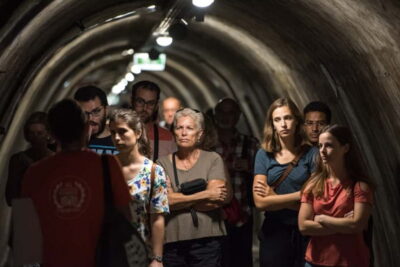
Skip-the-Ticket-Line Museum of Broken Relationships
Read our review →Browse the lists this tour appears in