
Reviewed · HISTORICAL TOURS
Private History tour – small group
Split can feel like a maze, until it doesn’t. This private History walk keeps the focus on what you’re seeing, from Roman gates to the waterfront. What I like most is the small group feel and the way the guide explains big ideas in plain, on-the-street language.
Two highlights I really value: you get a guided look at the Diocletian’s Palace spaces that most visitors skim, and you also finish with classic Split landmarks like Pjaca and Grgur Ninski that make the whole story click. One possible drawback is that it is weather-dependent, and part of it is outside, so plan for sun or rain.
Because it is private and short, it’s the kind of tour that helps you get your bearings fast. Your guide for this experience is Ivan Fistanić, and he brings a Master’s Degree in History approach to the details, with plenty of room for questions.
In This Review
- Key things that make this tour worth your time
- A private Split walking tour that actually stays short
- Starting at the Golden Gate, the palace’s main Roman doorway
- Peristyle of Diocletian’s Palace, where the imperial square comes alive
- Cathedral of Saint Domnius, Roman structure that still serves today
- Temple of Jupiter, late Roman structure and the baptismal conversion
- Vestibulum and the palace’s private-chamber feel
- Riva Harbor, where the modern promenade meets palace walls
- Fruit’s Square (Trg Brace Radic), a picturesque break outside the palace
- Pjaca, the old Town Hall square and the city’s medieval pulse
- Grgur Ninski statue, the landmark story you’ll remember
- Price and value, what you get for $238.28 per group
- Timing, logistics, and how to plan your day
- Who this tour suits best
- Should you book? My take
- FAQ
- How long is the Private History tour in Split?
- What is the price of the tour?
- How many people are in the group?
- Where does the tour start?
- Is this tour suitable for most travelers?
- Are tickets included for all stops?
- Will I get a mobile ticket?
- What kind of weather does the tour require?
Key things that make this tour worth your time
- Master’s Degree history guide: you’re not just hearing facts, you’re getting context you can picture.
- Diocletian’s Palace on foot: Golden Gate, Peristyle, private-chamber vestibule, and more, all in a tight route.
- Converted Roman to Christian stories: you’ll connect how buildings changed as Split’s faith and power changed.
- You see the waterfront and squares last: Riva, Fruit Square, and Pjaca help you understand the city beyond the palace walls.
- Easy good-luck moment: Grgur Ninski’s statue is a fun stop, and yes, there is a toe-rub tradition.
- Mobile ticket: practical and simple for day-of arrival.
A private Split walking tour that actually stays short
This is a private History tour in Split designed to fit into about 1 hour 30 minutes to 2 hours. The group size is kept small, up to 10 people per group, which matters in a place like Split where crowds can make good explanations harder to hear.
The route is a smart mix of Roman power and everyday city life. You start near the palace, then you gradually work your way outward to the waterfront and town squares. That structure helps you understand how Diocletian’s Palace was not some separate world, but the anchor that shaped how Split grew around it.
The tour also uses a central meeting point at Ul. kralja Tomislava 15, 21000 Split. Ending back at the same spot keeps things easy at the end of your walk, especially if you want to grab lunch right away.
When tours are this short, the biggest risk is feeling rushed. Here, the stops are timed to keep the walk moving while still giving you time to look closely and ask questions if you want.
Starting at the Golden Gate, the palace’s main Roman doorway
Stop 1 is the Golden Gate, the main entrance to Diocletian’s Palace and one of the four main Roman gates. It’s described as being on the road to the north toward Salona, the capital of the Roman province of Dalmatia and the birthplace of Diocletian.
What I like about starting here is that you get orientation. Before you step deeper into the palace spaces, you learn how this entrance relates to the wider Roman world. Split can be confusing at first, because the palace walls and corridors do their own thing. Starting with the gate gives your eyes a reference point.
This stop is quick, about 15 minutes, and it’s marked as free for admission. You’re outside, so it is a good place to settle your timing, take a few photos, and get your bearings before you move on.
If you are someone who loves maps, this is where you’ll feel the value. Even without opening a map, the gate location story gives you a mental picture of direction and importance.
More Venetian stones and Roman streets:
- Walking Tour of Split with a ‘Magister’ of History★ 5.0 · 1,122 reviews
- Split Walking Tour with Professor of History★ 5.0 · 926 reviews
- Split History and Gastro Small-Group Tour with Food and Drinks★ 5.0 · 375 reviews
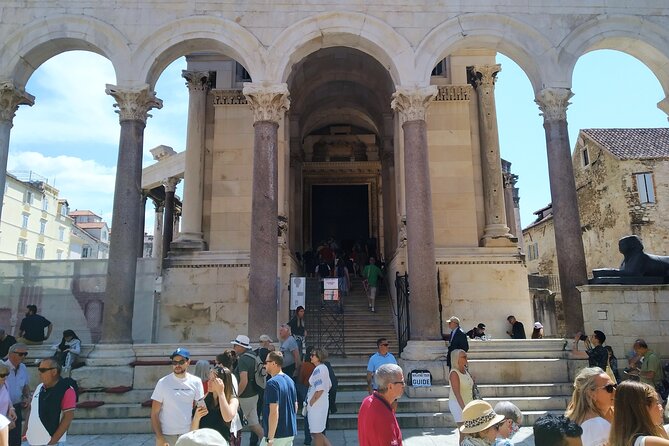
Peristyle of Diocletian’s Palace, where the imperial square comes alive
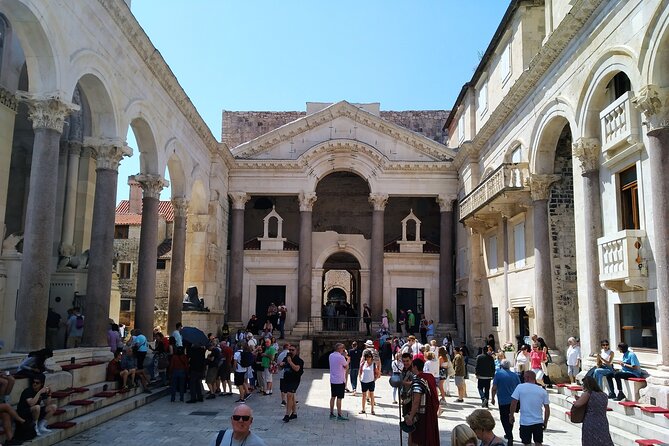
Stop 2 takes you from the main area toward the palace’s center, including a look connected with the palace’s cellars and how they were used over time. Then you reach the Peristyle, the open space of the imperial square.
This is one of those places where architecture does the talking. The Peristyle is framed by monumental arcades and oriented toward the imperial loggia. In plain terms, it’s dramatic, symmetrical, and made for power to feel obvious.
The tour guide explains how the building’s use evolved, including transitions tied to the growth of Christianity. That part matters, because you are not just looking at ancient stone. You’re learning why certain changes happened, and how the meaning of the space shifted as the centuries passed.
This stop is also about 15 minutes and listed as free. It is a great spot to stop and slow down, because you can scan the square and imagine it during different eras, not just the version you see today.
Practical tip: if you’re the type who likes to take photos from the same angles every time, you’ll be grateful for this stop’s openness. The Peristyle gives you multiple viewpoints without needing to squeeze through narrow lanes.
Cathedral of Saint Domnius, Roman structure that still serves today
Stop 3 is the Cathedral of St. Domnius. From the Peristyle you cannot miss it, and your guide points out significant parts and tells the story behind what you see.
The key detail here: you will not enter inside. Instead, you get the essentials from the outside, with an explanation of why it matters. The tour highlights it as one of the best preserved Roman structures in the city, and it’s still in use today.
This works well for a short tour. You get the identity and importance without losing time to ticket lines or long interior viewing. Also, you’re already in the right visual neighborhood, so the explanation clicks naturally.
This stop is about 10 minutes. Admission is listed as not included. So if you hope for an inside visit, plan for that separately, or treat this stop as the guided “what to notice” version.
If you like your tours with clear takeaways, this is one of the best places for it. You’ll know what to look for later even after your walking shoes start complaining.
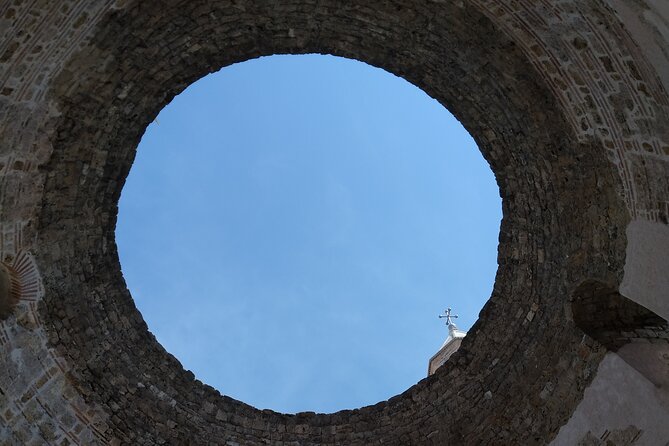
Temple of Jupiter, late Roman structure and the baptismal conversion
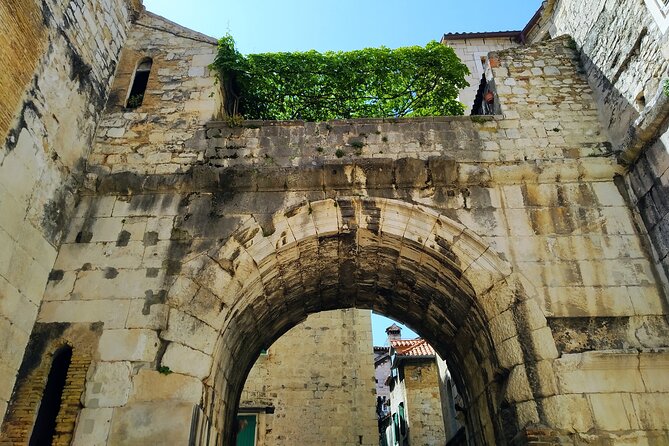
Stop 4 is the Temple of Jupiter, described as one of the best preserved late Roman temples in the world. The location is explained as a way to show the divine link between Diocletian and Jupiter, with Jupiter tied to the sky and thunder and positioned as king of the gods.
Then the story turns. During the Middle Ages, the temple was converted into a baptistery dedicated to St. John the Baptist.
This is a great stop for anyone who likes the “how did things change” angle. You can stand there and connect multiple eras: imperial messaging, then later Christian reuse. It helps you read the architecture like a timeline.
This stop is about 10 minutes and admission is listed as not included. Again, it’s a view-and-interpret stop. You’re learning what the building used to mean, and what it became, without being locked into an extra ticket-based visit.
If you only have a little time in Split, this kind of stop is a smart use of it. You get major historical shifts in a small package.
Still riding at anchor off Split
- Split: Krka Waterfalls Trip with Boat Cruise and Swimming
★ 4.8 · 10,519 reviews - From Split: Krka Waterfalls, Food & Wine Tasting Tour
★ 5.0 · 9,326 reviews - Blue cave, Mamma Mia and Hvar, 5 islands speedboat tour
★ 5.0 · 7,150 reviews - From Split: Krka Waterfalls, Food & Wine Tasting Tour
★ 4.9 · 6,598 reviews
Vestibulum and the palace’s private-chamber feel
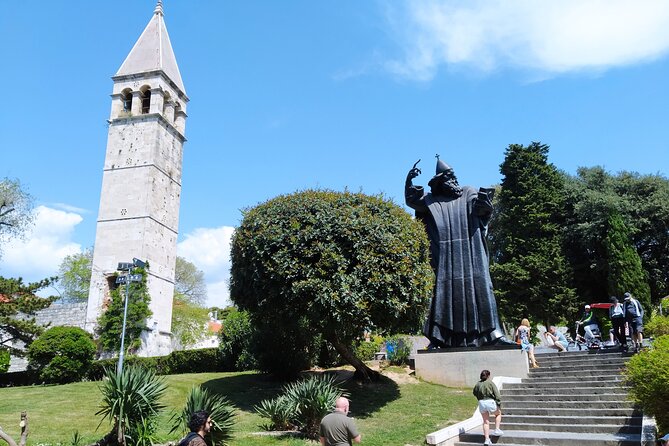
Stop 5 is the Vestibulum of Diocletian’s Palace, described as the pre-entrance to the private chambers. It’s presented as being decorated according to its importance, and you’ll learn what it looked like and what its function was.
From there, the tour includes a check on the Triclinium. Even if you don’t have a scholar’s vocabulary, it’s easy to understand this as space built for elite daily life, meals, and power.
This stop is about 10 minutes and listed as free. For me, it’s one of the most interesting parts of the palace experience because it adds a human scale. These aren’t only ceremonial public spaces. The explanation ties the palace to how people lived inside the system.
One consideration: if you’re expecting a lot of interior roaming, don’t. This is a guided walk with specific stops. The payoff is focus, not wandering.
Riva Harbor, where the modern promenade meets palace walls
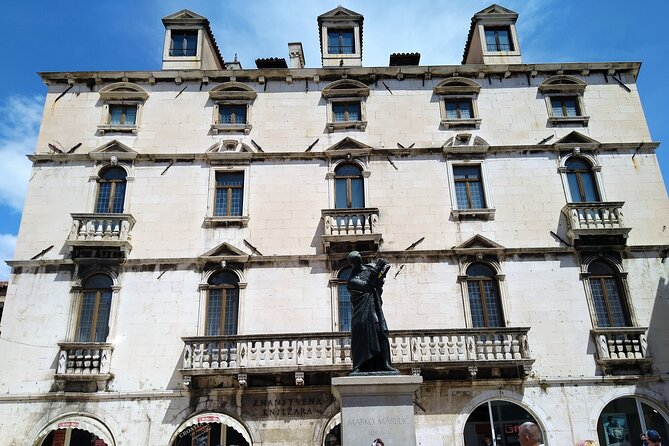
Stop 6 starts on Riva Harbor, the meeting point for locals and visitors and the main city promenade. This is where your tour shifts from Roman interiors to the lived-in modern city.
Your guide explains how Riva was built over the centuries and why it became central for local life. Plus, you get a beautiful view of the southern wall of Diocletian’s Palace from this spot.
This is not a random detour. It’s the bridge between past and present. You can stand here and understand how the palace stays visible, even after the city reshaped around it.
This stop is about 10 minutes and listed as free. If the weather is nice, this is a comfortable moment to pause, look out, and decide where you want to go next after the tour.
If the wind picks up, just note that Riva is open. Bringing a light layer can save you from a mid-walk chill.
Fruit’s Square (Trg Brace Radic), a picturesque break outside the palace
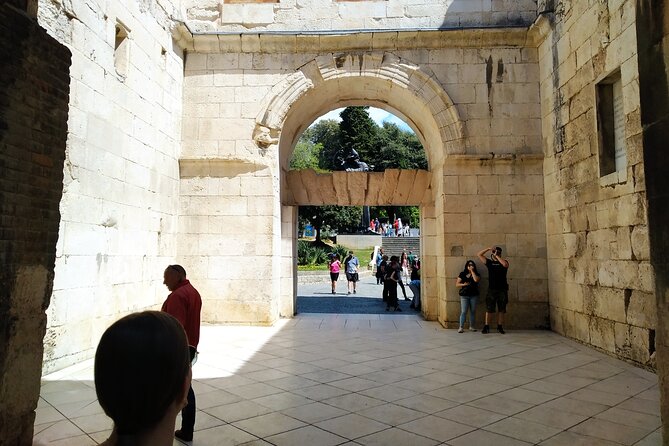
Stop 7 is Fruit’s Square (Trg Brace Radic), positioned just outside the palace of the Roman emperor Diocletian. This stop is chosen for its visual charm, but it also comes with history.
The tour explains a significant monument in the middle of the square and points you toward other important sights nearby. It also notes that Fruit Square is dominated by remains of a 15th century Venetian fort.
I like this stop because it shows how layers stack. The Roman base is still there, but later periods added their own structures and meaning. You’re not only stuck in the Roman story.
This stop is about 20 minutes and listed as free, which makes it the longest “outside” pause on the route. That extra time helps you see how the square functions in the present, not just how it functioned in the past.
Pjaca, the old Town Hall square and the city’s medieval pulse
Stop 8 is Pjaca, in front of the old Town Hall, outside the western wall of Diocletian’s Palace. It is presented as the city’s main square since medieval times, and it attracts visitors with its variety and energy.
On this stop, you can expect a guided look at the 14th century Town Hall plus other interesting structures around the square. This is one of those places where the architecture is clear, but the meaning becomes clearer after your palace stops.
In other words, by the time you reach Pjaca, you understand why people gathered here and what made it important.
This stop is about 10 minutes, listed as free. It’s short enough to keep the tour moving, but you still get the big points so you’re not just passing through.
Grgur Ninski statue, the landmark story you’ll remember
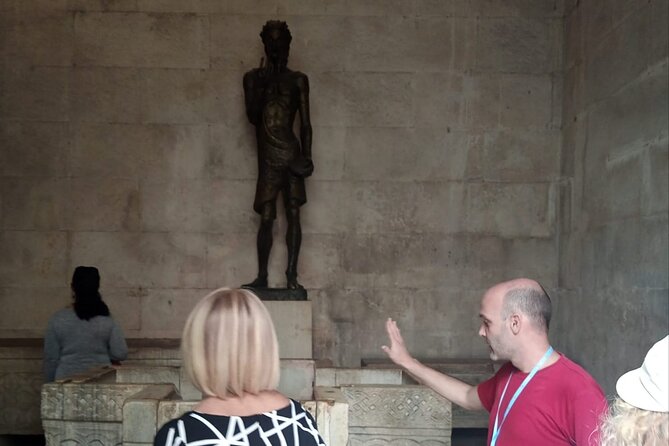
Stop 9 is the Grgur Ninski statue, described as a dominant and recognizable landmark of Split. Your guide explains the story and facts about Gregory of Nin, including the highest monument in Split dedicated to him and the sculptor behind the monument, Ivan Mestrovic.
Then comes the fun part. You’ll get the classic tip to rub the statue’s toe for good luck.
This is a satisfying ending because it turns history into something tangible and memorable. Gregory of Nin becomes more than a name. It feels like part of local identity you can point to instantly.
This stop is about 10 minutes and listed as free. Since it happens near the end, it also works as a smooth “wrap” where you can quickly recall all the themes from earlier stops, Roman power, Christian transitions, and the civic life that grew after.
Price and value, what you get for $238.28 per group
At $238.28 per group (up to 10 people), this tour is priced for groups to share the cost. For a private-style walk, that can be a good deal, especially if your group includes people who want more than quick photo stops.
The value here comes from three things you actually feel during the walk:
- You’re paying for time with Ivan Fistanić, a history-trained guide with a Master’s Degree in History.
- You get a tight route that connects Diocletian’s Palace spaces with Split’s key public areas.
- The stop mix includes interpretation at multiple “levels,” architecture, religion, and daily city layout.
If you’re traveling solo, the cost may feel steeper because it is per group. But because it’s a private small group, you still benefit if you want questions answered and explanations tailored to your pace.
Also, tickets are listed as free for several stops, with two stops marked as admission not included. In practice, that means you’re mostly doing guided viewing. You’re not paying extra throughout the walk, though you should expect that any paid entry would be separate for those specific sites.
Timing, logistics, and how to plan your day
The tour starts and ends back at Ul. kralja Tomislava 15. That central placement helps a lot. You can fit it early so the rest of your day makes sense, or you can place it after a morning of wandering to clean up the story.
The duration of about 1.5 to 2 hours means it’s also a smart choice if you are dealing with jet lag or you want something focused instead of a long day tour.
One more note: the experience needs good weather. If the forecast looks bad, expect that your plans might shift. Bring a small umbrella or a light rain layer for peace of mind.
For the best experience, wear comfortable shoes. Split’s old town has lots of uneven ground, and you’ll be standing and walking enough that foot comfort matters.
Who this tour suits best
I think this tour fits well if you:
- Want a guided history walk without a long, exhausting day
- Appreciate Roman architecture but also want the Christian-era changes explained
- Prefer a small group and a route that stays readable
- Like landmarks that are both meaningful and fun, like Grgur Ninski’s statue and the toe-rub tradition
It might be less ideal if you want a tour that goes deep into museums or long interior visits, because this one is built around outdoor viewing and clear guided interpretation.
Should you book? My take
Book it if you want the Diocletian’s Palace story told in the right order, starting with Golden Gate, moving into the Peristyle, then connecting to how the cathedral and temple relate to later religious use. You’ll also get a smooth transition to the city’s real-life stops like Riva, Fruit’s Square, and Pjaca.
Skip it only if you already have a firm grasp on palace geography and you specifically want lots of paid museum-style interior time. For most people, the short format and Ivan’s guided explanations are exactly what make it worth your time in Split.
FAQ
How long is the Private History tour in Split?
It lasts about 1 hour 30 minutes to 2 hours.
What is the price of the tour?
The price is $238.28 per group, up to 10 people.
How many people are in the group?
It is a private tour with only your group participating, with a maximum of up to 10 people per group.
Where does the tour start?
The meeting point is Ul. kralja Tomislava 15, 21000, Split, Croatia.
Is this tour suitable for most travelers?
Most travelers can participate.
Are tickets included for all stops?
Some stops are listed as admission ticket free, while the Cathedral of Saint Domnius and the Temple of Jupiter are listed as admission ticket not included.
Will I get a mobile ticket?
Yes, the tour includes a mobile ticket.
What kind of weather does the tour require?
The tour requires good weather. If canceled due to poor weather, you will be offered a different date or a full refund.
Latest arrivals logged at Split

Historical Tours, compared.
Walking Tour of Split with a ‘Magister’ of History
Read our review →
Split Walking Tour with Professor of History
Read our review →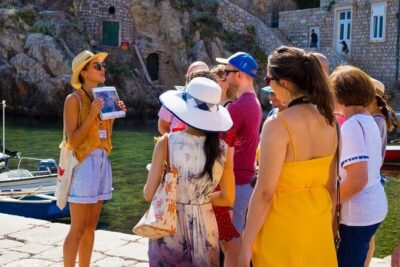
Split History and Gastro Small-Group Tour with Food and Drinks
Read our review →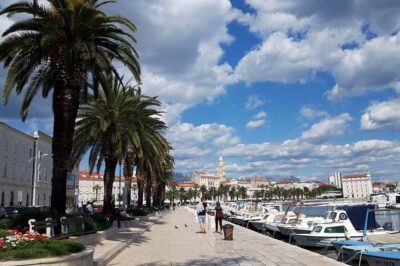
PREMIUM Emperor’s Walking Tour for History Lovers + Museum
Read our review →Browse the lists this tour appears in