
Reviewed · HISTORICAL TOURS
Private Walking Tour of Dubrovnik Hidden Gems and History
Dubrovnik is all stone and stories. This private walking tour strings together major landmarks and quieter details in just about two hours, so you get the meaning behind the views, not just photos.
I love the small-group feel and the way the route moves at a human pace, with time to ask questions. You’ll also get context that connects the city’s politics and identity to what you’re standing in front of.
My second favorite part is the mix of famous stops and specific, slightly nerdy details that make Dubrovnik feel real. The 15-minute stop at Onofrio’s Large Fountain turns into a mini lesson on how the Dubrovnik Republic handled something basic, like water supply. And the Franciscan Monastery area can include the old pharmacy if you want to go inside.
One thing to consider: not everything is included in price. The Franciscan Monastery Museum and the cathedral visit are optional, and you won’t enter Rector’s Palace, just see it from outside.
In This Review
- Key highlights you will actually notice
- Dubrovnik in Two Hours: What This Walk Really Gets You
- Price and Value: $228.05 Per Group, and What You Get for It
- Starting at Amerling Fountain, Finishing by the Bell Tower
- Entering Dubrovnik Through Pile Gate: More Than a Main Door
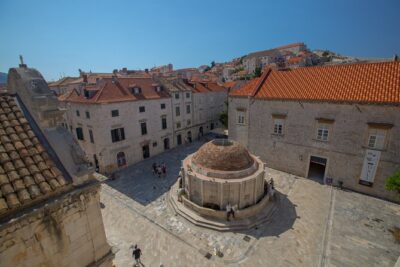
- Onofrio’s Large Fountain: 16 Masks, One City Problem (Water)
- Franciscan Monastery Museum: A Quiet Cloister Break (Optional)
- Stradun: The Old Town’s Straight Shot Through the Main Story
- Saint Blaise Church: The Patron Saint Story Becomes Tangible
- Sponza Palace: Where Trading Power Met Paperwork
- Rector’s Palace and the Viewpoint Approach
- Cathedral of the Assumption: Optional Interior, Big Baroque Feel
- Old Port and the Bell Tower Finale: Maro and Baro
- The War Stories That Add Real Depth to Dubrovnik
- Language and Guide Style: What You Can Expect
- Who This Walk Fits Best
- Should You Book This Private Dubrovnik Walking Tour?
- FAQ
- How long is the private walking tour?
- What is the group size?
- What languages are available?
- What does the tour include?
- Are entrance fees included for museums or monasteries?
- Which stops are optional for entering?
- Where does the tour start and what time?
- Where does the tour end?
- Do I need tickets in advance?
- Is free cancellation available?
- Are service animals allowed?
Key highlights you will actually notice
- Up to 6 people, private guide pace instead of getting swept into a big group.
- Onofrio’s fountain masks and the water-supply story make Dubrovnik’s everyday life click.
- Franciscan Monastery pharmacy option if you want a calmer, indoor break.
- Focused Old Town route from Pile Gate through Stradun to the Old Port and Bell Tower.
- War-era context added to the usual medieval Republic stories, so the city feels connected to real events.
- Stop-and-look timing built around short visits, not rushed photo stops.
Dubrovnik in Two Hours: What This Walk Really Gets You
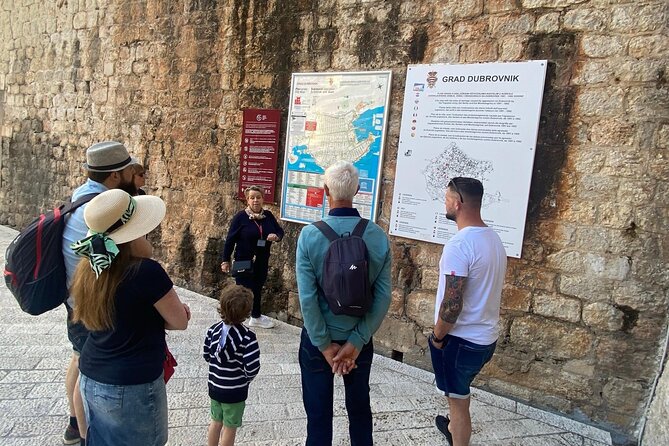
This is a private walking tour designed for a short, concentrated hit of Dubrovnik’s Old Town. Expect about two hours with multiple stops, each timed for a brief explanation plus time to look around. That matters because Dubrovnik Old Town is dense. If you wander on your own for the same amount of time, you usually end up seeing a lot, but not really understanding much.
The experience is also set up so you can stay flexible. It is private, meaning your guide can slow down for your interests, or move faster if you are power-walking between sights. The vibe stays friendly and personal, not lecturing.
And yes, you will cover the classics. But you’ll also get the kind of details that make the place feel lived-in. When you are standing at the fountain, for example, it is easy to treat it like a pretty landmark. With the story, it becomes a snapshot of civic engineering and daily life.
Price and Value: $228.05 Per Group, and What You Get for It
The price is $228.05 per group, up to 6 people. That is the big value lever here: you are not paying per person for the guide time. If you book for two, your per-person cost will be higher. If you fill a group closer to six, it becomes much more reasonable.
What you are paying for is not just someone pointing. It is a quality private guide service in English (and also available in Dutch-NL or French), plus guided storytelling at each stop. Many of the stops are outside or free to access, so the money goes into explanations rather than admissions.
What is not included is entrance fees for optional interior stops like the Franciscan Monastery Museum and the cathedral. So if you want museums and interiors, plan a little extra for tickets. If you’re happy with exteriors and short visits, you can keep costs tight.
In plain terms: if you value context and time efficiency, this price usually makes sense. If you prefer to self-guide with a phone audio app and don’t care about deep explanations, you might feel the cost.
More Walking Tours in Dubrovnik
- Dubrovnik: Old Town Walking Tour★ 4.8 · 5,174 reviews
- Dubrovnik Discovery Old Town Walking Tour★ 5.0 · 4,458 reviews
- Dubrovnik: Game of Thrones Walking Tour★ 5.0 · 1,732 reviews
Starting at Amerling Fountain, Finishing by the Bell Tower
Your tour starts at Amerling Fountain (Ul. Svetog Đurđa) at 9:00 am. Getting the start time matters in Dubrovnik. Morning light makes stonework pop, and you’ll hit the Old Town before it turns into a wall of shoulders.
You finish near the Clock Tower of Dubrovnik, close to the Bell Tower. That means you do not end up backtracking through the same streets at the end. You also get a clean mental loop: you enter at Pile Gate, work through the spine of the Old Town, and close with a dramatic, iconic tower moment.
Also, you get a mobile ticket. That is one less thing to juggle while you’re walking and taking photos.
Entering Dubrovnik Through Pile Gate: More Than a Main Door
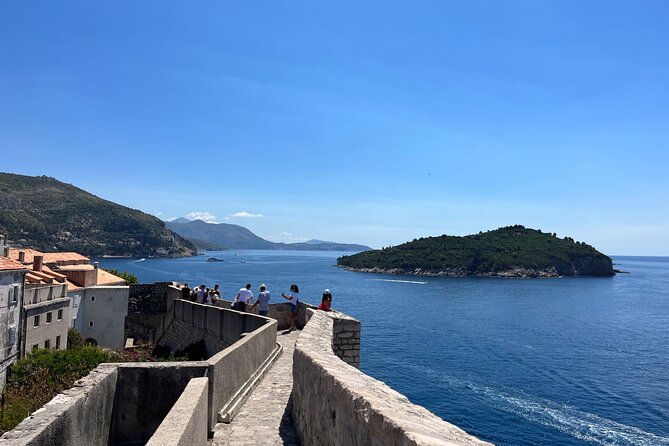
The first stop is Pile Gate, Dubrovnik’s main entrance to the Old Town, built as part of the medieval fortifications. This is where your guide helps you understand that Dubrovnik’s “pretty” look is not just aesthetic. It was defense, built into architecture.
You’ll see the stone bridge and drawbridge conceptually, plus the city’s patron saint connection through the statue of St. Blaise. For many people, that saint detail feels random. In Dubrovnik, it isn’t. It’s a thread that keeps returning throughout the tour, especially as you move toward the church and cathedral.
One practical tip: take a second right at the entrance to orient yourself. Stradun is the main street you’ll later walk through. Knowing where you are in the layout makes the rest of the Old Town feel more navigable.
Onofrio’s Large Fountain: 16 Masks, One City Problem (Water)
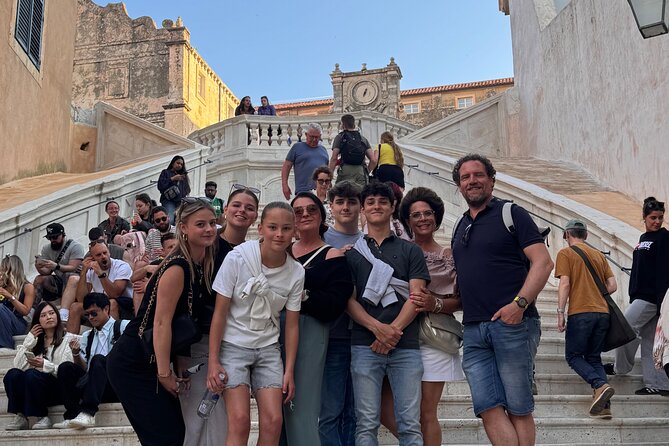
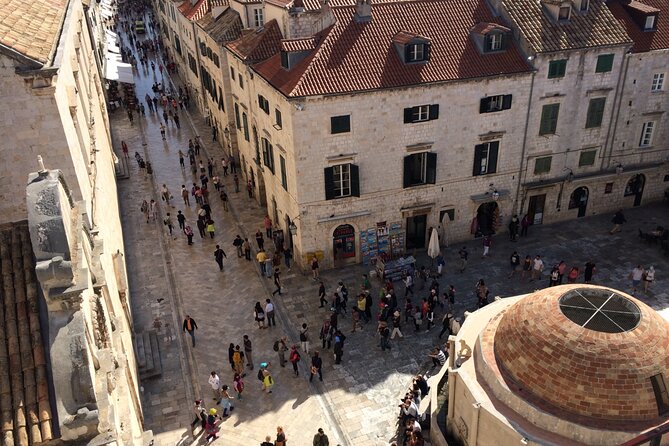
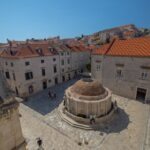
Next up is Onofrio’s Large Fountain, built in 1438, tied to Dubrovnik’s water supply system. The key detail here is the circular fountain with 16 carved stone masks, each with a spout that once fed drinking water into the city.
This stop is short on paper, but it is memorable because the story is specific. You’ll hear how water distribution worked in the time of the Dubrovnik Republic, and why this fountain mattered beyond being decorative.
It is a great example of what makes this tour different from a basic sightseeing walk. Instead of saying, “Here’s a cool fountain,” your guide frames it as infrastructure. And that flips the way you see the Old Town. You start noticing how practical the place was, not just how photogenic.
More marble lanes taken slowly:
- Dubrovnik Old Town History Walking Tour
★ 5.0 · 1,684 reviews - Dubrovnik: City Walls Early Morning or Sunset Walking Tour
★ 4.8 · 1,523 reviews - Dubrovnik: Ancient City Walls & Wars Walking Tour
★ 5.0 · 1,270 reviews - Dubrovnik: City Walls, Old Town Walking Tour & Adriatic View
★ 4.9 · 982 reviews
Franciscan Monastery Museum: A Quiet Cloister Break (Optional)
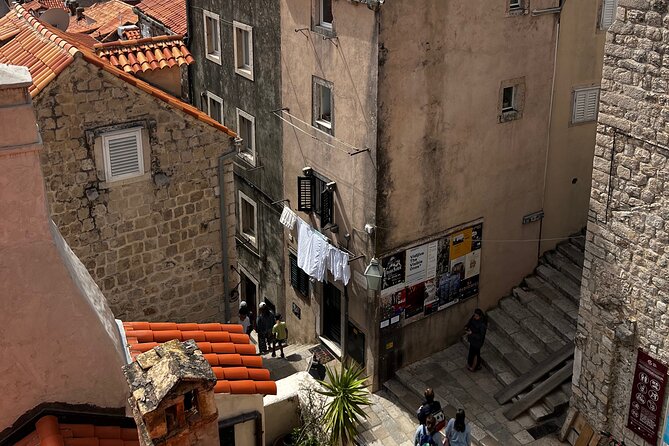
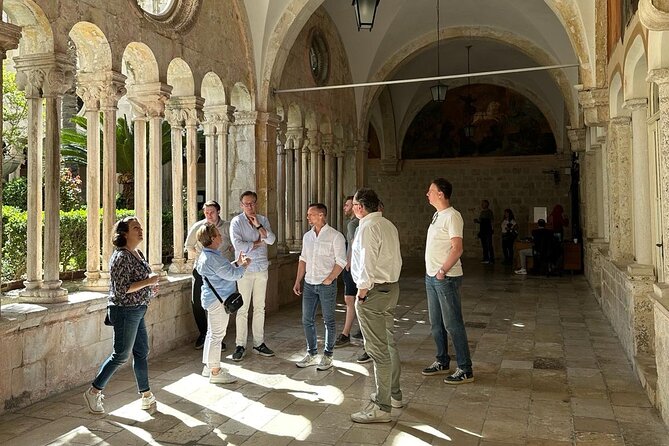
The Franciscan Monastery dates back to the 14th century and is known for its calm cloister and the pharmacy tradition. Here’s the useful part for your planning: the old pharmacy visit is optional, and entrance fees are not included.
If you choose to go in, this is where you get a different mood from the main street. Outside, Dubrovnik can feel crowded and bright. Inside the monastery complex, it often feels more like a pause button. You’re stepping into a long-running tradition where pharmacy and care were tied to the monastery world, with one of the oldest still-functioning pharmacies in Europe dating to 1317.
Drawback, if you’re budget-tight or short on time: optional interior access can add cost. Also, if you skip the museum portion, you still get the exterior context and the general story, just without the indoor experience.
Stradun: The Old Town’s Straight Shot Through the Main Story
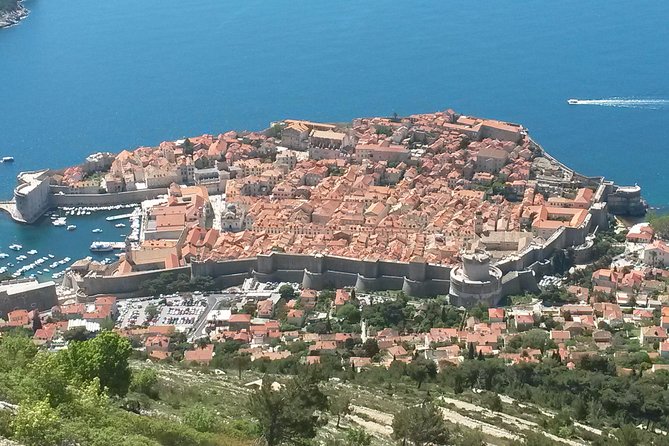
Then you move to Stradun, the main promenade of the Old Town. This is the wide limestone-paved street that runs through the heart of Dubrovnik, lined with historic buildings, shops, and cafés.
Your guide’s job here is to connect the architecture and street layout to how the city functioned socially and culturally. Without that layer, Stradun can feel like just another pedestrian street. With it, you start seeing it as a central corridor tied to the Republic’s identity.
Practical note: Stradun is where you’ll feel the most foot traffic. If you like photos, aim for a quick look and step aside between shots. The tour keeps your time efficient, so you do not get stuck lingering in the busiest spots.
Saint Blaise Church: The Patron Saint Story Becomes Tangible
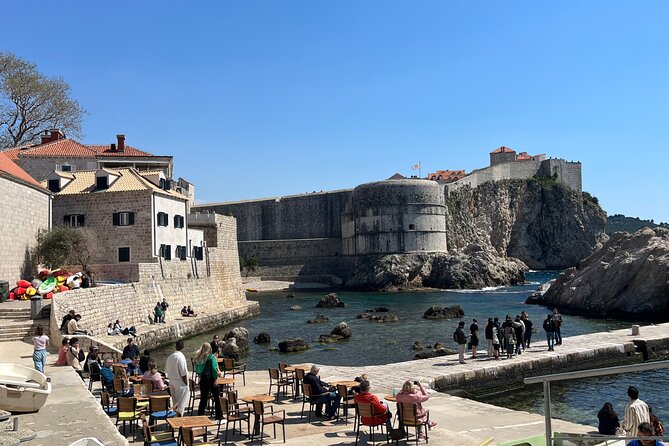
The tour continues with the Church of Saint Blaise, built in the early 18th century in Baroque style. This is another stop where the patron saint theme becomes real.
Inside, the church is known for a treasured statue of Saint Blaise holding a model of medieval Dubrovnik. The symbolism is the point: protection, civic identity, and the idea that the city’s wellbeing was treated like a shared responsibility.
Even if you only take in the exterior details during the quick stop, the explanation helps you understand why this saint appears again and again. Dubrovnik is one of those cities where local traditions are not decorative. They are part of how residents told their story.
Sponza Palace: Where Trading Power Met Paperwork
At Sponza Palace, you get a mix of Gothic and Renaissance architecture and a very useful explanation of what it used to do. Historically, it served as a customs house and treasury, and later it became a home for archives and memorial rooms, including space tied to Dubrovnik defenders and cultural events.
This is one of those stops that helps you see the Republic of Ragusa as more than a name. It was a system. It needed trade regulation, records, and a place where civic memory could live.
If you love historic administration, this is your moment. If you do not, the architecture and the civic-function story still give you a better sense of how a small city could operate with real sophistication.
Rector’s Palace and the Viewpoint Approach
You then reach the Rector’s Palace, which mixes Gothic, Renaissance, and Baroque elements. It used to be the seat of the Rector who governed the Republic of Ragusa.
Here is the clear expectation: you won’t enter Rector’s Palace. You will stop in front, so you can appreciate the architecture and understand what kind of authority this building represented.
That “outside only” approach is a tradeoff. You save time and keep the flow of the walk, but you miss indoor collections that some visitors might want. In a two-hour tour, this makes sense, but if you specifically want the furniture, portraits, and artifacts, you may want a separate ticketed visit later.
Cathedral of the Assumption: Optional Interior, Big Baroque Feel
Next is the Cathedral of the Assumption of the Virgin Mary (Assumption Cathedral). It was rebuilt in the 18th century after an earthquake, with a grand Baroque design.
Inside is where the story grows again, especially through the treasury and relics, including those linked to Saint Blaise, plus a painting attributed to Titian. Like the monastery, a visit is optional, and entrance fees are not included.
If you like religious art, relic stories, and major treasury displays, add the cathedral interior. If you prefer to save time and keep walking, you can focus on the exterior and still get the main context from your guide.
Old Port and the Bell Tower Finale: Maro and Baro
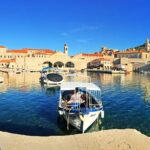
The tour ends on an atmospheric note at the Old Port of Dubrovnik, tucked beneath the city walls. In earlier times, it served as a hub for trade and naval power during the Republic of Ragusa. Today, it’s more relaxed: boats, cafés, and departures for nearby island excursions.
Then you reach the Bell Tower and the finish area near the Clock Tower. The Bell Tower stands at about 31 meters. It was originally built in the 15th century and reconstructed in the 1920s after earthquake damage.
The showstopper detail is the two bronze figures known as the Green Men, also referred to as Maro and Baro. They strike the bell every hour.
This ending works well because your brain has had time to absorb the city’s structure and identity. The bell tower moment feels like a punctuation mark on the whole walk.
The War Stories That Add Real Depth to Dubrovnik
One of the most praised aspects is how the guide adds depth beyond medieval dates. You’ll hear context about the background of the war, and how it shaped Dubrovnik’s modern identity.
That matters because Dubrovnik can be sold as a postcard. The minute you understand what was at stake, the stonework stops feeling like “just scenery.” It becomes evidence of resilience and memory.
This is also where a private guide matters. In a group, people often jump straight to photos. Here, you can ask questions and get the story framed in a way that makes sense for you, without the pressure of keeping pace with strangers.
Language and Guide Style: What You Can Expect
This tour is private and offered in English, with other language options available. A consistent theme in the experience feedback is that the guide adapts the tour to the group’s interests and answers specific questions well.
In one set of experiences, the guide is Antje, described as passionate about Dubrovnik and able to make the city feel personal rather than scripted. That style is exactly what you want on a short walking tour: you need a guide who can read the room.
You’ll also get practical tips as you go, including ideas for things to do after the tour.
Who This Walk Fits Best
This is a strong choice if:
- You have limited time in Dubrovnik and want a concentrated Old Town storyline.
- You like history explanations tied directly to what you see.
- You prefer a private format, up to 6 people, instead of big-group timing.
- You want both the medieval Republic angle and modern context.
It may be less ideal if:
- You want long museum time and lots of interior exploring, since some key places are optional and Rector’s Palace is exterior-only.
- You are mainly in Dubrovnik for beach time and do not want to walk streets for a couple of hours.
Most travelers can participate, and the route is in the Old Town area near public transportation, which helps if you’re doing a morning schedule and then continuing on.
Should You Book This Private Dubrovnik Walking Tour?
If you’re the type of traveler who looks at a building and wonders why it looks the way it does, this tour is a smart use of time. The value comes from the guide attention, the tightly chosen route, and the way practical stories (water supply, civic function) sit alongside bigger identity themes.
I’d especially book it if you want the Old Town highlights but also want a guide to explain the meaning behind them, including the war context. For a two-hour window, it’s a well-balanced plan that gets you oriented fast and leaves you with a clearer sense of how Dubrovnik worked, defended itself, and remembered its people.
If you are hoping for a lot of paid interior time, budget a little extra for optional museum and cathedral visits. Otherwise, you can keep it mostly exterior and still come away with real context.
FAQ
How long is the private walking tour?
It runs for about 2 hours.
What is the group size?
It is private, with up to 6 people in your group.
What languages are available?
The tour is offered in English, with guide services also available in Dutch-NL or French.
What does the tour include?
It includes quality private guide services in Dutch-NL/English or French.
Are entrance fees included for museums or monasteries?
No. Entrance fees for optional museums and monasteries are not included.
Which stops are optional for entering?
You can choose to visit Franciscan Monastery Museum and the cathedral. Rector’s Palace is viewed from outside, not entered.
Where does the tour start and what time?
It starts at Amerling Fountain, Ul. Svetog Đurđa, at 9:00 am.
Where does the tour end?
It ends near the Clock Tower of Dubrovnik, close to the Bell Tower.
Do I need tickets in advance?
You receive a mobile ticket.
Is free cancellation available?
Yes, you can cancel up to 24 hours in advance for a full refund.
Are service animals allowed?
Service animals are allowed.
Venetian Stones, Roman Streets
Latest arrivals logged at Dubrovnik






Historical Tours, compared.
Walking Tour of Split with a ‘Magister’ of History
Read our review →
Split Walking Tour with Professor of History
Read our review →

Split History and Gastro Small-Group Tour with Food and Drinks
Read our review →
PREMIUM Emperor’s Walking Tour for History Lovers + Museum
Read our review →Browse the lists this tour appears in