
Reviewed · WALKING TOURS
Pula Private Walking Tour
Roman Pula makes more sense on foot. This private walking tour threads the city’s biggest Roman landmarks with real, local commentary, not just dates and distance. I like that you get a professional local guide named Adriano, and you move at a comfortable pace through key spots across town. One thing to consider: several stops have sights where admission tickets are not included, so you may pay extra at the gate.
If you want an efficient way to understand why Pula matters, this is a strong format. It runs about 1 hour 30 minutes to 2 hours, covers multiple “wow” monuments, and ends near the main visitor area so you can keep exploring right afterward. The tour is offered in English, uses a mobile ticket, and it stays flexible enough that most people can participate.
In This Review
- Key Highlights You Will Notice Right Away
- Why This Private Walk Is a Smart First Step in Pula
- Meeting Point and the Simple Route Logic
- Stop 1: Arch of the Sergii and the James Joyce Connection
- Stop 2: Temple of Augustus and Why Early Imperial Sites Feel Different
- Stop 3: Giardini 2, Coffee Bars, and 130-Year-Old Shade
- Stop 4: Titov Park, a WWII Memorial, and a City Map Moment
- Stop 5: Twin Gate and the Zerostrasse Underground Link
- Stop 6: Circolo, Hercules Gate, and Italian Community Space
- Stop 7: Pula Arena, One of the Most Preserved Roman Amphitheaters
- Price and What You Actually Get for $21.14
- English, Private Groups, and the Pace That Keeps It Enjoyable
- The Best Use Case: When You Should Pick This Tour
- Should You Book This Pula Private Walking Tour?
- FAQ
- How long is the Pula Private Walking Tour?
- How much does the tour cost?
- What is included in the tour price?
- Are admission tickets included for the stops?
- Where does the tour start and end?
- Is this tour private?
- What language is the tour offered in?
- How do I access the tour ticket?
- Can I cancel for a full refund?
- Is it suitable for people who use public transport or service animals?
Key Highlights You Will Notice Right Away
- Adriano is your guide, a local historian with a history background and excellent English
- Small-group feel, sometimes even very small, so your questions do not get swallowed
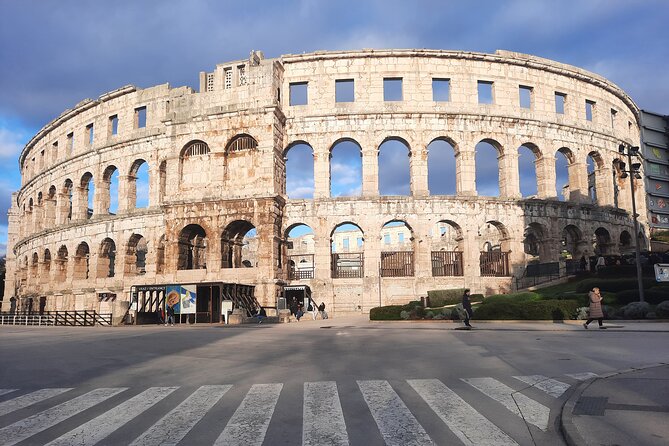
- Pula Arena focus, including the Roman amphitheater exterior and context for what you are seeing
- A mix of Roman and later layers, from imperial monuments to WWII remembrance
- Street-level Pula, including an easy stroll past Giardini 2 coffee culture and old shade trees
- Clear entry expectations, some stops are free, some are ticketed
Why This Private Walk Is a Smart First Step in Pula
Pula can feel like a set of great ruins scattered around a pleasant Adriatic town. This tour helps you connect the dots. You start near the Roman Forum area, then work through a string of monuments that, taken together, show how the city evolved.
I also like the “just enough structure” approach. You are not stuck in a long bus ride or forced into a rigid itinerary. Instead, you get a guided walking rhythm that gives you time to look closely, ask questions, and actually notice details.
Finally, the private part matters. You and your group set the tone. In small groups, the guide can slow down for photos, explain symbols, or answer the question you keep thinking about while you stare at stonework.
Meeting Point and the Simple Route Logic
You meet at Forum 3, 52100, Pula, and the start point is in front of the Amphitheater area. You finish at Flavijevska ul. 1, 52100, Pula, again in the heart of the sights zone. That matters because it reduces “backtracking.” After the tour, you can keep walking toward meals, viewpoints, or the next historic stop without crossing the city from scratch.
The tour runs about 1 hour 30 minutes to 2 hours. That timing is ideal if you are doing Pula as a day trip or if you just arrived and want orientation fast.
More Walking Tours in Pula
- Pula: Historic Walking Tour with Local Guide & City Views★ 4.8 · 214 reviews
- Pula walking tour★ 5.0 · 96 reviews
- Pula: Historic Sites Guided Walking Tour★ 4.8 · 78 reviews
Stop 1: Arch of the Sergii and the James Joyce Connection
Your first major photo moment is the Arch of the Sergii, a triumphal arch from the late first century BC. It is a strong “welcome” landmark because the scale instantly tells you this was a city built to project power, status, and legitimacy.
What I like most here is the way the guide can turn a single arch into a story of who funded it and why it mattered. You also get a nearby bronze statue connected to James Joyce. That adds a fun contrast, because it reminds you Pula is not frozen in Roman time. It has later cultural layers too.
This stop is listed as free admission. That is a nice early win: you get a meaningful landmark without ticket friction before the tour really starts building momentum.
Stop 2: Temple of Augustus and Why Early Imperial Sites Feel Different
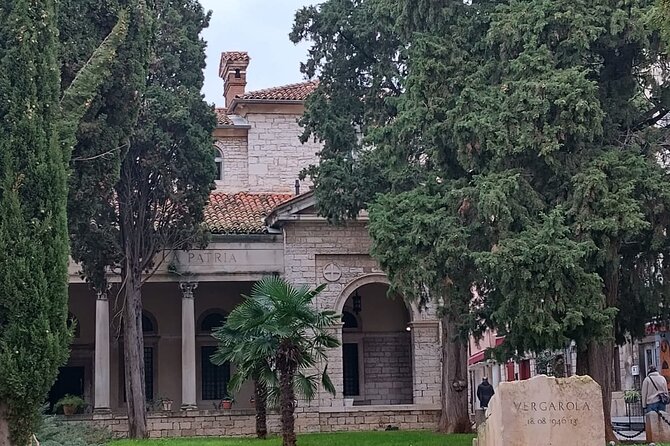
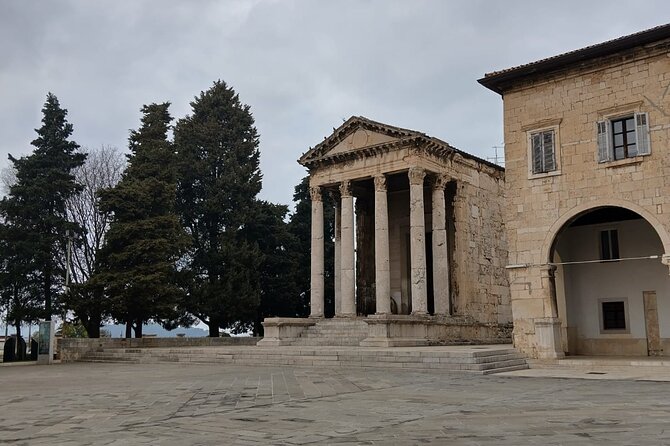
Next is the Temple of Augustus, built in the early 1st century and known as an important example of early imperial Roman sacral architecture. This is the kind of stop where the details matter, and a guide can point out why it feels distinct from a public arch or an arena.
This stop is not included for admission, so it is the first place where you should expect possible ticket costs. The payoff is that you are looking at a sanctuary tied to imperial authority, which helps you understand how religion and politics blended in Roman cities.
If you prefer to plan ahead and avoid surprises, this is the one you should mentally flag as likely “ticket time.”
Stop 3: Giardini 2, Coffee Bars, and 130-Year-Old Shade
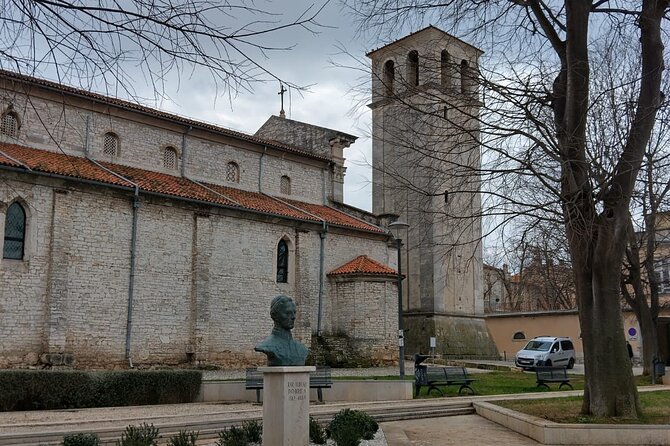
Not every highlight in Pula is a monument. Giardini 2 is a street linked to social life and events, and it is also your reset moment. You will see coffee bars and, importantly, four lines of hackberry trees that are about 130 years old.
I like this stop because it gives your brain a break from stone structures. You get a “live town” snapshot, and the old trees make the walkway feel cooler and calmer than you might expect in open sunshine.
This part is free. Also, if you have ever walked a historic city all day and felt your feet argue with you, this is the sort of pause that keeps the tour pleasant.
More marble lanes taken slowly:
- Pula Essentials Walking Tour
★ 4.8 · 64 reviews - Pula Essentials Walking Tour
★ 5.0 · 62 reviews - Pula Food Walking Tour
★ 4.5 · 22 reviews - Pula: Old Town Walking Tour for Foodies with Dinner and Wine
★ 4.6 · 18 reviews
Stop 4: Titov Park, a WWII Memorial, and a City Map Moment
Then you head to Titov Park, which includes a World War II memorial and a city map with a fountain in the park. This is an interesting pivot point because it shifts the focus from Roman influence to modern memory.
In a good tour, that change does not feel random. It makes you notice how cities keep layering meaning. A memorial like this is also a reminder that Pula’s story did not end with Rome.
This stop is free admission. Practical note: it is a good place to ask your guide about what to see next, because you get a mental map of where things are in town.
Stop 5: Twin Gate and the Zerostrasse Underground Link
Now you reach the Twin Gate, built in the 2nd century as an official entrance connected to the small Roman theater area. The gate also ties into something many people want to add later, the underground tunnels called Zerostrasse.
Even if you are not going underground on this specific walk, the Twin Gate context helps. It explains why tunnels and gates would have mattered for movement and access in a working ancient city.
This stop is marked as not included for admission. So if you are the type who wants to plan your cash for each paid stop, this is another one to flag.
One more reason I like this segment: it helps you understand that Pula was not only about “views.” It was also about systems, traffic, access points, and how people moved through the city.
Stop 6: Circolo, Hercules Gate, and Italian Community Space
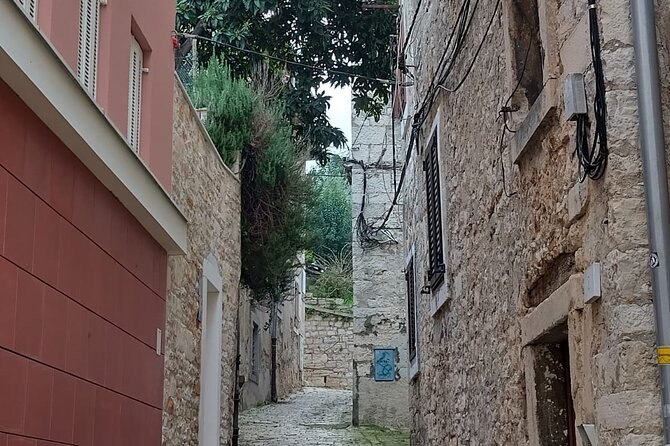
Next comes Circolo, which is connected with the Italian community centre. You also see Hercules Gate, and it is described as the oldest gate in Pula.
This is a smaller stop, but it is a meaningful one because you connect physical infrastructure with community life. Gates were not just Roman decorations. They shaped how the city handled arrivals, departures, and daily flow.
This stop is free. If you want a tour that balances big monuments with smaller, meaningful details, this is one of those “quiet” segments that makes the whole experience feel human, not just archaeological.
Stop 7: Pula Arena, One of the Most Preserved Roman Amphitheaters
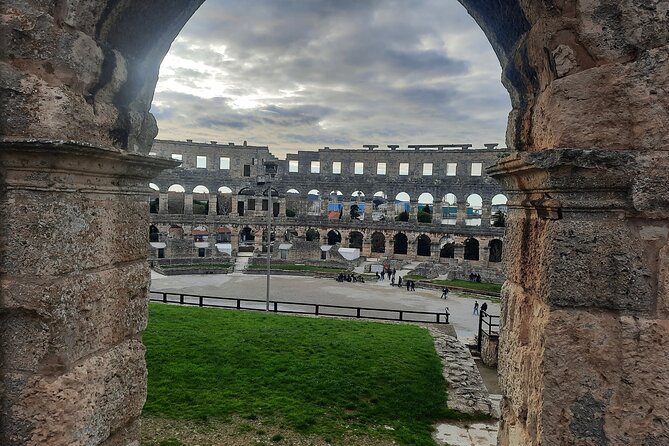
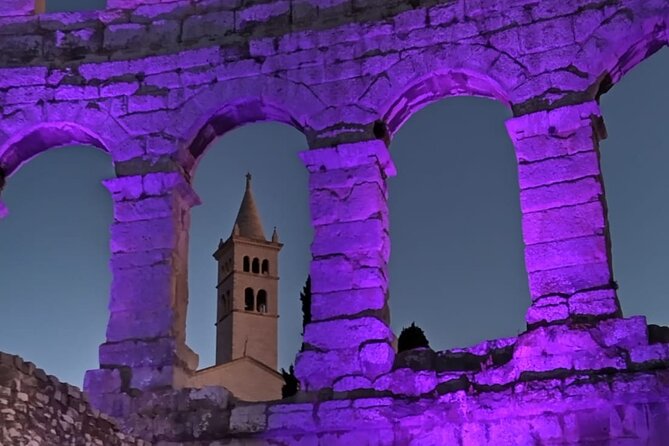
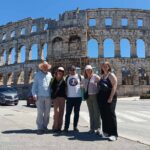
You end at the big visual anchor: Pula Arena, an amphitheater built in the 1st century AD and widely described as one of the most preserved in the world. For many people, this is the “I get it now” moment, because once you have seen gates, temples, and arches, the Arena looks like a piece of a bigger civic machine.
This stop is not included for admission. If you want to step inside (or see more than the exterior), budget for potential ticket time and cost.
What I appreciate is the way a guide can explain what you are looking at. The Arena is not only a ruin you pose in front of. It is a design for crowds, sound, and spectacle. When the guide connects that to the rest of the city, you stop thinking of it as random remains and start seeing it as Roman urban planning.
Price and What You Actually Get for $21.14
At $21.14 per person, this tour is priced like a practical, value-first city introduction. You get a professional local guide for about 1.5 to 2 hours, and you cover multiple landmark clusters without you having to build the whole route yourself.
Here is the honest tradeoff. The cost covers guiding, but some sights have entries not included. That means your total out-of-pocket might be a bit higher if you plan to go inside ticketed stops like the Temple of Augustus, Twin Gate, or Pula Arena.
Still, even with potential ticket add-ons, it often works out well because you are not just buying access. You are buying explanations that help you understand why each site exists and how it fits into a bigger story.
English, Private Groups, and the Pace That Keeps It Enjoyable
This is offered in English, and it is a private tour/activity, meaning only your group participates. That setup makes a difference when you want to ask follow-up questions instead of waiting for the next group to catch up.
In the real world, private tours can sometimes feel rushed if the schedule is tight. That is not the vibe here. The walk is paced to fit the listed duration, and the best part is that you can usually go at a human speed instead of a stampede speed. When your guide is the kind who grew up in Pula and speaks with confidence, you can ask small questions and get clear answers.
Also, the tour is described as near public transportation, and service animals are allowed. And it states that most travelers can participate, so it is a reasonable choice for many walking styles.
The Best Use Case: When You Should Pick This Tour
If you only have a few hours in Pula, you need an efficient orientation. This is the sort of tour that helps you avoid the common mistake of seeing one monument and missing the logic that connects them.
It also works if you want more than photo spots. The guide is described as friendly, personable, and fun, and you get a history angle without it turning into a lecture.
And if your schedule is tight, this can be a useful option. One of the strongest practical takeaways from the experience format is that it can still be a workable plan even when your dates are not booked far in advance. If you decide late, you still have a real shot.
Should You Book This Pula Private Walking Tour?
Yes, you should book it if you want a clear overview of Pula in a short time, with a real local guide named Adriano who can connect Roman monuments to the life of the city today. The route is easy to follow, it hits the big visual anchor of Pula Arena, and it includes a nice mix of landmark stops plus street-level atmosphere.
I would skip it or adjust expectations if you strongly dislike paying extra for entries. Several key stops are ticketed, and the tour does not include food or drinks.
If you want an efficient, high-value first walk, this one makes sense.
FAQ
How long is the Pula Private Walking Tour?
The tour lasts about 1 hour 30 minutes to 2 hours.
How much does the tour cost?
The price is $21.14 per person.
What is included in the tour price?
It includes a professional local tourist guide.
Are admission tickets included for the stops?
Some stops are free, but others have admission not included. Ticketed stops include the Temple of Augustus, Twin Gate, and Pula Arena.
Where does the tour start and end?
It starts at Forum 3, 52100, Pula (in front of the Amphitheater) and ends at Flavijevska ul. 1, 52100, Pula.
Is this tour private?
Yes. It is a private tour/activity, and only your group will participate.
What language is the tour offered in?
The tour is offered in English.
How do I access the tour ticket?
You get a mobile ticket.
Can I cancel for a full refund?
Yes, you can cancel for a full refund if you cancel at least 24 hours before the experience start time.
Is it suitable for people who use public transport or service animals?
The tour is near public transportation, service animals are allowed, and it says most travelers can participate.
Latest arrivals logged at Pula



Walking Tours, compared.
Walking Tour of Split and Diocletian’s Palace
Read our review →
Krka Waterfalls tour with Trogir Walking tour and Krka panoramic boat cruise
Read our review →
City Walls Early Morning or Sunset Walking Tour
Read our review →Browse the lists this tour appears in