
Reviewed · HISTORICAL TOURS
Split: History Walking Tour of the Old Town
Old Split hits you fast, then keeps explaining itself as you walk. In just 90 minutes, you move through the Palace of Diocletian and its Roman power points, then the tour gets playful with GoT-style cellars and maze-like passages.
I especially like two things here. First, the route is tightly focused on major stops like the Peristyle, Jupiter’s Temple, and Diocletian’s Cellars, so you actually understand what you’re seeing instead of just collecting photos. Second, the guide style often makes it fun and clear, with humor and hands-on teaching moments that can include jokes, riddles, and even a folder of photos and maps from guides like Maya or Nina.
One possible drawback: it’s a walking tour, and Split can be hot. Bring comfortable shoes and plan for sun, especially if you book during peak summer.
In This Review
- Key moments that make this tour worth your time
- Why Split’s Palace of Diocletian changes how you see the city
- Golden Gate to Peristyle: the Roman entrance you can actually follow
- Jupiter’s Temple and the Vestibule: symbols, riddles, and the fun side
- Diocletian’s Cellars: from palace underground to dragon-chaining lore
- Pjaca and Voćni trg: learning what everyday Split looks like
- Ending at the Riva: finish the walk and set up the rest of your day
- Price and value: what $41 buys in 90 minutes
- What to bring for comfort during the Golden Gate to Riva stretch
- Who should book this Split Old Town walking history tour
- Should you book this tour of Old Town Split history?
- FAQ
- How long is the Split Old Town History Walking Tour?
- Where does the tour start and end?
- What languages are the live guides?
- Is this tour private?
- What should I bring?
- Is free cancellation available?
Key moments that make this tour worth your time
- Golden Gate start that sets the Roman context right away
- Peristyle and mausoleum area where Diocletian’s palace stops being abstract and starts feeling real
- Jupiter’s Temple and the Vestibule, full of symbols and guide-led stories
- Diocletian’s Cellars, including GoT dragon-chaining and other pop-culture references
- People’s Square and Fruit Square, where daily life layers over ancient stone
- Finish at the Riva promenade, plus practical tips for your rest of the day
Why Split’s Palace of Diocletian changes how you see the city
Split is not just old, it is old in the most physical way possible. The big idea behind this tour is that the center of town was built as part of a Roman ruler’s palace complex, and those stone structures still shape where streets go and what you notice.
If you only browse on your own, you may see monuments but miss the logic. On this walk, the guide connects the dots: Emperor Diocletian’s role in the city, how his palace functioned, and how later generations repurposed the space. You also get specific stories that the guide uses to keep things memorable, like the tour’s humorous explanations and dramatic anecdotes tied to the characters that pass through Split’s history.
And yes, the tour brings in pop culture. The cellars are framed with GoT references, so even if you are not chasing medieval facts, you’ll still have scenes to picture while you walk underground. That mix is part of the value, because it gives your brain an easy hook to hang facts on.
Golden Gate to Peristyle: the Roman entrance you can actually follow
You start at the Golden Gate, which is the kind of landmark that turns a casual stroll into a guided journey. This is where the tour sets expectations: you’re walking through an ancient palace core, not an ordinary downtown.
From there, you move toward Peristyle, the monumental courtyard space tied to Diocletian’s palace. The guide points out how the architecture was meant to project power and order. You’ll likely get explanations about how the palace was organized and why certain spaces mattered, including the “big moments” areas like the Peristyle and surrounding palace structures.
What I like about this stretch is that it helps you read Split. The palace buildings are still there, so you can understand the city’s layout in real time. The tour also keeps things moving, with short stops that still give you time to look closely and ask questions when the guide invites them.
One caution: in the middle of the day, this part can be exposed. Even with shade when possible, you should assume some sun and plan accordingly.
More Walking Tours in Split
- Split: Old Town and Diocletian Palace Walking Tour★ 4.9 · 4,727 reviews
- Walking Tour of Split and Diocletian’s Palace★ 5.0 · 2,588 reviews
- Krka Waterfalls tour with Trogir Walking tour and Krka panoramic boat cruise★ 5.0 · 1,659 reviews
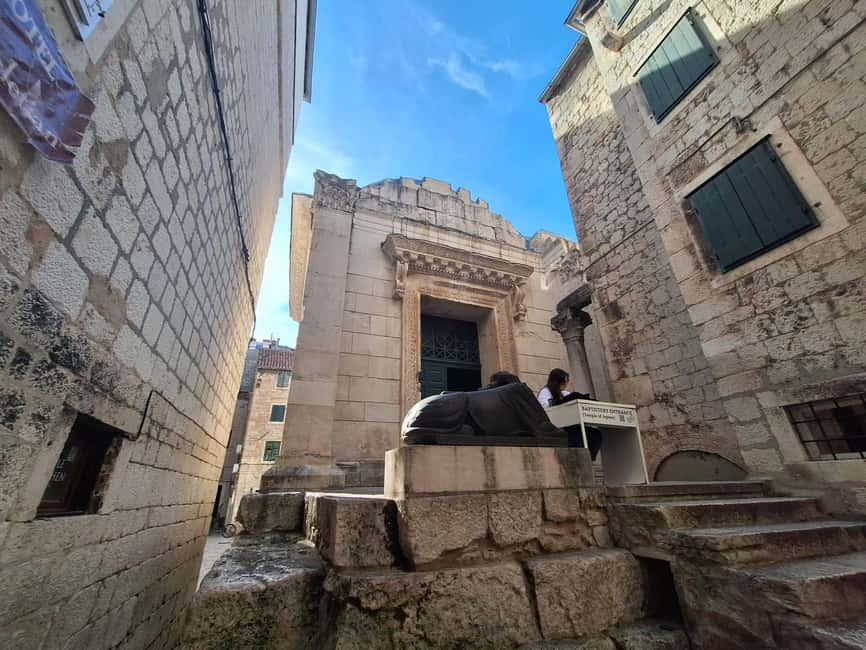
Jupiter’s Temple and the Vestibule: symbols, riddles, and the fun side
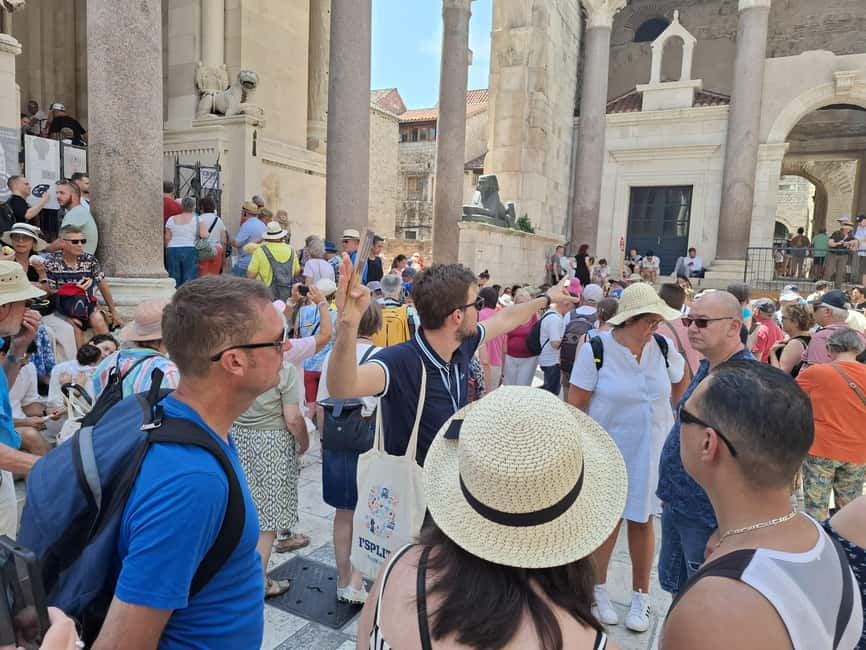
Temple of Jupiter is one of those stops that feels instantly dramatic, mostly because the palace complex has such a strong presence. The guide uses the space to teach you what you’re looking at, and the stories here can go beyond textbook facts.
You’ll hear about why a headless Sphinx guards the entrance tied to Jupiter’s Temple. That’s the kind of detail you might miss if you just walk by. The guide also uses the Vestibule area to explain how palace and later-era religious and public life blended together.
This section is where the tour tends to feel most playful. You might get riddles, a few jokes, and the kind of interactive teaching that keeps you paying attention. In one recent experience described for a Spanish guide named Nina, the humor and clear Spanish explanations were a big reason the group loved the tour. That same approach shows up as a theme: short, vivid storytelling that helps the stones make sense.
If you prefer quiet, you might find the guide’s theatrics a bit much. But if you like learning that doesn’t feel like a lecture, this is often the best part.
Diocletian’s Cellars: from palace underground to dragon-chaining lore
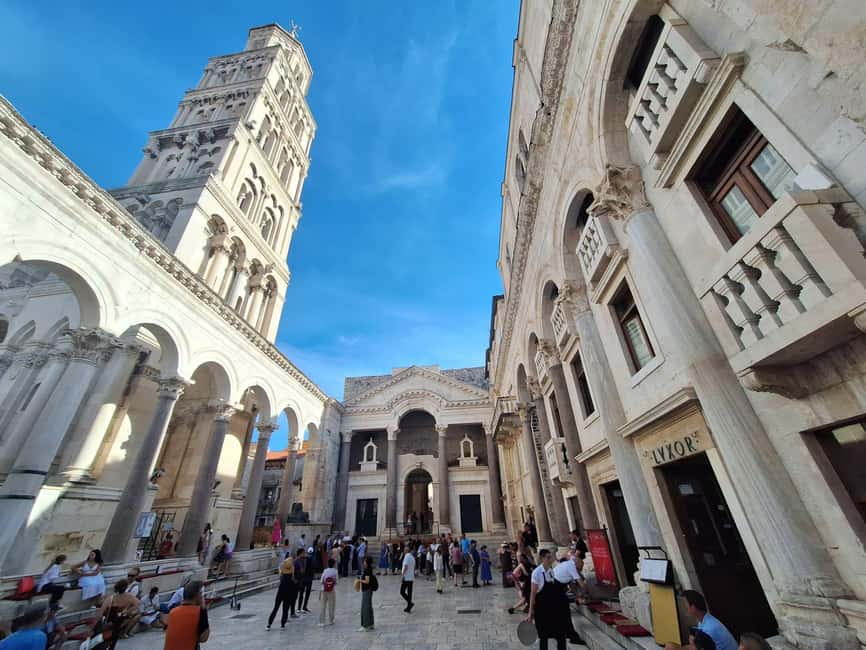
Then comes the cellars, and this is usually the heart of the tour experience. These underground spaces are cooler, darker, and more atmospheric, which matters because they let you feel the palace as a working machine, not just a set of ruins.
The guide leads you through Diocletian’s Cellars with stories that connect multiple time periods. The tour experience specifically highlights the cellars as places associated with GoT dragon-chaining, plus other dramatic references like Unsullied fighting scenes. Even if you’re not deep into the show, those references help you picture the scale and purpose of the spaces.
It’s also the segment where the tour’s practical pacing really matters. A good guide times the walk so you spend less time stuck out in heat, and you spend more time in the areas where the story actually belongs. One account described how the guide, Marko, handled the cellars in a way that helped the group avoid the worst of the heat and made the time fly.
There’s another payoff here. Underground, architecture becomes tangible. You can better understand how water, storage, movement, and security likely worked in an era when a palace needed to run like a city.
Pjaca and Voćni trg: learning what everyday Split looks like
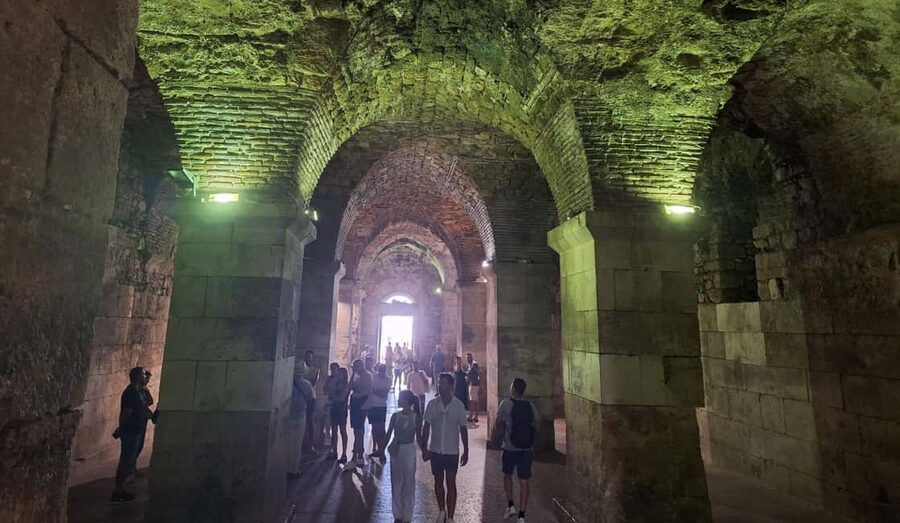
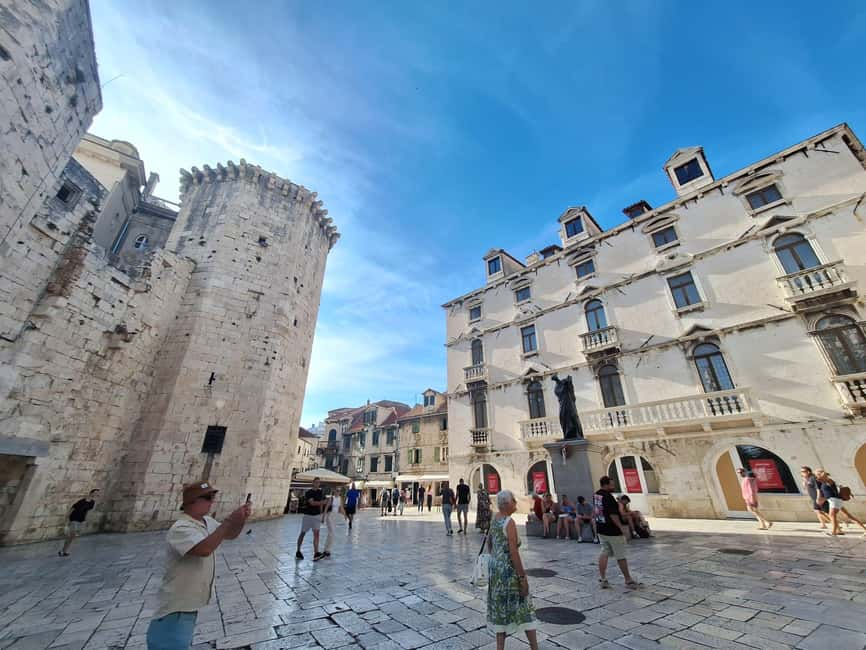
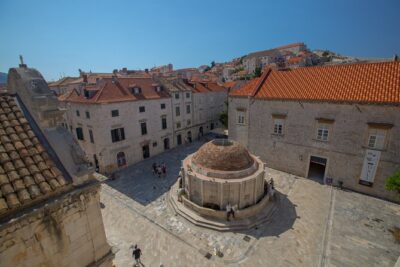
After the underground drama, the tour shifts back up into street life. You reach People’s Square and then Fruit Square (Voćni trg), which is where Split becomes less about emperor mythology and more about how people actually live around those ancient walls.
This stop is valuable because it reminds you that Split is not a museum town. The palace core is the big attraction, but the square areas show the human scale. The guide helps you connect the old structures to the rhythms you’ll see later when you walk around on your own.
You also get food-focused guidance here. The tour is designed to point out what locals eat and where you might find Dalmatian specialties. That turns a history walk into something more useful for your actual day, because you leave with a short list of what to try instead of guessing from menus.
One more thing: these squares can be busy, especially in summer. Since the tour is only about 90 minutes total, you won’t get stuck long in crowds, but you should still expect some foot traffic as you move between stops.
More marble lanes taken slowly:
- Split & Diocletian’s Palace Walking Tour
★ 5.0 · 1,125 reviews - Walking Tour of Split with a ‘Magister’ of History
★ 5.0 · 1,122 reviews - Split Walking Tour with Professor of History
★ 5.0 · 926 reviews - Split: Diocletian Palace & Old Town Guided Walking Tour
★ 4.7 · 882 reviews
Ending at the Riva: finish the walk and set up the rest of your day
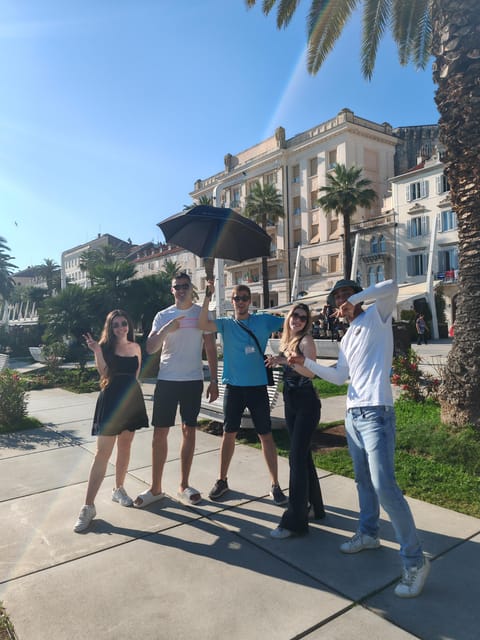
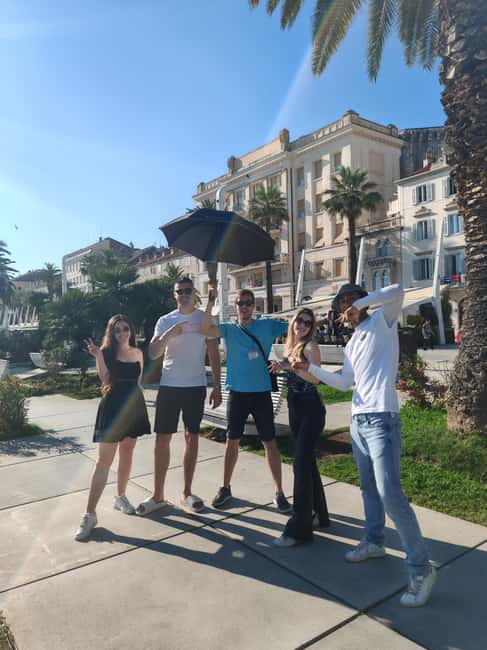
The tour ends at the Riva, the seafront promenade lined with tall palm trees. This ending matters. You move from stone and shadows back to open air, sea views, and the kind of energy that makes Split feel like a living port city.
You also get practical recommendations at the finish. The guide will share ideas for how to spend the rest of your day and which islands to visit. That’s a real value add for first-timers, because island hopping decisions are not only about beauty, they are also about timing and what fits your priorities.
There’s also a final layer of “how to travel like a local” here. By the time you reach the Riva, you’re in the right mindset to ask, What should I eat next? Where should I walk later? Which direction makes sense for the next hours? The tour is built to answer those questions.
If you plan to go straight into another activity after, start thinking now. Riva is great for decompressing, but you’ll likely want hydration and a snack before you jump into island logistics or long afternoon walks.
Price and value: what $41 buys in 90 minutes

At about $41 per person for a 90-minute guided walk, you’re paying for three things: licensed local interpretation, access to the story-rich palace areas, and the guide’s ability to connect details into a coherent tour.
This isn’t a bargain in the sense of being “cheap,” but it is a good value if you want more than surface sightseeing. You’re paying for time saved and mistakes avoided. Instead of wondering what Peristyle is, or why the cellars matter, a guide gives you answers while you’re standing in the right spot.
The stronger value comes from the balance of content. You get Roman architecture stops, underground cellars with dramatic storytelling, and then practical tips for food and what to do next. That mix is useful even if you are only spending one or two days in Split, because you get both context and direction.
Also, the guide experience can vary, and here the signs are strong: multiple accounts highlight humor, clarity, and specific small teaching touches like photo folders or shade-aware pacing.
What to bring for comfort during the Golden Gate to Riva stretch

This is a short tour, but it is still outdoors, and you’ll be on your feet. The basic kit is simple, and it’s worth taking seriously in Split’s sun.
Bring:
- Comfortable shoes
- Hat
- Sunscreen
- Water
If you run hot easily, try to arrive early for your meeting time so you are not walking into the harshest midday sun. And when the guide pauses for interpretation, take the chance to drink water and cool down.
If you are the type who likes photos, remember that the most interesting details can be in shaded courtyards or darker cellars. Keep that in mind and don’t rely on bright light for every shot.
Who should book this Split Old Town walking history tour
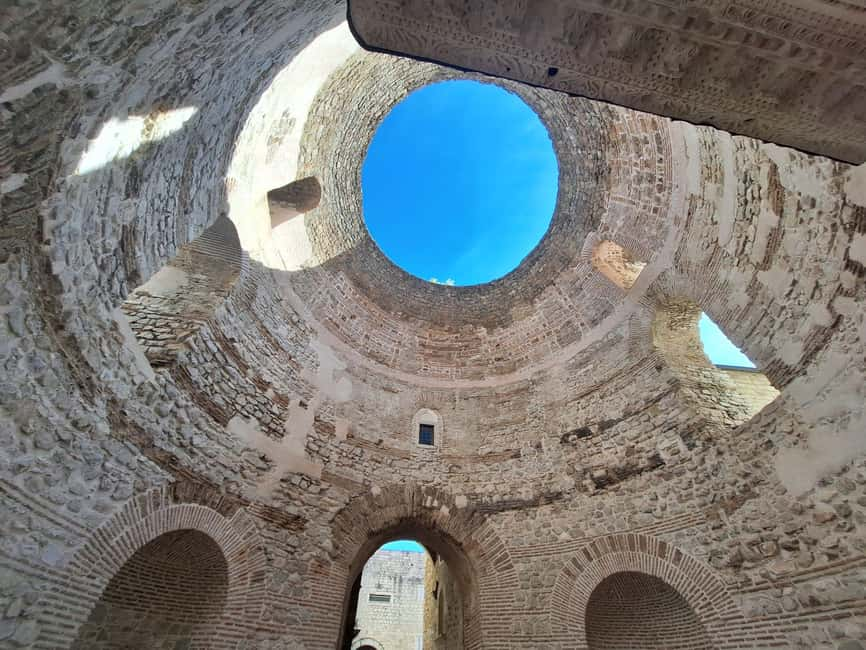
This tour is a great match if you want your first walk through Split to feel organized and meaningful. It suits:
- First-time visitors who want to understand Diocletian’s palace quickly
- People who like history but also appreciate a guide who makes it fun
- Game of Thrones fans who want the cellars framed with show lore
- Travelers who want local food pointers and island suggestions at the end
It’s also a good fit for couples or small groups, especially since private group options are available. If you prefer a slower pace, ask for the guide to keep you oriented visually, since a walking route can move faster than a sit-down museum visit.
If you dislike riddles or pop-culture references, you might still enjoy it for the Roman architecture and the cellars, but you may want to mentally treat the show references as storytelling spice, not the main course.
Should you book this tour of Old Town Split history?
I’d book it if you want a guided path through the palace core that helps you understand what you’re seeing, then you want food and day-planning tips before you wander off on your own. At 90 minutes, it’s short enough to fit almost any itinerary, and the combination of monuments plus cellars plus Riva recommendations gives you more practical payoff than a generic city walk.
Skip it only if you already know Split well, or if you strongly prefer quiet self-guided exploring. Otherwise, this is one of the easiest ways to get your bearings fast in the center of town and leave with a short list of what to eat, what to see next, and where to go by sea.
FAQ
How long is the Split Old Town History Walking Tour?
The tour lasts 90 minutes.
Where does the tour start and end?
It starts at Golden Gate in Split and ends at the Riva, the seafront promenade lined with palm trees. The exact meeting point can vary depending on the option you choose.
What languages are the live guides?
The live tour guide is available in English and Spanish.
Is this tour private?
Private group options are available.
What should I bring?
You should bring comfortable shoes, a hat, sunscreen, and water.
Is free cancellation available?
Yes. You can cancel up to 24 hours in advance for a full refund.
Venetian Stones, Roman Streets



Latest arrivals logged at Split





Historical Tours, compared.


Walking Tour of Split with a ‘Magister’ of History
Read our review →
Split Walking Tour with Professor of History
Read our review →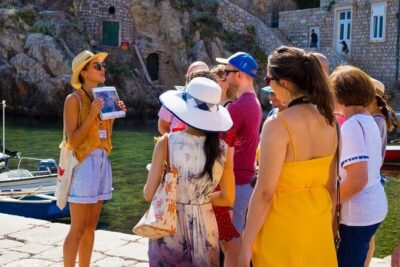

Split History and Gastro Small-Group Tour with Food and Drinks
Read our review →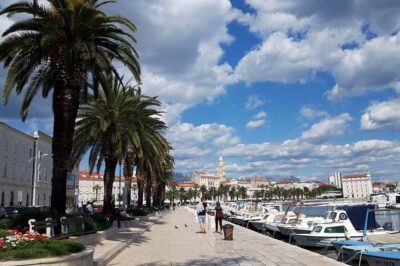
PREMIUM Emperor’s Walking Tour for History Lovers + Museum
Read our review →Browse the lists this tour appears in