
Reviewed · HISTORICAL TOURS
Split: Private Walking Tour in the Historical Town Center
Split makes sense fast with the right guide. This private walk is a smart way to see the top sights without getting lost, especially once you’re inside Diocletian’s Palace and its medieval lanes. I love how the route stitches together Roman, medieval, and later European influences in about 1:45 hours, and I love that you finish on the sea at Riva promenade with a plan for what to revisit. One drawback to consider, it is a walking tour and it is not suitable for wheelchair users, so come prepared for uneven historic surfaces and a steady pace.
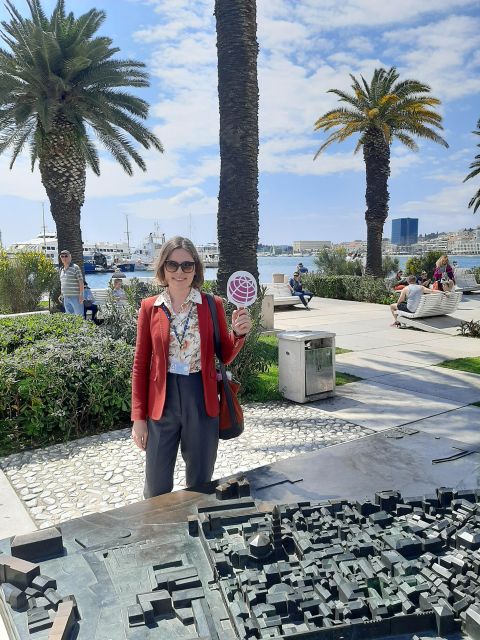
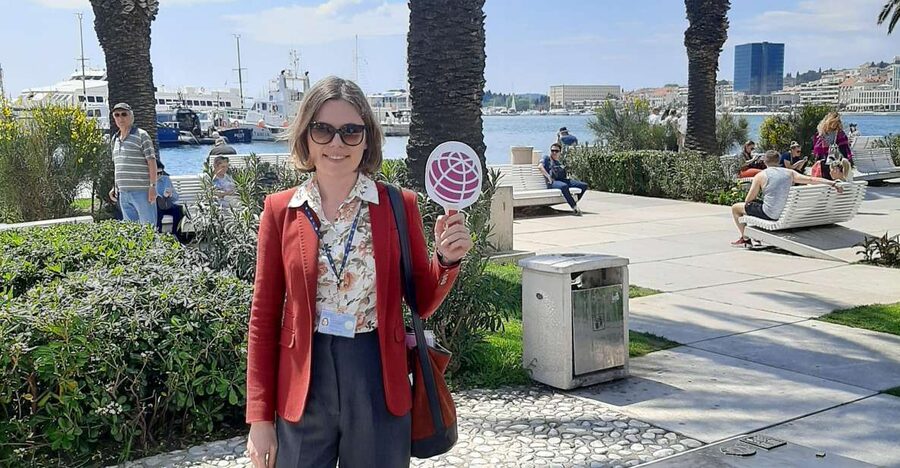
You meet by the bronze model of the old town on Riva promenade, then follow licensed local guide Sanja through the city’s most important corners. With a private group and multiple language options, the tour works well even when your questions get specific. If you’re traveling solo, the price can feel a bit high per person, but it usually makes more sense when you split the cost with your group.
In This Review
- Key highlights at a glance
- A private, 105-minute orientation in Split’s old core
- Meeting on Riva by the bronze model, then walking where the city breathes
- Stepping into Diocletian’s Palace: Roman fortress, medieval neighborhood
- Substructures (basements) and the underground perspective
- Peristil and the main square energy
- St. Domnius (Cathedral of Saint Domnius): faith and identity in one stop
- Jupiter’s Temple and the Baptistery viewpoint
- Golden Gate and People’s Square: how the town learned power
- Fruit Square, Pjaca, and Prokurative: squares that explain everyday life
- A real-life Jewish ghetto and an active synagogue
- Ending on Riva: tying the story to the sea
- Price and value: $153 per group up to 15, what that means for you
- Who this tour fits best
- Should you book it?
- FAQ
- Where is the meeting point for the Split private walking tour?
- How long is the walking tour?
- Is this tour private?
- What are the main sights included during the walk?
- Do I need to pay entrance fees during the tour?
- Does the tour include the Palace substructures?
- What languages are available for the live guide?
- Is the tour suitable for wheelchair users?
- What should I expect for tour cancellation and refunds?
Key highlights at a glance
- Private, 105-minute orientation that covers the must-see sights without wasting time
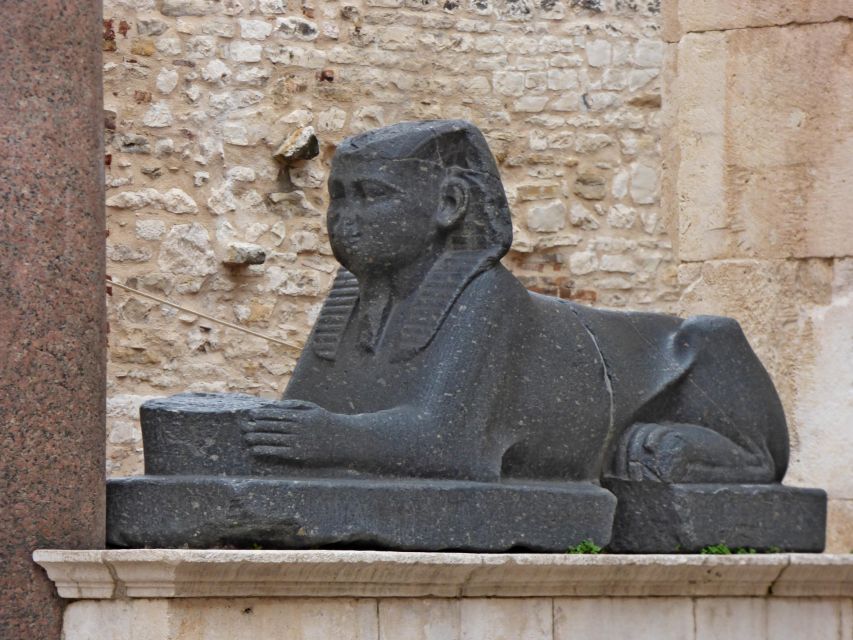
- Diocletian’s Palace mix of eras, from Roman structure to medieval neighborhood life
- Substructures visit (extra fee) to see the Palace’s underground level
- A guided path through key landmarks, including Peristil and St. Domnius
- Outside-Palace squares like Pjaca, Fruit Square, and Prokurative for the later power shifts
- Ending at the sea on Riva, so you leave with a clear direction for your next hours
A private, 105-minute orientation in Split’s old core
Split is one of those cities where the buildings feel ancient, but the streets still run like a living neighborhood. The best part of this tour is that it gives you structure, so you stop walking in circles and start connecting the dots. In just 105 minutes, you get a “map in your head” for how the Palace and the later medieval town developed.
It’s also genuinely practical that it’s private. With a small group, Sanja can pace the walk around your questions, and you can linger a moment where something catches your eye. The tour is designed to hit the big icons, then point you toward what’s worth deeper exploration when you’re on your own.
One more thing I like: the route is set up like a guided walk across the city’s main compass points, not just a quick loop of the most photographed spots. That matters because Split’s story is spatial, the Palace sits like a fortress core, and the later squares spread outward.
Meeting on Riva by the bronze model, then walking where the city breathes
Your tour starts on Riva promenade by the bronze model of Split’s historical core, right in front of the south entrance to Diocletian’s Palace. That’s a clever meeting spot because it instantly grounds you. Before you take a step, you’re looking at the shape of the old town, so later when you’re inside the walls, you’ll understand how everything fits.
From there, you head into the streets and squares of Split for about 1:45 hours of guided walking. You’re not stuck riding around. Instead, you’re absorbing how the city looks at street level, including where crowds naturally funnel and where the view opens up toward the sea.
If you like walking tours that feel like a guided “day plan,” this hits the mark. You’ll finish back at Riva, so it’s easy to continue your afternoon without reorienting yourself.
More Walking Tours in Split
- Split: Old Town and Diocletian Palace Walking Tour★ 4.9 · 4,727 reviews
- Walking Tour of Split and Diocletian’s Palace★ 5.0 · 2,588 reviews
- Krka Waterfalls tour with Trogir Walking tour and Krka panoramic boat cruise★ 5.0 · 1,659 reviews
Stepping into Diocletian’s Palace: Roman fortress, medieval neighborhood
The heart of the experience is Diocletian’s Palace, the 4th-century imperial complex that forms the oldest part of Split. You’ll enter and walk through the Palace zone where Roman engineering meets later residential life. That mix is the big takeaway here, the Palace was built as an emperor’s residence and fortress, but over time it became a container for daily living.
What makes this stop special is how you experience the layers while still moving. Sanja guides you through the space, helping you read what you’re seeing. You’ll visit the areas that are known for their architectural and historical importance, then connect them to the way the town grew around the Palace.
A practical note: some parts of this world are tight and you’ll be stepping over centuries, so wear comfortable shoes. Also, if you’re the type who likes photos, you’ll have plenty of moments, but the tour is still about understanding, not just pictures.
Substructures (basements) and the underground perspective
One highlight you should plan for is the Palace Substructures, sometimes called the basements level. You’ll visit this level with an entrance fee that isn’t included in the tour price. Even so, it’s worth budgeting for, because it changes how you picture the Palace.
From ground level, Diocletian’s Palace can feel like a walled town. Down at the substructures level, the perspective flips. You see the underworld of the complex, which helps you understand how the Palace functioned and why those upper spaces were built the way they were.
If you’re someone who likes architecture more than stories about kings and dates, this stop will hit your sweet spot. It turns the Palace into a whole system instead of just a pretty old site.
Peristil and the main square energy
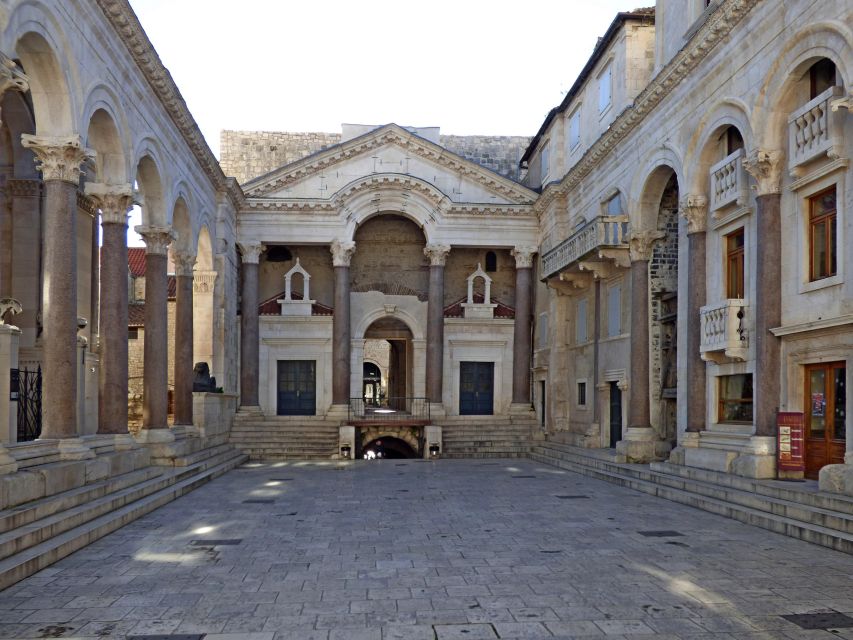
Next comes the Peristil, the Palace’s central open space. This is where you get that classic “Roman courtyard” feeling, with enough scale to sense how important this area was. You’ll get a guided explanation, then have a short window to look around and take in the proportions.
Peristil is also a turning point in your understanding. It’s not just a room in a building, it’s a crossroads inside the Palace. After you’ve been guided through the surrounding areas, the Peristil helps you mentally organize the rest.
The stop is timed so you’re not stuck staring for half an hour. Instead, you’re given enough context to keep noticing details as you continue, which is exactly what makes walking tours useful.
More marble lanes taken slowly:
- Split & Diocletian’s Palace Walking Tour
★ 5.0 · 1,125 reviews - Walking Tour of Split with a ‘Magister’ of History
★ 5.0 · 1,122 reviews - Split Walking Tour with Professor of History
★ 5.0 · 926 reviews - Split: Diocletian Palace & Old Town Guided Walking Tour
★ 4.7 · 882 reviews
St. Domnius (Cathedral of Saint Domnius): faith and identity in one stop
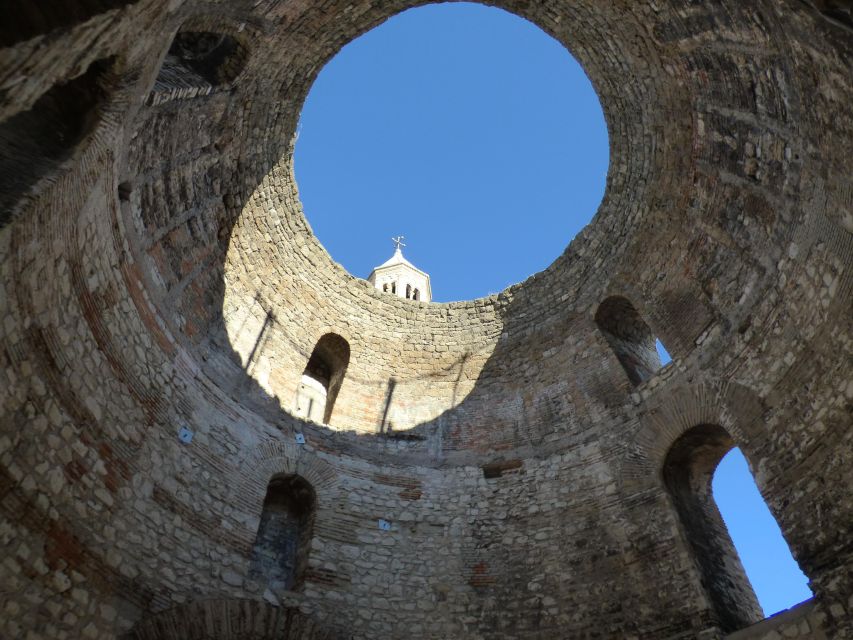
A must on any Split day is St. Domnius, the Cathedral of Saint Domnius. During this tour, you’ll pass by and get a guided visit with time to look around. It’s one of those places where the architecture does more than impress, it shows how this city stayed important long after the Romans.
You’ll see how the Cathedral relates to the broader Palace complex and to the medieval identity that formed around it. Sanja’s guidance is especially useful here because it helps you understand what you’re looking at, not just that it’s old.
A small tip for your own exploring after the tour: when you’re standing in the Cathedral area, glance around like you’re drawing a triangle between the open space, the Cathedral details, and the Palace walls. It helps you connect where people would have moved through this zone over time.
Jupiter’s Temple and the Baptistery viewpoint
Another Roman-related site you’ll encounter is Jupiter’s Temple, also connected with the Baptistery area. On this tour, it’s described as an exterior visit, with no entrance fee. That means you’ll still learn what it is, but you won’t lose time waiting in lines or switching venues.
Why this works: the exterior viewpoint keeps the flow moving, and it keeps your attention on the structure itself. It’s easier to compare what’s Roman versus what changed later when you’re not bouncing between too many indoor spaces.
If you’re trying to see everything in a limited time window, skipping this interior stop is smart. You get the essential context without adding hours.
Golden Gate and People’s Square: how the town learned power
As the walk continues, you’ll move through key landmarks like the Golden Gate and People’s Square. These spots matter because they represent how the city’s identity shifted from an imperial enclosure to a working town shaped by politics.
Golden Gate gives you a sense of defensive design and ceremonial access. It’s a place where street-level view matters, because you’ll want to orient where the gates sit in relation to the walls. Even if you only stay briefly, it helps your overall mental map.
People’s Square (Narodni trg) is where history starts feeling civic. This is where you learn about the socio-political lifestyle under different rulers, including Venetian, French, Austro-Hungarian, and Yugoslavian influences. The key value here is that you hear the story of governance and public life tied to real spaces you can later recognize on your own.
Fruit Square, Pjaca, and Prokurative: squares that explain everyday life
After the Palace core, you’ll head to the medieval neighborhood built outside it. This is where Split starts to look like a layered European capital, not just a preserved Roman relic.
You’ll visit famous squares including Pjaca, Fruit Square, and Prokurative. These are the places where people would have gathered, traded, debated, and celebrated. During your walk, you’ll get context for how rule changed, and how that change shows up in the feel of public spaces.
Fruit Square and Pjaca in particular are worth paying attention to for details you might otherwise miss. Look for how streets funnel into the square, and how the buildings frame the open area. That simple observation often becomes a useful habit once you leave the tour.
Also, because this is a walking tour, you get the bonus of seeing these places in sequence. It’s easier to remember them when you’ve walked through the corridors between them.
A real-life Jewish ghetto and an active synagogue
One of the more meaningful stops is the small former Jewish ghetto area, including a synagogue that is still active. This isn’t just a historical footnote, it’s a reminder that Split’s story includes real communities that lived here, not just empires that passed through.
The value of including this area in a highlights tour is that it expands the narrative beyond Roman and Christian landmarks. You get a fuller picture of the city’s multicultural history, and you also learn to notice continuity in places of worship.
If you’re visiting with respectful curiosity, this part tends to land emotionally. You’re watching the city function today while learning what it used to represent.
Ending on Riva: tying the story to the sea
You’ll finish at Riva promenade by the sea, returning to the general meeting area near the bronze model. That ending is more than convenient, it’s a smart way to close the loop. After walking the Palace interior and the medieval squares, Riva feels like where the whole place exhales.
This is also when you can use the guide’s tips to plan your next steps. With your bearings reset, you can choose whether to spend more time revisiting the Palace corners, roaming outward into the medieval streets, or simply enjoying the waterfront without worrying you’re missing something important.
I like finishing like this because it makes the tour feel like the start of your Split visit, not a rushed checklist.
Price and value: $153 per group up to 15, what that means for you
At $153 per group up to 15 for about 105 minutes, the pricing is aimed at private groups rather than single travelers. If you’re traveling as a pair or small group, the per-person cost depends on your group size, and you should factor that into your decision.
Where the value tends to show is in time saved and confusion avoided. Split’s old town can be maze-like, and a private guide helps you learn what you’re seeing while keeping the route efficient. You also get the extra benefit of practical recommendations for how to explore after the tour.
The main caution I’d give is simple: if you’re a solo traveler, you may feel it’s a bit pricey compared with shared tours. If you’re a small group, it becomes easier to justify, because you’re paying for personalized pacing and the freedom to ask questions.
Who this tour fits best
This private walking tour is best for you if you want a clear starting point for a first visit to Split. It’s ideal when you care about architecture, layered history, and how different eras shaped specific streets and squares.
It’s also a good match if you like tours that stay interactive. Sanja is described as answering questions clearly, and the fact that she speaks English, Italian, French, and Spanish helps ensure you get the level of explanation you want.
It may not be the right choice if you need wheelchair access. The route is not suitable for wheelchair users, so plan for a different approach if mobility is an issue.
Should you book it?
Yes, I’d book this if you want the fastest route to understanding Split’s old center. The combination of Diocletian’s Palace, key squares like Pjaca and Fruit Square, and the St. Domnius area makes this tour an efficient first-day foundation.
If you’re budget-sensitive and traveling solo, consider whether you’d rather share a guide to lower the per-person cost. But if your group includes more than one person and you want a guided explanation that you can use all week, this private setup is exactly the kind of value that pays off later.
FAQ
Where is the meeting point for the Split private walking tour?
You meet on Riva promenade by the bronze model of the old town, in front of the south entrance to Diocletian’s Palace.
How long is the walking tour?
The tour lasts about 105 minutes, or roughly 1 hour and 45 minutes.
Is this tour private?
Yes, it is a private group tour.
What are the main sights included during the walk?
You visit Diocletian’s Palace (including the Palace areas like Peristil and key structures), St. Domnius Cathedral, Jupiter’s Temple (external), Golden Gate, People’s Square, Fruit Square, and you also explore medieval areas outside the Palace including Pjaca and Prokurative. You end on Riva promenade.
Do I need to pay entrance fees during the tour?
Entrance fees are not included for the Palace Substructures (basements). Everything else is described as guided visits or external viewing.
Does the tour include the Palace substructures?
Yes, you will visit the Palace Substructures or basements, but there is an entrance fee for that part.
What languages are available for the live guide?
The tour is available in English, Italian, French, and Spanish.
Is the tour suitable for wheelchair users?
No, it is not suitable for wheelchair users.
What should I expect for tour cancellation and refunds?
Free cancellation is available up to 24 hours in advance for a full refund.
Venetian Stones, Roman Streets


Latest arrivals logged at Split






Historical Tours, compared.
Walking Tour of Split with a ‘Magister’ of History
Read our review →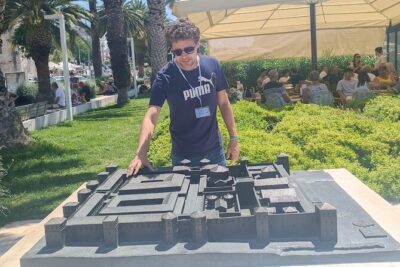
Split Walking Tour with Professor of History
Read our review →
Split History and Gastro Small-Group Tour with Food and Drinks
Read our review →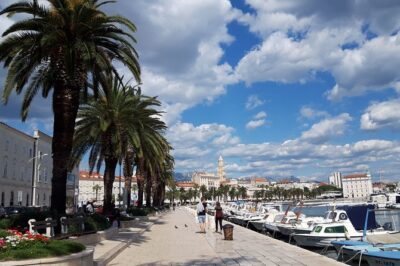
PREMIUM Emperor’s Walking Tour for History Lovers + Museum
Read our review →Browse the lists this tour appears in